
What We Do
The Informativity Institute is committed to research and education in Measurement Quantization (MQ), with the aim of developing its mathematical foundations, examining its physical predictions, and making the research accessible to readers and researchers.

Research
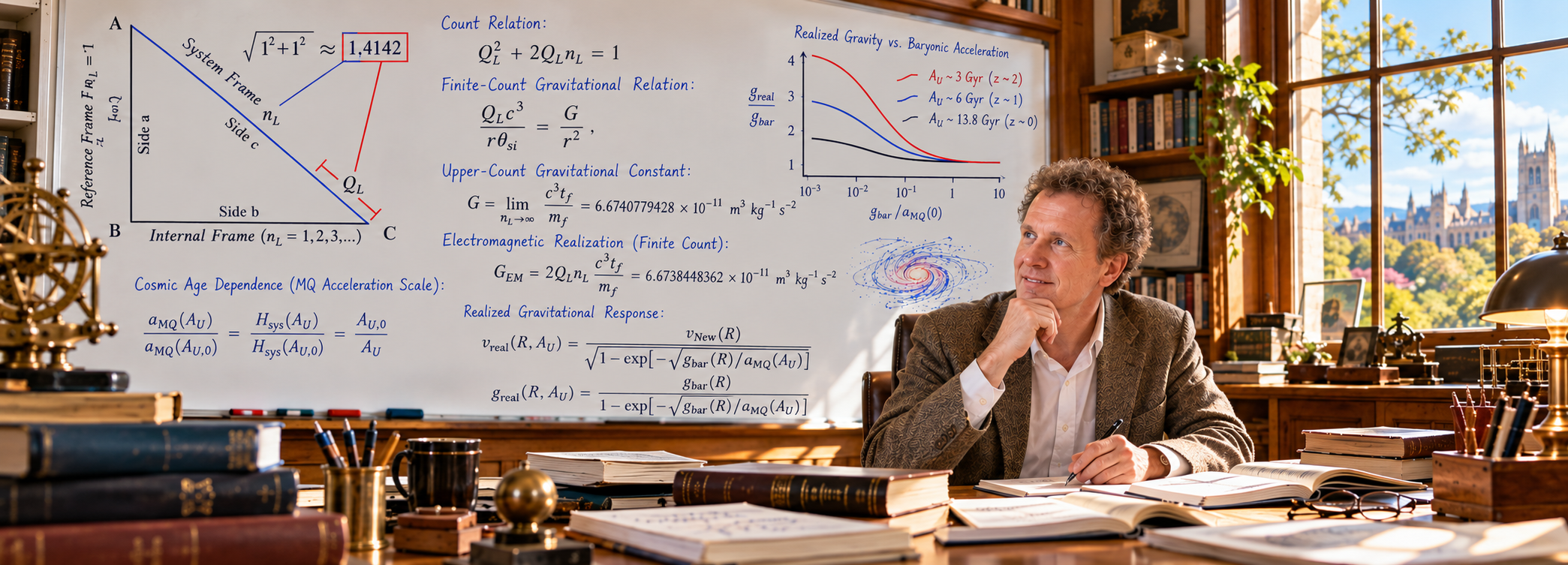
Our research investigates relationships among quantum gravity, electron structure, and the fine structure constant within MQ. Jody A. Geiger’s paper Measurement Quantization presents derivations relating physical constants to fundamental measures and discrete counts.[1] This work provides a mathematical framework for exploring how gravitational and electromagnetic quantities are related.
The distinction between a derived relationship and its numerical calibration matters. Section 1 of Extending Precision of the Physical Constants uses the measured fine structure constant and exact International System of Units (SI) constants to calibrate the calculation.[2] Expressing constants through fundamental measures therefore does not make the numerical results independent of those inputs. Agreement that follows from a shared calibration establishes consistency within that calculation. An independent test requires a prediction compared with measurements that were not used to determine it, with uncertainties and shared dependencies accounted for. Our research aims to identify such tests and assess each result within the scope it supports.

Education
Our educational work includes publications, conferences, collaboration, and the continued development of explanatory material for researchers and other interested readers. We aim to make the reasoning, assumptions, and sources behind MQ results clear enough for readers to examine and discuss.
One example of this engagement is the Cosmic Controversies Conference, held October 5–8, 2019, at the University of Chicago’s Gleacher Center. The conference’s public participant list includes Jody Geiger of the Informativity Institute.[3]

The Measurement Quantization Collaboration for Foundational Research
The MQ Collaboration for Foundational Research is a planned initiative connecting questions in the physical sciences with philosophy, semiotics, and critical inquiry. It aims to bring insights from the application of theory of knowledge to physics back into discussion of how knowledge is formed, represented, and evaluated. The intended collaboration would provide a setting for examining these questions across disciplines.