
Baryonic Tully–Fisher Relation
From Baryonic Mass to Asymptotically Flat Galactic Rotation. In Measurement Quantization, the baryonic Tully–Fisher relation emerges from the realization of gravity. The same realization law that produces the radial acceleration relation and flat rotation curves leads directly to a fourth-power relation between total baryonic mass and asymptotic rotational velocity.
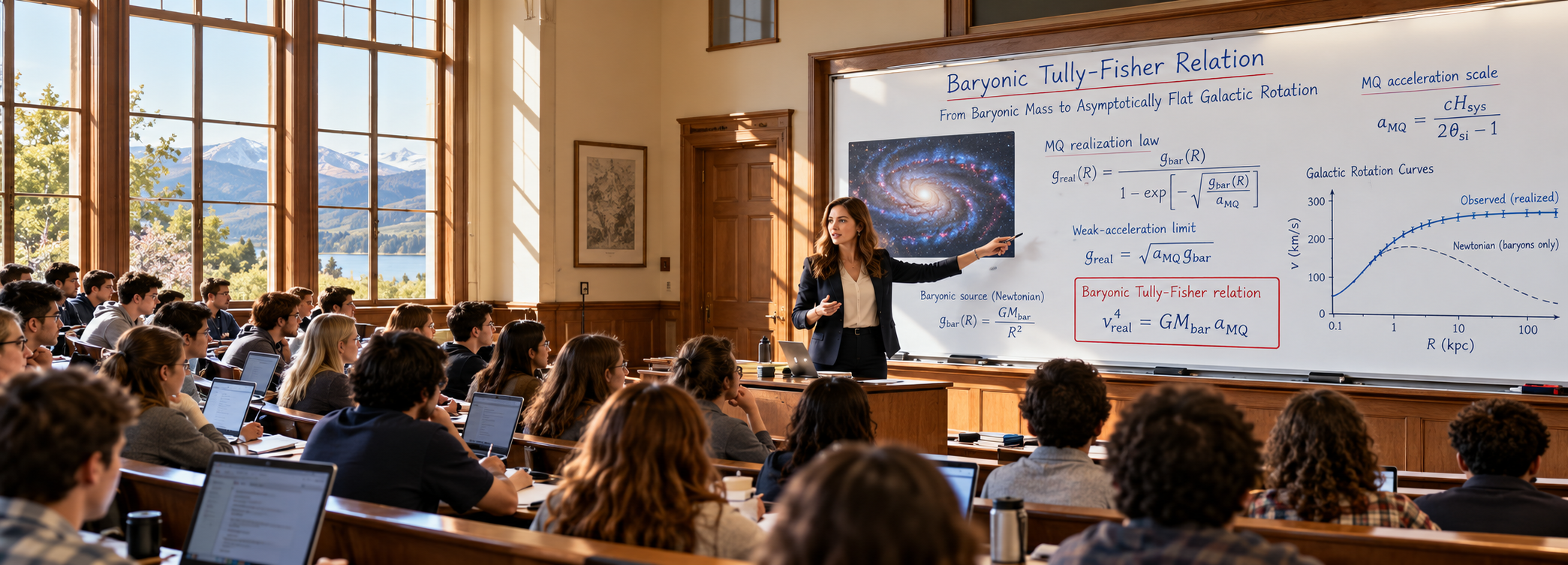
A spiral galaxy illustrates stars and gas supplying total baryonic mass M subscript bar, in kilograms. Radius R is galactocentric radius in meters; the chart displays kiloparsecs. Upright G denotes the upper-count gravitational coupling, in cubic meters per kilogram per second squared. Newtonian baryonic acceleration g subscript bar, realized acceleration g subscript real, and the positive MQ acceleration scale a subscript MQ have units meters per second squared. The realized circular speed v subscript real has units meters per second; the chart displays kilometers per second.
Rotation-curve illustration
From the Inner Galaxy to the Asymptotic Velocity. The horizontal radius axis is logarithmic, with labeled ticks 0.1, 1, 10 and 100 kiloparsecs. The vertical rotational-velocity axis is linear, with labeled ticks 0, 50, 100, 150, 200 and 250 kilometers per second. The blue MQ realized-velocity curve rises and approaches a flat outer profile. A dashed Newtonian baryons-only curve rises and then declines. Points and error bars are faithfully traced from the supplied artwork. No identified observational dataset or fitted galaxy model accompanies this source, so these marks are retained as an illustration.
1 Baryonic Source
The observed stars and gas supply the Newtonian baryonic source. Outside the dominant baryonic distribution, the source has the exterior inverse-square form.
g subscript bar equals upright G times total baryonic mass divided by radius squared.
2 MQ Realization Law
Gravitational realization is determined by the cosmologically derived acceleration scale and realization fraction.
g subscript real equals g subscript bar divided by one minus the exponential of minus the square root of g subscript bar divided by a subscript MQ.
3 Weak Acceleration Limit
In the outer galaxy, where baryonic acceleration is much smaller than the MQ acceleration scale, the realized acceleration has the exact square-root limit.
As g subscript bar divided by a subscript MQ tends to zero, g subscript real divided by the square root of a subscript MQ times g subscript bar tends to one.
4 Baryonic Tully–Fisher Relation
For a radius beyond the dominant baryonic distribution, the realized acceleration tends to an inverse-radius response, producing asymptotically constant rotational velocity.
As radius tends to infinity, the fourth power of realized velocity equals upright G times total baryonic mass times the MQ acceleration scale in the limit. The asymptotic rotational velocity is uniquely determined by the total baryonic mass and the MQ acceleration scale, derived independently from the System Frame cosmology.

Baryonic Tully-Fisher Relation
The baryonic Tully-Fisher relation (BTFR) is an empirical regularity in galactic dynamics. It connects the total baryonic mass of a rotationally supported galaxy to its characteristic outer rotational velocity. Unlike the original luminosity-based relation, the baryonic form includes the reconstructed stellar and gas masses. Lelli, McGaugh, and Schombert document this relationship in “The Small Scatter of the Baryonic Tully–Fisher Relation.”[1]
Across disk galaxies with different masses, sizes, gas fractions, and surface brightnesses, greater baryonic mass corresponds systematically to greater outer rotational velocity. The measured slope is close to a fourth-power mass–velocity relation under the adopted stellar mass-to-light calibration. The empirical slope, scatter, and normalization depend on that calibration and on how the outer velocity is measured.[1]
Within Measurement Quantization (MQ), the BTFR follows as an asymptotic consequence of the gravitational realization law. That law connects the Newtonian baryonic field to the realized gravitational response at low acceleration. The BTFR, the radial acceleration relation, and asymptotically flat galactic orbital dynamics consequently belong to the same galactic construction. Geiger develops this construction in “A First Principles Derivation of the Galactic Radial Acceleration Relation from Measurement Quantization,” a preprint.[2]
MQ begins with one axiom. Measure is discrete. The Internal Frame is the underlying domain of count configurations. The Frames mapping realizes their relationships as observable geometry and physical measures in the System Frame. Geometric reference relationships anchor an expanding frame of information, represented by realized configurations ordered by cosmic age.
Four physical inputs select and normalize the modeled universe in the fundamental-measure construction. The fine structure constant selects its dimensionless coefficient, the speed of light connects realized length and time, and the electron mass and Bohr radius complete the cross-dimensional normalization. These input roles do not make them four additional axioms or four statistically independent measurements. The exact SI numerical value of the speed of light is a unit convention. The measured cosmic microwave background (CMB) temperature separately selects the epoch through the adopted age prescription.
The MQ Acceleration Scale
The galactic derivation uses the MQ acceleration scale . Its value is fixed from the cosmological construction before galaxy velocities are compared. Here is the previously introduced frame’s Hubble-rate realization, is the speed of light, and is the invariant dimensionless MQ coefficient. The scale is
The galactic acceleration scale is shared by the galaxies tested at a specified epoch and is not fitted separately to the BTFR. It is inherited from the larger MQ cosmological structure. Its numerical value remains conditional on the adopted cosmic-age normalization and calibration. Galactic dynamics test the resulting fixed prediction against an adopted baryonic source and measured kinematics; source reconstruction and observational uncertainties remain relevant.[2]
Let denote the Newtonian inward baryonic circular acceleration at galactocentric radius . Let be the dimensionless realization depth and the dimensionless gravitational realization fraction. For a positive source and positive acceleration scale, the adopted positive quadratic norm and circular kinematics give
Subdivision consistency requires the unrealized fractions to multiply when depth is subdivided. Continuity, a zero realized fraction at zero depth, and the specified unit initial response then give . The unit response fixes the rate in the exponential; subdivision consistency alone leaves that rate unspecified.
The reconstructed baryonic distribution determines the Newtonian source field. The realization fraction specifies how that source relation is physically realized under the Frames mapping. At high acceleration the fraction tends toward unity. At low acceleration the predicted response exceeds the direct Newtonian baryonic prediction. This interpretation preserves the adopted source reconstruction; it does not make stellar masses, gas corrections, distances, or inclinations free of uncertainty.
Write for the realized inward radial acceleration. Both accelerations and the MQ scale have units of m s−2. The resulting local saturation law connects the BTFR to the broader MQ description of gravity. The symbol exp denotes the exponential function.
For positive baryonic acceleration, the denominator lies strictly between zero and one, so the law has acceleration units and predicts an enhancement over the baryonic source. No additional galaxy-specific MQ acceleration parameter is required. The total inward source must be nonnegative, with a zero-source boundary interpreted through the continuous weak-source limit. Individual source contributions must retain their physical signs. The adopted norm, composition, and normalization specify this construction; agreement with a rotation curve tests its observable prediction without uniquely establishing its mechanism.
Why the Outer Galaxy Is Different
The physical importance of the realization law appears most clearly when a galaxy is followed outward from its baryon-dominated inner region. At sufficiently high baryonic acceleration, is large compared with . The exponential term becomes negligible, the realization fraction approaches unity, and the realized acceleration approaches the baryonic acceleration. The ordinary Newtonian baryonic response is therefore recovered continuously.
As the source acceleration becomes small relative to the MQ scale, the exact weak-acceleration statement is the following limit. The ratio of realized acceleration to the square root of the product of source acceleration and the MQ scale tends to unity.
This square-root limit bridges the local acceleration law and the global BTFR. The same limiting scaling occurs in modified Newtonian dynamics (MOND), introduced by Milgrom in “A Modification of the Newtonian Dynamics as a Possible Alternative to the Hidden Mass Hypothesis.”[3] In this MQ construction, the limit follows from the specified realization law, while comes from the preceding cosmological construction.
From an Inverse-Square Field to an Inverse-Radial Response
Consider an isolated galaxy with finite total baryonic mass . Its enclosed baryonic mass converges to that total at large radius. Let be the macroscopic, upper-count-limit gravitational coupling used in the source calculation. The exact asymptotic Newtonian statement is
Combining the exterior source limit with the weak-acceleration limit gives an asymptotic inverse-radial realized response. Let denote the positive realized circular speed. Circular motion supplies the kinematic identity below. The common inverse-radius dependence then yields a radius-independent limiting speed.
For a finite baryonic source, the asymptotic Newtonian field decreases with the inverse square of radius. The weak-acceleration realization law gives an inverse-radial response, and circular kinematics yield both a constant limiting speed and a fourth-power mass–velocity relation. These are limits at fixed epoch, not exact equalities at every measured radius. A nonspherical galaxy does not generally have an exact point-mass source field at finite radius.
The MQ Baryonic Tully-Fisher Relation
The principal asymptotic result is
This expression is the MQ fourth-power BTFR scaling. Within the stated construction, the exponent follows from the exterior source limit, the square-root weak-acceleration limit, and circular kinematics. The normalization is fixed by and at the selected epoch, rather than by a separate constant for each galaxy.
Equivalently, in the asymptotic regime the mass-velocity relation fixes baryonic mass through the fourth power of the outer rotational velocity. Greater baryonic mass therefore supports a greater asymptotic velocity, but the dependence is highly constrained. Because velocity enters through the fourth root of the mass relation, the orbital response grows much more slowly than the baryonic mass.
The stronger result is structural. The same expression that transforms the Newtonian baryonic acceleration into the realized acceleration also determines the radial acceleration relation, the flattening of the outer rotation curve, and the BTFR normalization.
One Mechanism, Three Galactic Observables
The observed baryonic distribution first determines through ordinary Newtonian gravitation. The MQ realization law then maps that baryonic acceleration to . At high acceleration, the mapping tends to the Newtonian result. At low acceleration, it tends to the square-root weak-acceleration limit. For a finite baryonic source, the inverse-square baryonic field consequently becomes an inverse-radial realized response. Circular orbital motion then converts that response into an asymptotically constant velocity, and that velocity satisfies the BTFR limit above.
The BTFR is the exterior asymptotic consequence of the acceleration law. Galaxies can retain different radii, stellar distributions, gas contents, and surface brightnesses. For convergent enclosed baryonic mass and circular motion, the limiting velocity loses its explicit radius dependence. What remains is the total baryonic mass and the common realization scale.
Relation to the Radial Acceleration Relation
The BTFR relates total baryonic mass to characteristic outer velocity. The radial acceleration relation (RAR) instead compares the baryon-predicted and dynamically inferred accelerations at individual radii. McGaugh, Lelli, and Schombert reported the exponential functional form in “Radial Acceleration Relation in Rotationally Supported Galaxies.”[4] MQ uses that same functional form. Its specific claim concerns the framework derivation and the scale fixed from non-galactic inputs; an empirical fit of this shape does not independently establish those steps.
The BTFR is obtained when this local relation is carried into the exterior weak-acceleration limit. In that sense, the local realization law contains more dynamical information than the BTFR alone. The BTFR describes the asymptotic endpoint, whereas the realization law describes the continuous trajectory from the Newtonian inner galaxy to that endpoint.
This is why the MQ treatment of dark matter is most naturally understood as a unified galactic-dynamics problem rather than as a collection of unrelated empirical coincidences. A successful realization law must reproduce not merely a flat portion of a rotation curve. It must preserve the observed dependence of dynamics on the baryonic source throughout the transition while arriving at the correct mass-velocity scaling in the outer limit.
The Meaning of Effective Mass
A Newtonian reconstruction of an enhanced circular response assigns additional gravitating mass. For a spherical reconstruction, the circular-orbit relation converts the measured speed and radius into an inferred enclosed mass. In a nonspherical galaxy, that conversion requires its geometry and source model. This is the interpretation discussed on effective mass of the galaxy.
MQ assigns a different interpretation. The observed baryonic source remains the source entering the baryonic acceleration. The difference between baryonic and realized acceleration arises from gravitational realization under the Frames mapping. What appears as additional gravitating mass in a purely Newtonian reconstruction is therefore represented in MQ by a change in realized gravitational response.
This interpretation does not by itself establish that every observation conventionally attributed to non-baryonic dark matter is explained by the galactic realization law. Cluster dynamics, gravitational lensing, structure formation, and cosmological observations provide additional and distinct tests. The BTFR result is specifically a statement about the galactic weak-acceleration limit and the dynamics derived from it.
Why the Normalization Matters
Reproducing a power-law exponent is less restrictive when its normalization remains freely adjustable. The stronger test is whether both the functional dependence and its characteristic scale follow from quantities established independently of the data being explained.
The MQ construction is constrained in precisely this way. The asymptotic relation contains no galaxy-specific acceleration scale. Once and the cosmologically inherited are fixed, the asymptotic mass-velocity normalization is fixed as well. Changing the acceleration scale to improve the fit of one galaxy would change the predicted normalization for every galaxy and would abandon the common upstream construction.
This makes the relation a useful falsification condition. Persistent systematic offsets in well-measured galaxies that cannot be accounted for by uncertainties in distance, inclination, baryonic mass reconstruction, or rotational velocity would challenge the common realization law rather than merely require another galaxy-specific parameter.
A Cosmological Consequence
Because is proportional to at fixed coefficient, the adopted MQ cosmic-age prescription predicts an evolving BTFR normalization. At fixed baryonic mass, an earlier epoch with a larger expansion-rate realization has a larger acceleration scale and a larger asymptotic speed. This is a conditional epoch prediction, distinct from the present-epoch fourth-power limit.
This is a stronger proposition than reproducing nearby galaxy dynamics. At a different cosmic epoch, a changed acceleration scale changes the relation between baryonic mass and asymptotic rotational velocity. The same upstream dependence is relevant to MQ's treatment of early galaxy formation.
Testing the epoch dependence requires the predicted normalization change to be compared with measured changes, including uncertainties and selection effects in mass and velocity. A short age interval can produce a small predicted shift; observations at earlier epochs increase the model’s time baseline. The derivation here supplies no quantitative high-redshift comparison or finding that existing evolution measurements pass or fail the prediction.
The Deeper Result
The baryonic Tully-Fisher relation is often presented as a remarkable correlation between the amount of ordinary matter in a galaxy and the speed with which its outer material rotates. In MQ, the relation has a more specific mathematical origin.
Baryonic mass supplies the adopted Newtonian source. The positive quadratic System Frame norm and circular kinematics fix the square-root realization depth. Continuous subdivision-consistent composition, the zero-depth boundary condition, and the unit initial response fix the exponential fraction within the specified construction. The weak-acceleration and finite-mass exterior limits then produce an inverse-radial realized response. Circular kinematics give a constant asymptotic speed whose fourth power is fixed by baryonic mass and the MQ acceleration scale.
The compact asymptotic equation displayed above carries a substantial provenance. Within MQ, the BTFR is not an isolated phenomenological rule. It is the asymptotic galactic expression of the same discrete realization structure that connects cosmological expansion, baryonic gravitational acceleration, the radial acceleration relation, and flat outer rotation curves through the MQ frames of reference.
The observable relation between matter and motion is therefore not imposed at the level of the galaxy. It is inherited from the deeper relation between count structure and physical realization.
Source Notes
[1] Federico Lelli, Stacy S. McGaugh, and James M. Schombert, “The Small Scatter of the Baryonic Tully–Fisher Relation,” The Astrophysical Journal Letters 816, L14 (2016). Published paper. The measured relation depends on the adopted stellar mass-to-light calibration.
[2] Jody A. Geiger, “A First Principles Derivation of the Galactic Radial Acceleration Relation from Measurement Quantization,” preprint (2026). Public manuscript. The on-page equations give the specified galactic law and its exact asymptotic consequences. They do not independently establish the absolute cosmological time normalization or a unique physical mechanism.
[3] Mordehai Milgrom, “A Modification of the Newtonian Dynamics as a Possible Alternative to the Hidden Mass Hypothesis,” The Astrophysical Journal 270, 365–370 (1983). Published paper.
[4] Stacy S. McGaugh, Federico Lelli, and James M. Schombert, “Radial Acceleration Relation in Rotationally Supported Galaxies,” Physical Review Letters 117, 201101 (2016). Published paper. Its empirical relation is prior observational context, separate from the MQ derivation and normalization claim.