

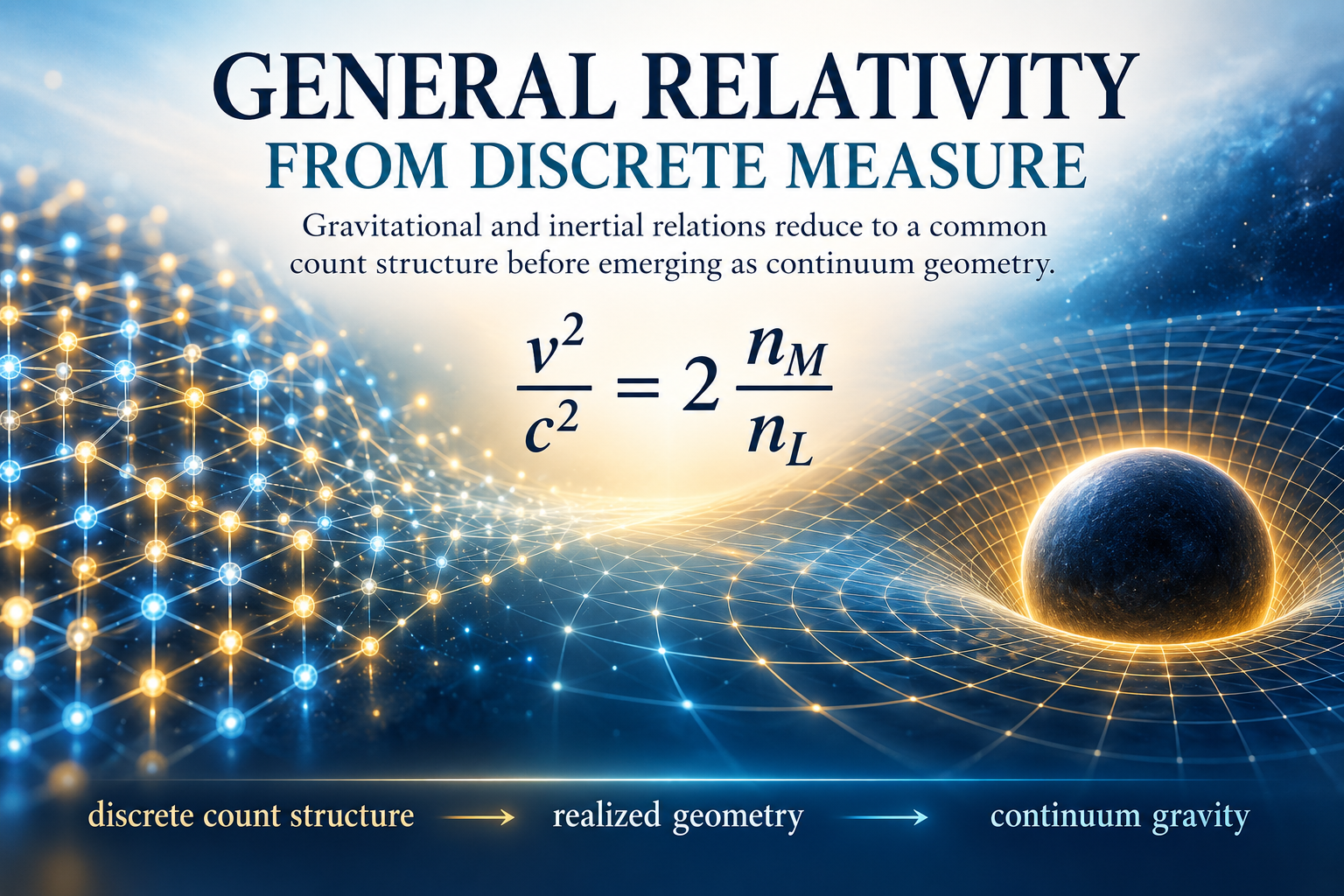







GENERAL RELATIVITY FROM DISCRETE MEASURE
General relativity describes gravitation geometrically. Matter and energy determine the realized geometry of spacetime, while freely falling bodies follow trajectories determined by that geometry. Measurement Quantization (MQ) retains this successful macroscopic description but asks a more fundamental question. What physical structure gives rise to the geometry described by general relativity?
In MQ, spacetime geometry is not primitive. The starting point is the discrete relational structure of the Internal Frame, expressed through fundamental measures, count relations, and adjacency. Observable geometry arises when this structure is physically realized through the Frames mapping in the System Frame. At scales large compared with the fundamental count scale, the realized description admits a smooth continuum limit and acquires the mathematical structure conventionally identified with spacetime.
This changes the relationship between MQ and general relativity from that presented in the earlier version of this page. MQ does not require spacetime curvature to be absent from the physical description. Rather, curvature is not primitive in MQ. It emerges in the System Frame as a continuum description of underlying discrete relations that are themselves represented without primitive curvature in the Internal Frame.
From Gravitational Measure to Count
Before considering the emergent continuum geometry, it is useful to see how gravitation is expressed at the discrete level.
This is an important feature of the MQ construction. The familiar gravitational relations are not simply rewritten using different symbols. Dimensional quantities are resolved into counts of the fundamental measures, allowing gravitational and inertial descriptions to be compared through the same underlying count structure.
For a mass m at radial separation l, the Newtonian escape-velocity relation begins as
v = (2 G m / l )1/2
where v is velocity, G is the gravitational constant, m is gravitational mass, and l is radial separation.
MQ then resolves mass and separation into counts of the fundamental measures. Let mf denote the fundamental measure of mass, lf the fundamental measure of length, nM the mass count, and nL the radial length count. Thus m = nMmf and l = nLlf.
Substitution gives
v2 = 2 G nMmf / (nLlf)
The crucial step is that G is itself expressible through the fundamental measures. Substituting its MQ form removes the dimensional gravitational constant from the relation and reduces the gravitational description to fundamental measures and their counts.
Using the fundamental relation lf = c tf, where tf is the fundamental measure of time and c is the speed of light, the dimensional factors reduce, leaving
v2 / c2 = 2 nM / nL
This result is significant because the left side is the same dimensionless velocity ratio that governs the contraction and dilation of measure with respect to motion.
MQ has therefore converted a gravitational relation containing G, mass, distance, length, and time into a relation between integer counts of the fundamental measures.
The gravitational description has become discrete.
Resolving Equivalence
The corresponding inertial construction is developed in MQ's treatment of contraction and dilation with motion. There, the geometry of motion produces the same dimensionless velocity ratio in count form.
Equating the inertial and gravitational realizations gives
nL2 / nLc2 = 2 nM / nL
where nLc is the length count associated with the limiting propagation relation defined by c.
This equality is more than a change of nomenclature. The two sides arise from physically different starting descriptions. One describes motion. The other describes gravitation. After dimensional quantities are resolved into the underlying fundamental measures, both reduce to the same count structure.
That provides a discrete basis for equivalence.
Rather than postulating that inertial and gravitational descriptions must agree, MQ identifies the count relation common to both. Their equivalence is consequently expressed at the level of the discrete physical structure from which their observable descriptions arise.
The same relation then generates the familiar contraction and dilation factors. For realized length,
lo = ll (1 - 2 nM / nL)1/2
for realized mass,
mo = ml / (1 - 2 nM / nL)1/2
and for realized time,
to = tl (1 - 2 nM / nL)1/2
The subscripts distinguish the corresponding realized measures in the derivation. What matters physically is the common gravitational count factor
(1 - 2 nM / nL)1/2
The derivation therefore does something more specific than beginning with a continuous gravitational metric and quantizing it afterward. It begins with dimensional gravitational relations, resolves their quantities through the fundamental measures, and exposes the dimensionless count relation underlying the observed relativistic behavior.
From Discrete Measure to Continuous Geometry
The count derivation establishes the discrete gravitational structure. The modern MQ treatment then addresses the complementary question. How does this count structure become the smooth geometry observed at macroscopic scales?
The Internal Frame does not begin with a differentiable spacetime manifold. Its primitive description is relational and discrete. Physical evolution is represented through admissible changes in count and adjacency rather than by assuming differentiable trajectories through a pre-existing continuum geometry.
The Frames mapping connects this discrete description to measurable physical relations. When sufficiently many fundamental relations are considered together, the mapped separation structure admits a smooth coarse-grained limit. A metric then emerges in the System Frame.
This is the point at which the mathematical language of general relativity becomes applicable.
The metric tensor gμν is therefore not a primitive object in MQ. It is the continuum realization of mapped measurable separations. Once this metric structure is established, the associated connection and curvature follow through the standard differential-geometric construction.
MQ consequently does not introduce a competing macroscopic geometry. It proposes an underlying physical origin for the geometry already described by general relativity.
This distinction also connects gravitation to MQ's treatment of frames of reference. The Internal Frame preserves the underlying discrete count relations. The System Frame contains their physical realization. The Frames mapping establishes the relation between them.
Gravity Before Curvature
The order of construction is important.
General relativity begins with a differentiable geometry and relates its curvature to the distribution of matter and energy. MQ begins beneath that continuum description. Count structure and its conservation are primitive. Realized geometry follows through the Frames mapping. Curvature becomes meaningful only after those relations admit a continuum realization in the System Frame.
The absence of primitive curvature within an irreducible discrete description therefore does not prohibit curvature from emerging when large collections of those relations are realized as a continuous geometry.
The distinction is between primitive curvature and emergent curvature.
At observational scales where a continuum description is valid, MQ recovers the geometric structure required by general relativity. At the underlying count-resolved level, the geometry is not independently postulated.
Recovering Einstein's Gravitational Description
The MQ variational principle extends this discrete construction into the continuum regime. It supplies the common framework from which the realized metric, gravitational dynamics, stress-energy, and conservation structure are obtained.
In the continuum limit, curvature constructed from the emergent metric assumes the Einstein gravitational form. The Einstein tensor is constructed from the curvature of the realized metric. Stress-energy is obtained variationally from the same MQ construction, while the gravitational coupling is connected to the fundamental measures and their realization rather than being introduced only as an independently measured phenomenological parameter.
Einstein's field relation therefore appears in MQ as the continuum realization of an underlying discrete structure rather than as the framework's starting postulate.
This distinction is essential. MQ is not intended to replace the experimentally successful predictions of general relativity at macroscopic scales. It seeks to explain why the mathematical structures used by general relativity arise.
At those scales, count-resolved corrections are suppressed and the continuum description is recovered.
Conservation and Free Fall
Recovering the gravitational field relation is not sufficient by itself. The associated conservation structure and the motion of freely falling bodies must also be recovered.
In MQ, conservation originates with conserved count in the Internal Frame. Through the Frames mapping, this discrete conservation structure is realized as the corresponding continuum conservation law in the System Frame. The resulting stress-energy description is therefore compatible with the divergence-free curvature structure required by general relativity.
Free fall follows from the same construction.
A freely falling body follows a geodesic of the emergent metric in the continuum limit. MQ therefore does not predict a different macroscopic trajectory merely because the underlying description is discrete. The distinction concerns the origin of the geometry governing that trajectory.
In general relativity, the metric supplies the geometry along which free motion occurs. In MQ, that metric is itself the coarse-grained realization of underlying count structure. The same Frames mapping responsible for gravitational geometry consequently establishes the realized geometry governing free motion.
The original count derivation and the modern emergent-geometry construction therefore address two levels of the same problem. The former shows how gravitational and inertial relations reduce to a common discrete structure. The latter shows how that structure realizes the continuum geometry of general relativity.
Singularities and the Continuum Limit
The distinction between the underlying discrete structure and its continuum realization also changes the interpretation of singular behavior.
General relativity contains solutions in which continuum quantities can become unbounded. MQ does not identify such mathematical divergence with an unbounded primitive physical measure. Its underlying description remains count-resolved and subject to the admissible bounds of the discrete structure.
A singularity appearing in a continuum representation therefore does not, by itself, establish a singularity in the underlying MQ description.
This is more precise than the older statement that singularities simply cannot occur because all count terms are bounded. The modern MQ construction distinguishes the domain of the emergent continuum description from the discrete structure from which that description arises. Where the continuum approximation ceases to remain physically adequate, extrapolating that approximation beyond its domain does not determine the behavior of the underlying count-resolved description.
MQ therefore provides a physical reason not to treat an unbounded continuum result as necessarily fundamental.
General Relativity as an Emergent Limit
The relationship between MQ and general relativity can now be stated at both levels.
At the discrete level, dimensional gravitational relations are reduced to counts of the fundamental measures. The resulting gravitational ratio is identical in form to the dimensionless relation independently obtained for motion. This provides the count-resolved foundation for equivalence and for the contraction and dilation of measure.
At the continuum level, those discrete relations are realized through the Frames mapping. Realized separations admit an emergent metric, curvature follows from that metric, and gravitational dynamics and conservation arise through the MQ variational principle.
General relativity remains the effective geometric description wherever the continuum approximation is appropriate. Its metric geometry, geodesic motion, conservation structure, and gravitational field relation emerge in the macroscopic MQ limit.
The conceptual progression is therefore:
fundamental measures → discrete count relations → inertial-gravitational equivalence → Frames mapping → realized separation → emergent metric → curvature and stress-energy → general relativity
This is the central distinction of the MQ treatment.
The relativistic equations are not merely reproduced in a discrete notation. The physical quantities appearing in the gravitational description are reduced to fundamental measures and count, their common relation with inertial motion is exposed, and the continuous geometry of general relativity is then recovered as the large-scale realization of that discrete structure.
The modern treatment is developed further in General Relativity as an Emergent Geometry of Discrete Measurement.
Einstein's central insight that gravitation can be described through geometry is therefore retained.
MQ places a count-resolved physical structure beneath that geometry.
General relativity is recovered as the macroscopic geometric limit of discrete measure.

8: Resolving the Hubble tension 68.261 and 73.510 km s Mpc
International Journal of Geometric Methods in Modern Physics
7: Measurement Quantization
Journal of High Energy Physics, Gravitation and Cosmology
6: Physically Significant Units of Measure
5: Measurement Quantization Unites Classical and Quantum Physics
4: Quantum Model of Gravity Unifies Relativistic Effects, Describes Inflation/Expansion Transition, Matches CMB Data
3: Measurement Quantization Accounts for Galactic Rotational Velocities and Obviates Dark Matter
2: Measurement Quantization Describes History of Universe -
Quantum Inflation, Transition to Expansion, CMB Power Spectrum
International Journal of Theoretical and Mathematical Physics
1: Measurement Quantization Describes the Physical Constants