

TERMS INPUTS SYMBOLS CONDORDANCE ANALYSIS
—————————— read pre-print on research gate (new window) ——————————
Quantum Measurement
From Count Availability to a Definite Physical Record
Quantum measurement presents one of the deepest conceptual problems in modern physics. Quantum mechanics predicts experimental statistics with extraordinary accuracy, yet its mathematical description does not, by itself, explain why an interaction represented by several possible outcomes ultimately leaves one definite, stable record. Unitary evolution preserves superposition. Measurement produces a result. The difficulty lies in connecting those two statements without simply inserting outcome selection as an additional rule.
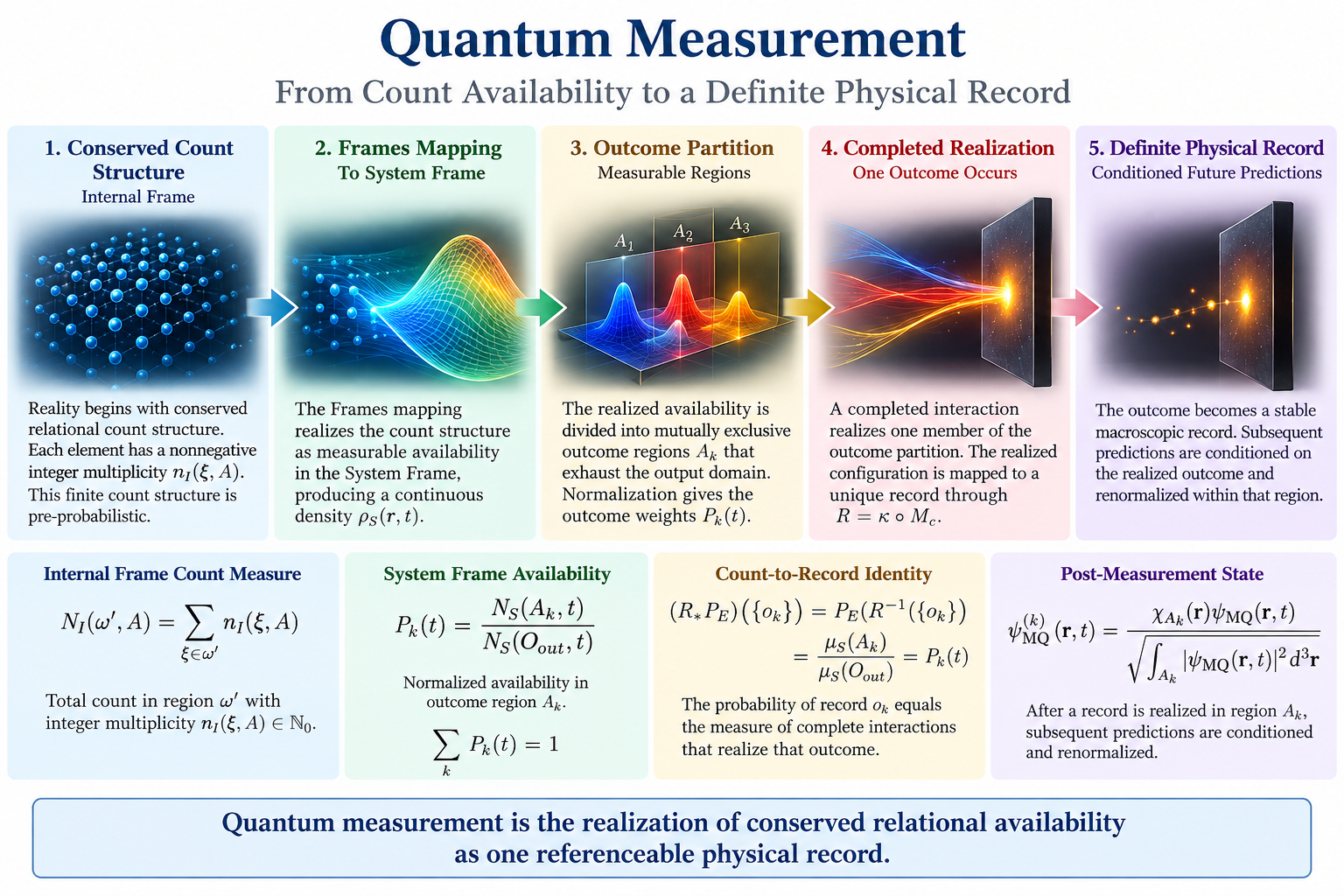
Measurement Quantization (MQ) approaches the problem from a different starting point. The wave function is not taken to be the primitive physical object, probability is not introduced as the primitive description of uncertainty, and measurement is not reduced merely to the discreteness of an observable. Instead, MQ begins with conserved relational count structure in the Internal Frame. Through the Frames mapping, that structure is realized as measurable availability in the System Frame. A completed interaction then maps that availability into one member of a mutually exclusive outcome partition.
The resulting architecture is therefore not simply "discrete measurement." It is a sequence from count to measure, measure to event, event to probability, and completed event to record.
The Primitive Structure Is Count, Not Probability
MQ begins beneath the probabilistic description normally associated with quantum mechanics. Let nI(ξ,A) denote the nonnegative integer multiplicity associated with relational element ξ at internal update index A in the Internal Frame. The allowed values satisfy nI(ξ,A) ∈ N0. For a relational region ω', the total count NI(ω',A) is the sum of those multiplicities.
NI(ω',A) = ∑ξ ∈ ω' nI(ξ,A)
This is not yet a probability distribution. It is a finite count structure. Its significance is that finite distinguishability, additive composition, nonnegative conserved multiplicity, relational relabeling invariance, and the absence of an additional primitive weighting field select ordinary counting measure as the minimal pre-probabilistic carrier within the stated MQ assumptions.
For a finite set D of primitive count units contained in the complete count domain UA, normalization therefore produces the ratio |D| / |*UA|. An arbitrary nonuniform weighting cannot simply be inserted without adding new physical structure. Probability consequently does not enter MQ as an independent field placed on top of otherwise unspecified microscopic states.
This distinction is essential. A normalized count ratio is mathematically available before a measurement is interpreted probabilistically, but normalization alone does not establish that the ratio is the frequency with which an observer will actually obtain a particular record. MQ therefore requires a second step.
From the Internal Frame to Observable Outcomes
The Internal Frame is not ordinary spacetime. Its primitive count structure must first be realized through the Frames mapping before familiar physical quantities such as position, duration, momentum, probability density, detector regions, and macroscopic records are defined. This distinction is developed more generally in the Institute's discussion of MQ frames of reference.
For a measurement context, let ρS(r,t) denote the encoded System Frame availability density, let Ak denote the measurable region associated with outcome k, and let NS(Ak,t) denote the availability contained in that region. The normalized outcome weight is
Pk(t) = NS(Ak,t) / NS(Oout,t)
where Oout denotes the complete realized output domain and the mutually exclusive regions Ak exhaust that domain. Accordingly, ∑k Pk(t) = 1.
At this stage MQ has obtained normalized outcome availability. It still has not assumed that an outcome weight is an empirical probability. That identification requires the measurement interaction itself.
The Count-to-Record Identity
Consider the finite space E of complete admissible interaction configurations for a fixed preparation and measurement context. Let Mc denote completed contextual realization through an admissible Frames mapping. Let κ assign each realized output region Ak its corresponding outcome label ok. The realized record map R is then
R = κ ∘ Mc
A completed interaction is therefore not assigned a label by a second stochastic law. The completed realization belongs to one member of the disjoint outcome partition, and that membership determines the record label.
The central measurement relation follows when the primitive count measure is pushed through this map:
(R*PE)({ok}) = PE(R-1({ok})) = μS(Ak) / μS(Oout) = Pk(t)
Here PE is the normalized measure over complete admissible interaction configurations, μS is the mapped System Frame measure, R-1({ok}) is the set of complete interactions producing record ok, and R* denotes pushforward through the record map.
This is the pivotal MQ expression for quantum measurement. It states that the normalized availability assigned to an outcome equals the measure of the complete interactions that realize that outcome. The mathematical weight and the distribution of realized records are therefore two descriptions of the same inherited count structure.
That closes a logical gap that is easy to overlook. Normalization does not create empirical probability. Completed realization does. The outcome partition defines the possible events, the record map associates each complete interaction with exactly one event, and the pushforward of the inherited count measure establishes the empirical probability distribution.
Why the Wave Function Comes Later
The MQ wave function is constructed only after the underlying availability structure has been realized. Let ψMQ(r,t) denote the MQ wave-function representation, let N1(t) be the total realized availability, and let φ(r,t) encode the phase associated with mapped count redistribution. MQ writes
ψMQ(r,t) = sqrt(ρS(r,t) / N1(t)) eiφ(r,t)
with
N1(t) = ∫R3 ρS(r,t) d3r
and therefore
∫R3 |ψMQ(r,t)|2 d3r = 1
The familiar modulus-squared structure thus appears naturally, but its interpretation is reversed relative to a primitive wave-function ontology. MQ does not infer the existence of probability merely because an amplitude can be squared and normalized. The probability law has already been established through counting measure, completed realization, the outcome partition, and the record-map pushforward. The squared modulus is its amplitude representation.
This is why the distinction between deriving a normalized wave function and deriving the empirical probability interpretation of that wave function matters. They are not the same problem.
Once the availability geometry is completed into the appropriate Hilbert representation, the same construction extends beyond position-space partitions to spectral projectors and positive operator-valued measures. The ordinary Born-form machinery is thereby recovered as a representation of the earlier count-to-event probability structure rather than introduced as the primitive source of that structure.
What Happens When an Outcome Is Observed?
Suppose outcome region Ak has been realized. Standard textbook language often describes the subsequent change of state as wave-function collapse. MQ separates two operations that this language can conflate.
The first is physical realization. A complete interaction terminates in one distinguishable outcome class and produces a stable macroscopic record. The second is predictive conditioning. Once that record exists, subsequent predictions must be restricted to the realized outcome and renormalized.
If χAk(r) is the indicator function of the realized outcome region, then the conditioned MQ wave-function representation becomes
ψMQ(r,t) → ψMQ(k)(r,t) = χAk(r) ψMQ(r,t) / sqrt(∫Ak |ψMQ(r,t)|2 d3r)
This expression resembles projection and renormalization in ordinary quantum mechanics, but MQ assigns it a different logical role. It updates the representation after a physical record has already been realized. It is not itself the physical mechanism that chooses the record.
Accordingly, MQ does not require a primitive stochastic destruction of the underlying Internal Frame count structure. The conserved count structure persists. What changes after measurement is the realized System Frame context and therefore the information relevant to subsequent predictions.
Interference Is Not a Contradiction
Treating the wave function as derived does not remove interference. Phase remains essential because it encodes mapped redistribution structure.
For two coherent alternatives with probability densities ρP,1 and ρP,2 and phases φ1 and φ2, MQ obtains
ρP = ρP,1 + ρP,2 + 2 sqrt(ρP,1ρP,2) cos(φ2 - φ1)
The interference term arises in the System Frame amplitude representation. It does not require the underlying Internal Frame multiplicity itself to become a complex-valued physical field.
This provides a useful conceptual separation. Count conservation describes the primitive availability structure. Complex amplitude and phase provide the reversible representation required to describe how realized alternatives combine and interfere. Measurement completes when that evolving structure is mapped into an exclusive, stable record.
The broader connection between discrete measure and quantum behavior is discussed in Determinism and the Foundations of Quantum Behavior and in the Institute's treatment of the physical significance of measure.
Quantum Dynamics from the Same Structure
The measurement construction is not intended to stand apart from quantum dynamics. Under the stated nonrelativistic admissibility conditions, MQ reconstructs Schrödinger-form evolution for ψMQ. Translation covariance supplies the Weyl relations and their infinitesimal canonical commutator, while the MQ phase-action scale fixes the corresponding physical scale rather than leaving the kinematic generator unrelated to the underlying measurement structure.
This matters because a solution to quantum measurement should coexist with the dynamics that generate interference and entanglement. MQ's proposed resolution is therefore not to suppress quantum evolution whenever an observer appears. The same count architecture is carried through continuous amplitude evolution, interference, composite states, contextual measurement, and realized records.
The role of the fundamental measurement scales underlying this construction connects quantum measurement to the broader MQ treatment of fundamental measures and Planck's constant.
Entanglement and Bell Correlations
Composite systems expose an especially important consequence of the framework. MQ does not generally require composite availability to factor into independent local probability distributions. For two realized subsystems A and B, the joint normalized availability can be non-factorizable.
That property permits the familiar nonclassical correlations of entangled systems. In the ideal two-channel polarization construction developed in the quantum-measurement paper, the continuous norm-preserving rotation of the derived channel amplitude produces the standard angular response and the resulting Bell-CHSH correlations.
This does not amount to a restoration of a Bell-local hidden-variable model. Bell's theorem constrains theories satisfying the relevant factorizability and auxiliary assumptions, and experiments have repeatedly observed Bell-inequality violations. MQ instead preserves operational no-signaling while allowing the composite availability from which the joint probabilities are obtained to remain non-factorizable.
The distinction is important. A non-factorizable joint structure does not imply that a controllable signal can be transmitted between spacelike-separated measurements. The realized marginal statistics remain independent of the remote measurement setting. MQ therefore seeks to reproduce the empirically required Bell correlations without assigning independent Bell-local response functions to an additional hidden variable.
The Measurement Problem Recast
From this perspective, the traditional measurement problem is partly a consequence of beginning the physical description too late.
If the wave function is assumed to be the complete primitive description, unitary evolution naturally leaves the theory confronting a superposition of possible records. One must then explain why only one record is experienced. MQ instead places a conserved pre-probabilistic structure beneath the wave function. The wave function represents realized availability and phase structure, while the completed contextual interaction maps the underlying finite interaction domain into a mutually exclusive outcome partition.
The important question therefore changes.
It is no longer simply, "What collapses the wave function?"
The more fundamental question becomes, "How does conserved relational availability become a unique referenceable physical record?"
MQ answers with a chain of mathematically distinct operations:
conserved count → Frames mapping → realized availability → exclusive outcome event → completed contextual realization → stable record → conditioned future prediction.
Each step has a separate role. Conservation prevents the primitive count structure from being created or destroyed merely to accommodate an observation. The Frames mapping establishes the measurable representation. Normalization supplies relative availability. The outcome partition supplies mutually exclusive events. Completed realization identifies one event in an individual interaction. The record map makes that outcome macroscopically distinguishable. Restriction and renormalization then describe what should be predicted after the event has occurred.
A Falsifiable Measurement Architecture
This structure also clarifies what would constitute a failure of the MQ account. The measurement solution depends on more than reproducing familiar quantum equations after sufficient assumptions have been introduced. Its central empirical identification requires the normalized inherited count measure and the distribution generated by completed record realization to agree.
If the count-to-record identity fails, then MQ's proposed explanation of quantum measurement fails even if its discrete mathematics remains internally consistent. Likewise, failure of the subsequent kinematic reconstruction would challenge the claimed derivation of quantum dynamics without automatically erasing the logically prior count and record construction.
The framework therefore has an unusually explicit dependency structure. Its claims concerning probability, dynamics, Bell correlations, relativistic continuation, and finite-count metrology do not all stand or fall as a single undifferentiated proposition.
One particularly sharp proposed empirical distinction arises at finite count. MQ predicts a specific upper-count correction to gravitational quantum transition frequencies, with the cited quantum-measurement analysis giving a shift of 11.6426596 ppm relative to the corresponding standard quantum-mechanical prediction. That difference has not yet been experimentally tested at the precision required to discriminate the two descriptions. It should therefore be understood as a prediction, not as present empirical confirmation.
Measurement as Realization
The central contribution of MQ to quantum measurement is consequently not another interpretation of an otherwise primitive wave function. It is an attempt to derive the structures that make the wave function, probability, and definite records possible.
At the deepest level of the construction there is conserved finite relational multiplicity. At the observable level there is continuous System Frame measure. Between them lies the Frames mapping. Probability emerges when normalized count measure is connected to physically exclusive events through completed realization. Complex amplitudes encode the resulting availability and its phase relations. Interference follows from coherent amplitude composition. A completed interaction produces one stable record, after which ordinary restriction and renormalization condition future predictions.
In this account, the quantum and the classical are not separated by an observer-dependent boundary. They are different stages in the realization of the same underlying measurement structure.
The conceptual shift is therefore substantial. Quantum measurement is not fundamentally the destruction of alternatives by observation. In MQ, it is the realization of conserved relational availability as one referenceable physical record.
The underlying count-based framework and its broader consequences are developed in Measurement Quantization, MQ Frames of Reference, Fundamental Measures, and the current quantum-measurement paper on ResearchGate.

8: Resolving the Hubble tension 68.261 and 73.510 km s Mpc
International Journal of Geometric Methods in Modern Physics
7: Measurement Quantization
Journal of High Energy Physics, Gravitation and Cosmology
6: Physically Significant Units of Measure
5: Measurement Quantization Unites Classical and Quantum Physics
4: Quantum Model of Gravity Unifies Relativistic Effects, Describes Inflation/Expansion Transition, Matches CMB Data
3: Measurement Quantization Accounts for Galactic Rotational Velocities and Obviates Dark Matter
2: Measurement Quantization Describes History of Universe -
Quantum Inflation, Transition to Expansion, CMB Power Spectrum
International Journal of Theoretical and Mathematical Physics
1: Measurement Quantization Describes the Physical Constants