TERMS INPUTS SYMBOLS CONDORDANCE ANALYSIS
—————————— read pre-print on research gate (new window) ——————————
Gravitational Lensing
Light Deflection as an Independent Test of Gravitational Realization
Gravitational lensing is one of the most direct observational consequences of gravitation because the trajectory being measured belongs to light rather than to the massive bodies whose motions are ordinarily used to infer a gravitational field. A galaxy rotation curve asks how matter moves through a gravitational environment. A gravitational lens asks how that same environment redirects electromagnetic radiation. The observables are different, but a consistent theory of gravity cannot assign them unrelated gravitational responses.
This distinction is particularly important for Measurement Quantization. MQ does not introduce a separate phenomenological rule for gravitational lensing. The gravitational realization responsible for non-Newtonian galactic dynamics must also enter the emergent System Frame metric through the same Frames mapping. Photons then propagate through that metric along null geodesics. Consequently, galactic orbital dynamics and gravitational lensing become two observational interrogations of one gravitational construction rather than two effects supplied with independently adjustable explanations.
This provides a considerably stronger requirement than reproducing a galactic rotation curve. A radial acceleration law may reproduce stellar velocities without establishing how spacetime responds to the same source. Lensing requires the relativistic completion. In MQ, the decisive question is therefore not simply whether the realized gravitational acceleration is sufficiently large. It is whether the covariant System Frame solution produces the temporal and spatial metric potentials required to bend light by the observed amount.
From Gravitational Acceleration to Light Deflection
In the conventional weak-field limit, a light ray passing outside a spherical gravitating source is deflected according to the familiar general-relativistic relation. Let α denote the physical gravitational deflection angle, b the impact parameter, M the gravitating mass, c the speed of light, and G the gravitational constant resolved at the upper count limit. The exterior point-source result is
α = 4 G M / (c2 b)
The importance of this expression extends beyond the familiar factor of four. It establishes that light deflection is determined by the spacetime geometry sourced by gravitation. A theory that modifies the gravitational response experienced by massive bodies must therefore establish how that modification appears in the metric traversed by photons.
MQ approaches this requirement through its discrete treatment of gravitation. The realized radial acceleration is not introduced specifically for lensing. It is the same gravitational realization developed from the MQ count structure and used in galactic dynamics.
Let abar(r) denote the Newtonian acceleration generated by the baryonic source at radial distance r, and let aMQ(r) denote the corresponding realized MQ gravitational acceleration. With a0 denoting the MQ acceleration scale established upstream by the cosmological construction, the galactic realization law is
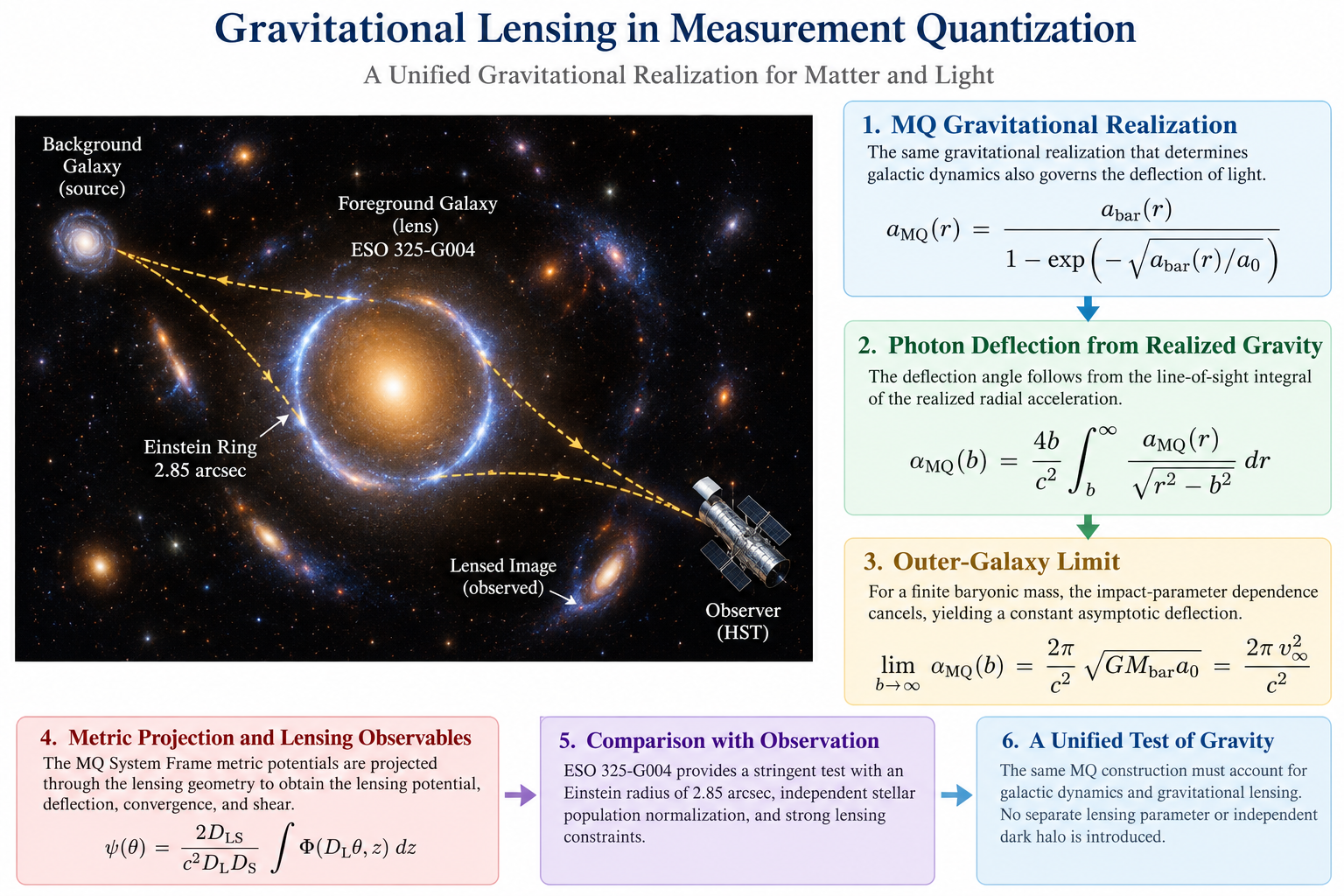
aMQ(r) = abar(r) / [1 - exp(-sqrt(abar(r) / a0))]
This expression is central to the connection between galactic dynamics and lensing. The acceleration scale is not fitted separately to a lens, and the realization function is not reconstructed from the observed Einstein ring. Both are inherited from the same MQ gravitational construction applied to orbital dynamics.
For a static, spherically symmetric weak field with negligible gravitational slip, the radial acceleration can be inserted directly into the null-geodesic weak-field reduction. The resulting MQ deflection at impact parameter b is
αMQ(b) = (4 b / c2) ∫b∞ [aMQ(r) / sqrt(r2 - b2)] dr
This is the more physically informative MQ lensing expression. It does not merely assign an enlarged mass to an Einstein deflection formula. It integrates the realized gravitational acceleration along the photon trajectory. Every radial interval through which the ray propagates contributes according to the gravitational realization at that location.
Substitution of the MQ galactic realization law gives
αMQ(b) = (4 b / c2) ∫b∞ { abar(r) / [1 - exp(-sqrt(abar(r) / a0))] } [dr / sqrt(r2 - b2)]
The structure is consequential. There is no lensing-specific acceleration scale, independent halo profile, or second realization function. Once the baryonic source and the upstream MQ quantities are specified, the spherical weak-field deflection is fixed.
Why the Outer-Galaxy Limit Matters
The connection becomes especially transparent outside a finite baryonic source. At sufficiently large r, the Newtonian baryonic acceleration is abar = G Mbar / r2, where Mbar is the finite enclosed baryonic mass. The low-acceleration limit of the MQ realization law then gives a radial acceleration proportional to 1 / r. This is the same behavior that produces asymptotically constant orbital velocity.
The corresponding photon-deflection integral has a striking consequence. Its explicit impact-parameter dependence cancels in the outer limit, leaving
limb→∞ αMQ(b) = (2 π / c2) sqrt(G Mbar a0)
Let v∞ denote the asymptotic realized orbital velocity. The same finite-mass limit gives v∞4 = G Mbar a0. The asymptotic lensing expression can therefore be written as
limb→∞ αMQ(b) = 2 π v∞2 / c2
This relation exposes the central cross-observable prediction. The gravitational realization that determines the asymptotic orbital speed also determines the asymptotic photon deflection. Once the baryonic source and the MQ acceleration scale are fixed, there is no independent parameter available to reconcile one observable with the other.
That is a much stronger statement than saying that MQ can produce additional gravitational deflection. The theory links two different classes of measurement. Stellar motion determines one manifestation of the realized gravitational field. Photon trajectories interrogate the relativistic geometry generated by that same realization. A disagreement between the two cannot legitimately be repaired by choosing a different acceleration scale for lensing without abandoning the common MQ construction.
The Relativistic Requirement
The spherical result is nevertheless not the complete gravitational-lensing problem.
A real galaxy is an extended three-dimensional source. Its projected stellar distribution may be elliptical, nearby structures may contribute external gravitational fields, and the observable arcs sample a two-dimensional lensing geometry. More fundamentally, photons respond to the metric rather than to a scalar acceleration considered in isolation.
In the weak-field description of a metric theory, two scalar gravitational potentials characterize the relevant temporal and spatial perturbations. Their difference is commonly described through gravitational slip. Massive nonrelativistic bodies predominantly constrain the potential governing their acceleration, whereas gravitational lensing responds to the appropriate combination of both potentials. This is why successful rotation-curve phenomenology does not, by itself, constitute a successful theory of gravitational lensing.
The MQ requirement is correspondingly stringent. The System Frame metric must emerge from the same frames construction responsible for the underlying gravitational realization. The metric and material source enter the MQ variational principle, and freely propagating photons must follow the resulting null geodesics. The relation between the two weak-field metric potentials must therefore be obtained from that covariant solution rather than imposed because the general-relativistic answer is desired.
Under the negligible-slip specialization, the two potentials reduce to the common weak-field potential used in the spherical calculation above. This specialization is sufficient for a consistency benchmark. It is not sufficient to claim a general solution for extended gravitational lenses.
That limitation is scientifically useful. It identifies exactly what must be calculated for MQ to move from spherical gravitational consistency to a complete relativistic lensing prediction.
Extended Lenses, Convergence, and Shear
Once the relevant System Frame metric potentials have been solved, the conventional thin-lens projection provides the bridge to observable lensing maps. Let θ denote the two-dimensional angular position in the lens plane, and let DL, DS, and DLS denote the observer-to-lens, observer-to-source, and lens-to-source angular-diameter distances. Let z denote physical distance along the unperturbed line of sight and Φ the common weak-field potential in the negligible-slip specialization. The dimensionless lensing potential is
ψ(θ) = (2 DLS / (c2 DL DS)) ∫ Φ(DL θ, z) dz
The angular deflection field is then determined by the transverse gradient of that projected potential,
α(θ) = ∇θ ψ(θ)
and the convergence κ, which describes isotropic focusing or magnification, follows from
κ = (1 / 2) (ψ,11 + ψ,22)
while the two shear components are
γ1 = (1 / 2) (ψ,11 - ψ,22)
γ2 = ψ,12
These are standard thin-lens consequences of the weak-field metric. They are not additional MQ realization laws. Their importance to MQ is that they transform the metric solution into directly testable observables. A resolved source distribution can therefore be propagated through the MQ equations to predict the positions and shapes of arcs, Einstein rings, convergence fields, and shear fields.
This creates a particularly clean falsification pathway. The baryonic source must first be determined independently of the lensing result. The MQ gravitational realization and System Frame metric are then calculated without fitting to the arcs. Only after those quantities are frozen should the predicted lensing maps be compared with observation.
ESO 325-G004 as a Relativistic Benchmark
The nearby giant elliptical galaxy ESO 325-G004 provides an unusually useful test because it combines strong gravitational lensing with unusually strong independent constraints on its stellar population.
The lens lies at redshift 0.035. Its prominent arcs form an Einstein ring at 2.85 arcsec, corresponding to 1.96 kpc in the cosmology used in the published analysis. The Einstein aperture is only about one quarter of the galaxy's effective radius, placing the measurement well inside the stellar-dominated central region. Hubble Space Telescope photometry gives an F814W luminosity of 4.07 +/- 0.08 × 10¹⁰ solar luminosities inside the Einstein radius. Independent stellar-population analysis gives a Milky-Way-like stellar mass-to-light ratio of 3.01 +/- 0.25 in the same band. The conventional strong-lensing reconstruction gives a total projected mass of 1.50 +/- 0.06 × 10¹¹ solar masses inside the Einstein aperture.
ESO 325-G004 is therefore valuable precisely because the source can be constrained without first asking lensing how much gravitating material must be present. That separation is essential for an MQ test.
The appropriate procedure is to construct the baryonic source from the observed stellar-light distribution and independently measured stellar-population normalization. A lensing-inferred total mass, dark-matter fraction, or lensing-adjusted stellar normalization must not then be fed back into the MQ source. Doing so would erase the independence of the test.
A spherical MQ benchmark constructed in this manner enhances the deflection produced by the independently normalized stellar source by a factor of 1.0475 relative to the general-relativistic point-mass deflection for the same baryonic mass and impact parameter. Solving the spherical lens equation with the published geometry gives an MQ Einstein radius of about 2.67 arcsec, compared with the observed 2.85 arcsec. With the published luminosity, stellar-population normalization, and lensing-mass uncertainties propagated through the comparison, the equivalent-mass difference is about 1.8 standard deviations.
That result should not be described as either a successful full lensing prediction or a failure of the covariant theory. It is a spherical benchmark. It deliberately omits the resolved two-dimensional stellar-light distribution and does not solve the extended System Frame metric or independently derive its gravitational slip. The benchmark instead establishes the normalization that the completed covariant calculation must explain.
This is an unusually restrictive position for the theory. The remaining difference cannot properly be filled with a lens-specific acceleration scale or an arbitrarily selected dark halo while still calling the result the parameter-frozen MQ prediction. It must emerge, if the theory is correct, from the covariant extended-source solution, its metric potentials, the actual three-dimensional source geometry, and independently constrained environmental contributions.
The galaxy also permits a complementary relativistic check. Strong-lensing measurements combined with spatially resolved stellar kinematics have constrained the weak-field spatial-curvature contribution per unit mass on kiloparsec scales and found it consistent with the general-relativistic value. Consequently, an MQ metric solution cannot merely reproduce the observed amount of deflection. It must reproduce the relationship between dynamical and lensing curvature to the precision allowed by those observations.
Lensing as a Cross-Observable Test of MQ
Gravitational lensing therefore occupies a special position in Measurement Quantization. The gravitational constant, galactic gravitational realization, frame structure, and relativistic metric cannot remain separate pieces of the theory when photons pass a galaxy. They meet in a single observable trajectory.
For spherical systems in the weak-field negligible-slip limit, MQ already provides a definite bridge. The galactic realization law determines the radial acceleration, the radial acceleration determines the integrated photon deflection, and the finite-mass outer limit links that deflection directly to the asymptotic orbital velocity. No new lensing scale is introduced.
For general extended lenses, the next step is more demanding. The full covariant System Frame equations must determine both weak-field metric potentials from an independently specified baryonic source. Those potentials must then be projected through the lensing geometry to predict the deflection, convergence, shear, critical curves, and Einstein-ring morphology before comparison with observation.
This distinction between what has already been derived and what remains to be calculated is fundamental. The spherical calculation demonstrates cross-observable consistency under a clearly stated weak-field specialization. It does not substitute for the general covariant calculation.
The eventual test is therefore exceptionally clean. A galaxy supplies its baryonic structure. MQ supplies its gravitational realization without lens-specific tuning. The covariant theory supplies the metric. The metric supplies the photon trajectories. Observation then determines whether all four stages agree.
That is why gravitational lensing is more than another application of the MQ gravitational relation. It is a test of whether the discrete measurement structure proposed by MQ survives the transition from the motion of matter to the geometry traversed by light.

8: Resolving the Hubble tension 68.261 and 73.510 km s Mpc
International Journal of Geometric Methods in Modern Physics
7: Measurement Quantization
Journal of High Energy Physics, Gravitation and Cosmology
6: Physically Significant Units of Measure
5: Measurement Quantization Unites Classical and Quantum Physics
4: Quantum Model of Gravity Unifies Relativistic Effects, Describes Inflation/Expansion Transition, Matches CMB Data
3: Measurement Quantization Accounts for Galactic Rotational Velocities and Obviates Dark Matter
2: Measurement Quantization Describes History of Universe -
Quantum Inflation, Transition to Expansion, CMB Power Spectrum
International Journal of Theoretical and Mathematical Physics
1: Measurement Quantization Describes the Physical Constants