
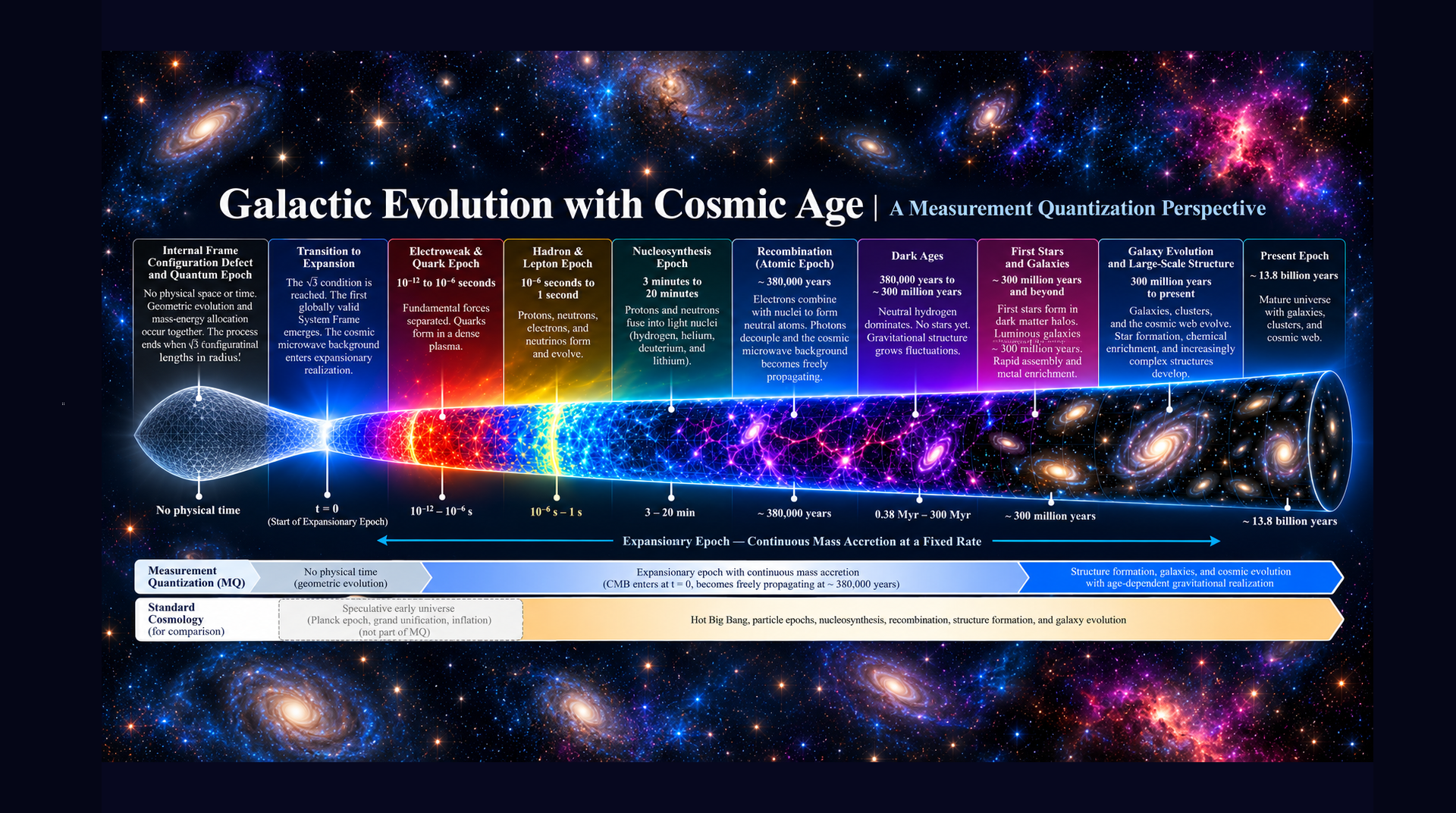
Galactic Evolution with Cosmic Age
Within the stated MQ realization law, the acceleration scale rises at smaller positive realized cosmic ages and gives a stronger response for an otherwise fixed baryonic source. This is the fixed-source consequence in MQKB523 DEF1296, rather than a complete history of galaxy formation. The progressive weakening with age is the source concept in DEF1123 and DEF1300. The System Frame age belongs to realized physics; no physical clock or gravitational geometry is assigned to the nonphysical, vectorless, dimensionless configuration domain.
Symbols and scope
A_U is the positive realized cosmic age and A_U,0 is its present-age reference. The central present-age reference used for these illustrative plots is 13.7943 billion years. The positive a_MQ(A_U) is the MQ galactic acceleration scale in metres per second squared. H_sys(A_U) is the System Frame expansion frequency in inverse seconds. The age ratio uses the source inverse-age expansion prescription with its other normalization parameters held fixed. R is galactocentric radius in metres. The positive baryonic acceleration g_bar(R), in metres per second squared, and its mass distribution are held fixed when comparing ages. The realized acceleration is g_real(R,A_U). The Newtonian circular speed v_New(R), in metres per second, is associated with that fixed baryonic field; v_real is the modeled realized circular speed. The circular relation v_New squared equals R g_bar gives the displayed speed law from the acceleration law.
Age scaling
This scaling is used in the realized epoch. It is not extrapolated through A_U=0 or into a pre-referenceable configuration domain. The present normalization is a reference for comparing ages; this graphic does not refit an acceleration parameter.
Realized gravitational response
The exponential arguments are dimensionless. The square-root denominator in the velocity law and the denominator in the acceleration law follow the same source response. The comparison holds the baryonic acceleration and Newtonian speed fixed. It does not assume that a real galaxy preserves the same mass distribution as it evolves.
Calculated enhancement chart
The horizontal axis is g_bar divided by a_MQ(A_U,0), from 0.001 to 10; the vertical axis is g_real divided by g_bar. Both axes are logarithmic. The curves evaluate the displayed source law at ages 3, 6 and 13.7943 Gyr. They use 241 logarithmically spaced positive baryonic-acceleration ratios, with the fixed inverse-age scale. These are modeled fixed-source curves, not observational measurements or fits. For x=g_bar/a_MQ(A_U,0), the enhancement is evaluated as one divided by one minus exp of minus square root of x A_U/A_U,0, an algebraic substitution of the displayed relations. The older source chart had a finite low-acceleration plateau incompatible with that expression; the replacement follows the equation and increases toward lower baryonic acceleration.
The upper strip retains conceptual galaxy artwork, not observations or one measured galaxy tracked through time. Its age labels 0.3, 1, 3 and 13.7943 Gyr are illustrative reference ages. The source redshift labels and approximate age-redshift pairings are removed because this relation alone supplies no independently specified A_U(z). No cosmological redshift-to-age background is silently selected. The increasing-age arrow compares response at fixed baryonic source.
Physical interpretation
Stronger earlier-age realization can motivate investigation of galaxy development, but a quantitative assembly prediction requires coupled evolution of mass supply, baryonic distribution and dynamics, as distinguished in the source early-structure coupling problem. The title names the application; the plotted result itself isolates realization-law evolution. No claim of established faster galaxy assembly from this fixed-source curve alone is made. No equation numbers or additional visible footer are added.

Galactic Evolution with Cosmic Age
Why Measurement Quantization predicts stronger gravitational realization in the early universe
Galaxies are observed across an enormous span of cosmic history. A nearby galaxy is observed in a mature universe, while a galaxy at extreme cosmological redshift is observed at an earlier stage. In the standard general-relativistic description with cold dark matter, cosmic age alone does not rescale the local gravitational coupling. Baryonic structure, halo structure, and the cosmological environment can evolve. A change in those sources must be distinguished from an explicit age dependence assigned to the local gravitational response.
Measurement Quantization (MQ) starts from one axiom, “measure is discrete.” Within its proposed construction, discrete count relationships geometrically anchor an expanding frame of information describing a universe with four measured inputs. The fine structure constant, speed of light, electron mass, and Bohr radius select and normalize the fundamental-measure realization. These input roles are distinct from the axiom and from the symbolic form of a law.
The four inputs are not four statistically independent measurements. The exact SI value of the speed of light also supplies a unit convention. The measured cosmic microwave background temperature separately selects the epoch through the adopted age prescription. Galaxy applications additionally require a baryonic mass reconstruction. The distinction between a law’s form and its numerical realization is developed in the fundamental expression discussion.
For galactic dynamics, MQ predicts an acceleration scale that varies with cosmic age. Under the same realization law, an earlier epoch gives a larger scale and a larger response relative to the Newtonian baryonic prediction, particularly at low baryonic acceleration. This is a conditional dynamical prediction within the construction, rather than a completed calculation of early galaxy formation.[1]
Cosmic Age Enters the Gravitational Realization Law
The Internal Frame is the discrete count configuration domain. The System Frame is its non-discrete relational realization, in which physical observables are defined. The Frames mapping relates admissible count configurations to that realized structure. This distinction is developed more generally in Frames of Reference. For galactic dynamics, let denote the positive MQ acceleration scale, in m s−2, and the System Frame expansion rate, in inverse seconds. At fixed realization coefficients, both have the following inverse-age dependence.
Let denote the positive System Frame age of the universe, in seconds, and its present value. The cosmic-age scaling of the MQ acceleration is
As cosmic age decreases, increases under this relation. The scale is fixed by the adopted cosmological state rather than fitted separately to each galaxy. The present age normalization uses the same MQ prescription discussed in the age and diameter of the universe page.[1]
Physical meaning
The present acceleration scale is an epoch-specific realization. Its age dependence is prescribed before the galaxy residuals are evaluated. A redshift-to-age conversion must also be fixed in advance. An externally supplied expansion history used for that conversion is a benchmark input; it is not automatically a self-consistent MQ expansion solution.
From Cosmic Age to Galactic Dynamics
Consider a galaxy with positive baryonic acceleration (), in m s−2, at galactocentric radius , in metres. This is the Newtonian circular acceleration calculated from the adopted baryonic mass distribution. Define () as its Newtonian circular speed and (, ) as the MQ realized circular speed at the selected epoch, both in m s−1. The calculation retains that baryonic source law and changes its realized response.
On the positive circular-speed branch, the age-dependent galactic realization law is
The expression makes the local baryonic acceleration and the epoch-dependent acceleration scale explicit. It is the age-dependent circular-orbit relation in Jody A. Geiger’s A First Principles Derivation of the Galactic Radial Acceleration Relation from Measurement Quantization, Section 5.5, Eq. (194). A stationary circular-response law does not itself evolve a collapsing gas cloud.[1]
The effect is not a uniform multiplication of gravity everywhere. At large baryonic acceleration relative to , the exponential tends to zero and the response tends to the Newtonian baryonic value. At smaller relative acceleration, the denominator decreases and the enhancement grows. The same mathematical structure therefore prescribes how the circular response changes with cosmic age, conditional on the adopted baryonic source.
Earlier Cosmic Age Means Stronger Realized Gravity
For two otherwise identical baryonic configurations evaluated at different positive cosmic ages, the earlier epoch has the larger . At fixed positive , the denominator in the velocity law is then smaller and the realized speed is larger. The fractional change is larger in lower-acceleration regions.
Fixed-source comparison
The comparison is intentionally controlled. Hold the baryonic acceleration structure fixed and change only cosmic age. MQ then predicts greater gravitational realization at the earlier epoch. This isolates the age dependence of the gravitational law from the many astrophysical processes that simultaneously change a real galaxy.
This makes the prediction fundamentally different from simply asserting that young galaxies contained more unseen gravitating matter. MQ does not require an independently specified dark-matter distribution to generate the enhanced response. The enhancement arises from the realization law itself and from the cosmic age at which that law is evaluated. The relationship to the broader galactic mass discrepancy is discussed in Dark Matter and Effective Mass of a Galaxy.
Cosmic age therefore becomes dynamically relevant. A galaxy with the same baryonic acceleration structure does not have precisely the same MQ gravitational realization at every epoch.
Galactic Evolution Is Not Gravitationally Static
Imagine holding the baryonic source structure fixed while moving the system conceptually from an early cosmic age toward the present. This is not intended to describe the actual evolution of an individual galaxy. Real galaxies accrete matter, form stars, undergo feedback, merge, lose gas, redistribute angular momentum, and continuously change their baryonic structure. The fixed-source comparison instead isolates the gravitational consequence of cosmic age.
Under that controlled comparison, MQ predicts that the realized gravitational enhancement decreases as the universe ages. The early galaxy therefore occupies a gravitational environment that is intrinsically different from the environment of an otherwise equivalent galaxy today. Its baryonic matter can generate a larger realized gravitational response without changing Newton's baryonic source expression and without introducing an independently fitted halo for that particular galaxy.
Cosmic age is therefore more than a timestamp in MQ galactic dynamics. It participates in the realization of the gravitational response.
The Connection to Early Galaxy Formation
Cosmic Dawn motivates this investigation. In Spectroscopic confirmation of two luminous galaxies at a redshift of 14, Carniani and colleagues reported JADES galaxies with cosmological redshift = 14.32 and = 13.90. The inferred emission times are roughly 300 million years after the Big Bang in the cosmology adopted by that paper. This is a model-dependent conversion from measured redshift, not an independent determination of MQ cosmic age. The study found a larger early luminous population than many pre-JWST predictions anticipated.[2]
In Photometric detection at 7.7 μm of a galaxy beyond redshift 14 with JWST/MIRI, Helton and colleagues favored a young stellar-population interpretation for JADES-GS-z14-0, with roughly half a billion solar masses in stars and a recent burst. The inferred nebular contribution suggests enrichment. These are stellar-population model inferences, not direct mass measurements; alternative fits remain possible.[3]
Interpretive boundary
The JWST observations do not by themselves select MQ over conventional structure formation. Stellar populations, feedback, dust, and halo growth affect their interpretation. MQ supplies a prescribed age dependence for the circular gravitational response. Whether that dependence accelerates assembly by the required amount must be determined by an evolving formation calculation.
Donnan and colleagues’ No evidence (yet) for increased star-formation efficiency at early times reproduces ultraviolet luminosity functions over roughly redshifts 6–13 with a non-evolving efficiency that depends on halo mass and progressively younger stellar populations. This supplies a concrete conventional explanation within that study’s range, rather than evidence that the early-galaxy observations uniquely require modified gravity.[4]
Under an extrapolation of the MQ law to early cosmic ages, the same low-acceleration baryonic configuration has a larger circular gravitational response than it has today. That result does not create baryons, prescribe a star-formation rate, or determine the formation time of an individual galaxy. Its use during assembly requires additional dynamics.
Why the Effect Can Matter for Early Assembly
Galaxy formation is a competition among several physical processes. Matter must accumulate within gravitational structures. Gas must collapse, cool, fragment, form stars, respond to stellar and black-hole feedback, and frequently interact or merge with neighboring systems. A gravitational theory cannot replace this astrophysics. It can, however, change the gravitational response driving that evolution.
In MQ, the relevant difference is already encoded before a galaxy-specific formation model is constructed. A low-acceleration baryonic configuration at early cosmic age lies deeper in the MQ realization regime because is larger. The realized gravitational response is consequently greater relative to the baryonic Newtonian prediction than it would be for the same source at the present epoch.
This supplies a candidate gravitational contribution to early assembly. The demonstrated result here is the fixed-source circular-response change. As increases, decreases and that enhancement declines continuously. No separately switched early-epoch boost is inserted. The magnitude of any change in formation time remains a task for dynamical modeling.
A Quantitative Evolution Rather Than an Adjustable Epoch Effect
The numerical examples are conditional benchmarks. Section 5.5, Table 21 of A First Principles Derivation of the Galactic Radial Acceleration Relation from Measurement Quantization adopts a present age of 13.7943 billion years and a Planck 2018 flat late-time expansion history for redshift conversion. It reports an acceleration-scale ratio () / (0) of 1.0862 at = 0.08 and 3.1246 at = 1.44. Here an argument of zero denotes present redshift, not zero cosmic age.[1]
At = 1.44, the same benchmark reports a speed increase of 28.65% for a fixed source with = 0.1 (0), and 20.96% with = (0), relative to its present-epoch response. Substitution of the reported scale ratio into the velocity law reproduces both percentages. They are illustrative calculations at source reporting precision, with no propagated uncertainty supplied, rather than measurements or precision error bounds.[1]
Why this remains predictive
These values are not galaxy fits. They evaluate a prescribed age conversion with the baryonic acceleration held fixed. The expansion benchmark and adopted MQ age normalization remain model dependencies. Their conversion uncertainty must be propagated in an observational test, and the late-time benchmark must not be extrapolated to Cosmic Dawn without further justification.
What MQ Does Not Yet Claim
The cosmic-age relation is a gravitational prediction, not yet a complete numerical theory of early galaxy populations. A full calculation of galaxy formation within MQ must simultaneously evolve baryonic assembly, gas dynamics, cooling, star formation, feedback, mergers, environment, and the age-dependent gravitational realization law. It must then predict observables such as galaxy abundance, stellar mass, size, rotation, velocity dispersion, and their evolution with redshift.
The existence of a galaxy at > 14 is therefore not a direct test of this MQ law. The cited observations establish an early luminous population and support model-dependent inferences about its stellar content and enrichment. Testing the proposed contribution to assembly requires an evolving formation calculation with predicted observables.
This distinction is scientifically important. The theory predicts the direction and functional form of the gravitational evolution before such a calculation is performed. The astrophysical calculation must determine how much of the observed early assembly follows from that effect.
A Direct Observational Test
The age dependence also creates a test that does not depend simply on counting unexpectedly early galaxies. The stronger test is to reconstruct baryonic mass distributions and resolved kinematics for galaxies at different epochs and ask whether the relationship between baryonic acceleration and realized dynamics changes with cosmic age in the manner prescribed by MQ.
For otherwise comparable low-acceleration baryonic configurations, MQ predicts a systematic shift toward greater realized velocity at earlier cosmic ages. The fractional change should also be larger in lower-acceleration regions.
Falsifiable comparison
Fix the baryonic reconstruction procedure, redshift-to-age conversion, cosmological normalization, and MQ parameters before examining the kinematic residuals. No galaxy-specific adjustment of the acceleration scale is permitted. Source normalization, gas pressure support, inclination, distance, sample selection, and correlated uncertainties must be controlled. A statistically secure absence of the prescribed shift in suitably sensitive, matched systems would challenge this age dependence; a detected trend must also be distinguished from these systematics.
The cosmic-age relation supplies a prospective test across cosmic time. The reviewed source sets out this test, but does not report a completed frozen-parameter, independently reconstructed multi-epoch test. Its value as a new discriminator depends on evaluating data withheld from the model construction.[1]
Gravity Across Cosmic Time
The central MQ proposition is straightforward but far-reaching. A galaxy does not exist gravitationally independent of the cosmic age in which it is realized.
The baryonic source remains the baryonic source. What changes is the relation between that source and its realized gravitational response. Because the MQ acceleration scale varies inversely with System Frame cosmic age, low-acceleration systems in the younger universe exhibit greater gravitational realization relative to their Newtonian baryonic prediction.
This links the proposed cosmological construction to galactic dynamics. The framework starts from discrete measure, develops the fundamental measures, relates count structure to observables through the frames of reference, and adopts an epoch prescription for the age and diameter of the universe. Those dependencies accompany the age-dependent galactic prediction.
JWST has established luminous galaxies at very high redshift. Within the cited studies’ cosmology, their emission occurred when the universe was only a few hundred million years old. MQ proposes a specific additional relationship. Otherwise comparable low-acceleration baryonic configurations have a larger realized circular response at an earlier cosmic age.
Earlier cosmic age means a larger MQ acceleration scale. A larger acceleration scale produces greater gravitational realization in low-acceleration baryonic systems. As the universe ages, that enhancement declines according to the same cosmological relation. Galactic evolution and cosmic evolution are therefore linked in MQ at the level of the gravitational law itself.
Source Notes
[1] Jody A. Geiger, A First Principles Derivation of the Galactic Radial Acceleration Relation from Measurement Quantization, author preprint, 2026, Sections 3.12, 5.5–5.7, Eqs. (191)–(195), and Table 21. The public preprint retains an earlier Internal Frame rate label in Eq. (191); at fixed coefficients both frame rates have the same inverse-age ratio. This page uses the System Frame rate convention for the acceleration scale. The table is a conditional benchmark with an externally supplied redshift conversion, not a completed cosmological solution or a test of early galaxy formation. The present age normalization is inferred from the adopted temperature-to-age prescription, whose absolute normalization and radiation-history justification remain assumptions requiring assessment.
[2] S. Carniani et al., Spectroscopic confirmation of two luminous galaxies at a redshift of 14, Nature 633, 318–322 (2024). DOI 10.1038/s41586-024-07860-9. Redshifts quoted in the narrative are the values reported in that study.
[3] J. M. Helton et al., Photometric detection at 7.7 μm of a galaxy beyond redshift 14 with JWST/MIRI, Nature Astronomy 9, 729–740 (2025). DOI 10.1038/s41550-025-02503-z. The favored young-population interpretation is model dependent; the paper also discusses alternative stellar-population fits and sensitivity to the initial mass function.
[4] C. T. Donnan, J. S. Dunlop, R. J. McLure, D. J. McLeod, and F. Cullen, No evidence (yet) for increased star-formation efficiency at early times, Monthly Notices of the Royal Astronomical Society 539(3), 2409–2423 (2025). DOI 10.1093/mnras/staf641. An author-posted version is also available.