
TERMS INPUTS SYMBOLS CONDORDANCE ANALYSIS
—————————— read pre-print on research gate (new window) ——————————
Galaxy Clusters and the Bullet Cluster
The most demanding spatial test of gravitational realization
A galaxy cluster is a gravitational system on a scale at which galaxies themselves become only part of the observable matter. Most of the baryonic mass is contained in hot intracluster plasma detected through X-ray emission, while the total gravitating distribution can be reconstructed independently through gravitational lensing. This separation of observables makes galaxy clusters unusually powerful tests of gravitational theory. The visible galaxies trace one component, X-ray observations trace the dominant baryonic gas, and lensing measures the geometry through which light propagates.
The dark matter problem therefore becomes more stringent at cluster scales. A theory cannot merely reproduce galactic rotation velocities. It must produce the gravitational field responsible for lensing, and in a dynamically merging system it must predict where that field will be located.
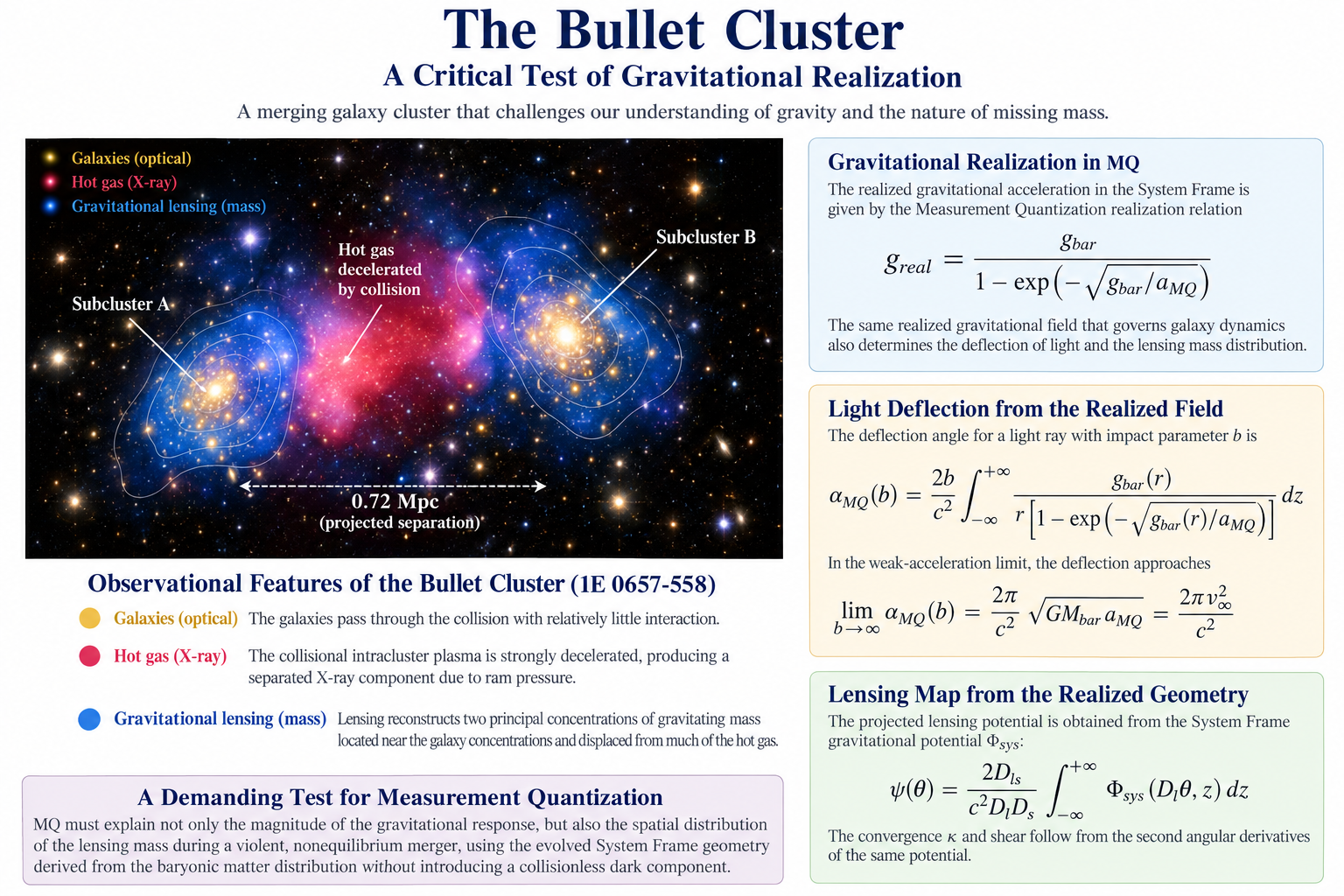
The Bullet Cluster, formally 1E 0657-558, makes this requirement particularly severe. It is a merger of two galaxy clusters observed at redshift z = 0.296. During the collision, the galaxies passed through the encounter comparatively freely while the electrically interacting intracluster plasmas experienced ram pressure and were strongly decelerated. Gravitational lensing reconstructs two principal concentrations of gravitating mass displaced from much of the X-ray-emitting gas and located substantially nearer the galaxy concentrations. The two principal cluster mass concentrations are separated by approximately 0.72 Mpc in projection.
This observation is one of the most important empirical arguments for collisionless dark matter. Under the standard interpretation, the galaxies and nonbaryonic dark matter pass through the collision with relatively little interaction while the plasma is slowed. The resulting separation between the dominant baryonic gas and the lensing reconstruction follows naturally if most cluster mass resides in collisionless dark matter.
Measurement Quantization (MQ) must confront exactly the same observation. It cannot explain the Bullet Cluster merely by noting that gravity can exceed the Newtonian response of the reconstructed baryonic mass. It must explain the spatial distribution of that response during a violent, nonequilibrium merger.
From galaxies to cluster lensing
The starting point is the same gravitational realization mechanism used by MQ at galactic scales. Let gbar denote the Newtonian acceleration calculated from the reconstructed baryonic mass, greal the realized gravitational acceleration in the System Frame, and aMQ the MQ acceleration scale. The stationary spherical realization relation is
greal = gbar / [1 - exp(-sqrt(gbar / aMQ))]
The significance of this expression extends beyond rotation curves. It does not introduce a second gravitating substance. Instead, the baryonic source establishes the gravitational availability while the Frames mapping determines how that gravitational response is realized in the System Frame. Consequently, the gravitational field inferred from dynamics need not correspond one-to-one with the Newtonian field calculated from the visible baryonic mass.
This distinction is central to the MQ interpretation of missing mass. In the conventional accounting, additional gravitational response is represented by additional matter. In MQ, the additional response arises from the realization of the gravitational geometry itself.
For an enclosed baryonic mass Mbar within radius R, the stationary realized source can be written using the realization fraction P as
Msys(< R) = Mbar(< R) / P(R)
where Msys is the enclosed realized gravitational source expressed in the System Frame. The corresponding stationary source density is
T00sys(R) / c2 = [1 / (4 pi R2)] d/dR [Mbar(< R) / P(R)]
Here T00sys is the time-time component of the realized System Frame stress-energy tensor and c is the speed of light.
These expressions identify an important conceptual difference between an MQ gravitational reconstruction and a conventional dark-matter reconstruction. Msys is not an independently assigned halo surrounding the baryonic matter. It is the gravitational source represented by the realized geometry derived from the matter action.
This same distinction must survive an independent relativistic observable. That observable is gravitational lensing.
Light must respond to the same realized gravity
A successful theory cannot use one gravitational mechanism for stellar motion and another for light. MQ therefore requires the same realized System Frame geometry responsible for galactic dynamics to determine gravitational lensing.
In spherical symmetry, let b denote the impact parameter of a light ray, z the coordinate along the line of sight, and r = sqrt(b2 + z2) the radial distance from the gravitating source. The MQ weak-field deflection generated by the realized gravitational field is
αMQ(b) = (2 b / c2) integral-infinity+infinity [greal(r) / r] dz
Substitution of the stationary realization law gives
αMQ(b) = (2 b / c2) integral-infinity+infinity {gbar(r) / [r (1 - exp(-sqrt(gbar(r) / aMQ)))]} dz
This is the important bridge between the galactic and lensing problems. The realization function is not inserted because lensing requires extra mass. The gravitational field entering the light-deflection integral is the same realized field obtained from the MQ gravitational construction.
In the asymptotic weak-acceleration limit, with G denoting the gravitational constant and Mbar the total baryonic mass, MQ gives
limb -> infinity αMQ(b) = (2 pi / c2) sqrt(G Mbar aMQ)
The asymptotic circular velocity vinfinity satisfies vinfinity4 = G Mbar aMQ, so the same result becomes
limb -> infinity αMQ(b) = 2 pi vinfinity2 / c2
Thus the asymptotic gravitational field that produces approximately flat galactic rotation curves also produces a nonvanishing lensing response. Rotation and lensing are not separate MQ hypotheses. They are different observables of the same realized gravitational geometry.
That connection is essential, but it is not yet the Bullet Cluster calculation.
From a deflection angle to a lensing map
A cluster observation is two-dimensional. The relevant comparison is therefore not merely a spherical deflection angle but the complete projected lensing potential and the convergence and shear fields derived from it.
Let Dl denote the angular-diameter distance to the lens, Ds the distance to the background source, Dls the distance from lens to source, θ the angular position on the sky, and Φsys the gravitational potential of the realized System Frame geometry. The projected lensing potential ψ is
ψ(θ) = [2 Dls / (c2 Dl Ds)] integral-infinity+infinity Φsys(Dl θ, z) dz
The angular deflection field is then α(θ) = ∇θ ψ(θ). The convergence κ, which describes the locally isotropic focusing of the image, follows from the second angular derivatives,
κ(θ) = (1 / 2) [∂2ψ / ∂θ12 + ∂2ψ / ∂θ22]
while the two shear components are determined by the complementary second derivatives of the same potential.
This is the observational level at which MQ must ultimately be tested against a merging cluster. Starting with independently reconstructed baryonic matter, the theory must produce Φsys, ray trace background sources through that geometry, and predict the resulting κ and shear maps. Those maps can then be compared directly with the maps inferred from strong and weak gravitational lensing.
The distinction is critical. A statement that MQ can generate enhanced gravity is not a prediction of the Bullet Cluster lensing morphology. The observed positions, amplitudes, and shapes of the lensing peaks constitute a substantially stronger test.
Why the Bullet Cluster is a dynamical problem
The stationary equations explain why the Bullet Cluster cannot be treated as two oversized equilibrium galaxies. During the collision, the baryonic distribution changes rapidly. Gas is shocked and decelerated, galaxies continue through the encounter, and the gravitational configuration evolves in three dimensions.
MQKB498 therefore formulates the cluster collision at the action level.
Let gμνsys(x,t) denote the emergent System Frame metric at spacetime position (x,t), Gμνsys its Einstein tensor, Λsys the System Frame cosmological term, and Tμνsys(x,t) the stress-energy tensor obtained by metric variation of the realized matter action under the MQ variational principle. The macroscopic field equation is
Gμνsys[gsys(x,t)] + Λsys gμνsys(x,t) = (8 pi G / c4) Tμνsys(x,t)
with local conservation
∇μ Tμνsys(x,t) = 0
This is the equation that matters for a strongly nonlinear cluster collision. The equilibrium realization law is recovered as a stationary spherical consistency condition. It is not substituted for the nonlinear evolution.
That point prevents an important conceptual error. MQ does not introduce a conventional baryonic stress-energy tensor and then append an artificial "effective dark matter" distribution wherever additional gravity is needed. The observed gas and galaxy phase-space distributions constrain the material fields entering the realized matter action. The resulting Tμνsys and gμνsys must emerge from that construction.
Causality does not provide an adjustable gravitational lag
One superficially attractive explanation for the Bullet Cluster would be to suppose that gravity simply remains behind after the baryonic matter moves. MQKB498 specifically rules out treating such a long-lived lag as a free mechanism.
In the weak-field harmonic-gauge limit, let hμνsys denote the trace-reversed metric perturbation and square denote the flat-background wave operator. The field equation becomes
square hμνsys(x,t) = -(16 pi G / c4) Tμνsys(x,t)
with the corresponding retarded solution determined by the source evaluated at the causal retarded time t - |x - x'| / c.
For a projected scale of approximately 720 kpc, the light-crossing time is only about 2.35 million years. Hydrodynamic modeling of the Bullet Cluster distinguishes the velocity of the bow shock from the velocity of the subcluster mass centroid. The often quoted shock speed near 4500-4700 km/s is not the translational velocity of the gravitating subcluster. Detailed merger calculations can obtain the observed shock with a subcluster centroid speed closer to 2600-2700 km/s because the upstream gas is already falling inward and the shock propagates faster than the subcluster itself.
At approximately 2600-2700 km/s, traversing 720 kpc requires roughly 261-271 million years, more than two orders of magnitude longer than the light-crossing time.
A causal propagation delay therefore cannot preserve a gravitational field hundreds of kiloparsecs behind its source for the duration of the encounter. If MQ ultimately reproduces the Bullet Cluster offsets, the effect must arise from the evolved spatial structure of the realized stress-energy and nonlinear System Frame metric. It cannot be supplied by an arbitrary gravitational memory time.
This makes the MQ proposal more restrictive, not less.
What the observation requires MQ to reproduce
The Bullet Cluster presents three physically distinct distributions. The galaxies are approximately collisionless during the encounter. The dominant baryonic plasma is collisional and is displaced by ram pressure. The lensing reconstruction identifies where the projected gravitational curvature is concentrated.
Under Lambda-CDM, the separation is interpreted as the direct spatial separation of collisionless dark matter from collisional baryonic plasma. This remains the standard interpretation and is supported by strong- and weak-lensing reconstructions of 1E 0657-558.
MQ proposes a different physical ontology. The lensing reconstruction is not assumed to be a literal map of an unseen material substance. It is a reconstruction of the gravitational geometry required to produce the observed lensing. The question is therefore whether the evolving realized System Frame geometry generated by the independently specified baryonic merger can develop gravitational-curvature peaks in the observed locations even though most of the baryonic mass in the hot gas occupies different locations.
That proposition is substantially stronger than reproducing an integrated cluster mass.
It requires the initial gas and galaxy distributions, their velocities, the collision geometry, the action-derived realized source, and the nonlinear metric evolution to generate the correct two-dimensional lensing morphology without introducing a collisionless dark component or fitting an independent cluster-specific realization law.
The Bullet Cluster is therefore a falsification test
The effective mass of a galaxy and the broader MQ treatment of gravity establish how gravitational response can differ from a simple Newtonian inference from visible mass. The unification of gravitational and electromagnetic phenomena provides the deeper MQ context in which that response arises through the mapping of measure rather than through the addition of an unseen gravitational substance.
Galaxy clusters demand more.
The decisive calculation begins with observationally constrained baryonic initial conditions for a merger such as 1E 0657-558. Those data must be evolved with the nonlinear MQ field equations. The resulting System Frame metric must then be used for ray tracing. From that calculation must follow the predicted convergence, shear, critical curves, and lensing centroids.
No lens-specific dark halo may be added after the fact. No arbitrary gravitational delay may be introduced. No cluster-specific value of aMQ may be selected to force agreement. The same underlying realization structure must remain consistent with the galactic dynamics from which its stationary weak-field behavior was established.
MQKB498 does not yet contain that completed numerical experiment.
Accordingly, the Bullet Cluster should not presently be described as observational confirmation of MQ. MQ supplies the action-level dynamical framework, the stationary consistency relation, the weak-field causal limit, and the lensing observables required to formulate the test. The nonlinear merger evolution and parameter-frozen comparison with the measured Bullet Cluster convergence and shear maps remain to be performed.
That unresolved calculation is scientifically valuable precisely because the outcome is not guaranteed.
If the evolved MQ metric places the principal lensing curvature near the observed galaxy concentrations while reproducing the measured lensing amplitudes and morphology from independently constrained baryonic initial conditions, the result would demonstrate that the famous separation between X-ray gas and lensing mass does not uniquely require a collisionless material component.
If it instead forces the gravitational curvature to remain associated with the dominant X-ray plasma, or fails to reproduce the observed convergence and shear without additional free parameters, the Bullet Cluster would expose a direct limitation of the MQ gravitational construction.
The Bullet Cluster is therefore not a peripheral application of Measurement Quantization. It is one of its most consequential outstanding tests. Galaxy rotation curves ask whether the magnitude of gravitational realization is correct. Gravitational lensing asks whether the relativistic geometry is correct. The Bullet Cluster asks the harder question of whether that geometry evolves to the correct place.

8: Resolving the Hubble tension 68.261 and 73.510 km s Mpc
International Journal of Geometric Methods in Modern Physics
7: Measurement Quantization
Journal of High Energy Physics, Gravitation and Cosmology
6: Physically Significant Units of Measure
5: Measurement Quantization Unites Classical and Quantum Physics
4: Quantum Model of Gravity Unifies Relativistic Effects, Describes Inflation/Expansion Transition, Matches CMB Data
3: Measurement Quantization Accounts for Galactic Rotational Velocities and Obviates Dark Matter
2: Measurement Quantization Describes History of Universe -
Quantum Inflation, Transition to Expansion, CMB Power Spectrum
International Journal of Theoretical and Mathematical Physics
1: Measurement Quantization Describes the Physical Constants