

Discrete Approach to the Contraction and Dilation of Measure relative to an inertial frame
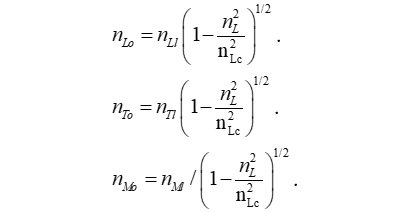
In MQ Form
Contraction and dilation expression with respect to an inertial frame written in terms of counts of the fundamental measures.
Definitions and concordance analysis
Calculations

Discussion
Einstein’s approach to describing the contraction and dilation of measure differs from that when using Measurement Quantization (MQ). So, what has changed?
Frames of reference. Einstein envisioned classical behavior as a non-discrete function of two frames, that of the observer and that being observed. This is sometimes described with respect to a train moving down tracks, such that we consider what is experienced by an observer on the train relative to an observer standing near the tracks. This model of understanding has served well with incredible precision.
One would think there was nothing more that could be added to improve such a model. But there is where we consider the MQ framework. MQ utilizes and expanded classical nomenclature. That is, we describe phenomena as a function of fundamental measures lf, mf, and tf and counts of those measures, nL, nM, and nT. We also recognize three frames of reference, discrete Reference Frame of the observer, the discrete Internal Frame of the universe and the non-discrete System Frame of the universe. And where the notions of length, mass and time are shown to be a discrete function of fundamental references, we can demonstrate that measure is both discrete and countable with respect to the Internal Frame.
It follows by the same physical support that the frame of the universe must be non-discrete, in that the universe can have no external reference.
One approach to verifying these claims regards a new form of length contraction not related to relativity. We call this effect the Informativity differential. It is resolved as the non-discrete portion of the hypotenouse of a right-angle triangle as resolved with a more precise calculation of sides a and b. This effect has been published, physically demonstrated using existing data from CODATA publications in 2010, 2014, and 2018.
With this foundation, we approach relativity in a very different fashion. We begin with the Pathagorean theorem, such that the first term describes the maximum range of possible values, the second term describes the minimum range of possible values and the final term describes unity. All terms are correlated to their count bound.

With respect to the observed frame, a (i.e. the count change in distance nLl) can take any value from 0 to nmax. With respect to the local frame, b (i.e. nLo) can take any value from 0 to nmin. The result is an expression that describes all possible events with respect to length and motion.

We can for convenience also introduce the fundamental measures back into the expressions, thus removing some of the count terms. The expressions match Einstein’s with one important difference; these expressions are discrete. Recognition of count bounds is essential to avoiding singularities as so commonly occur in classical theory.
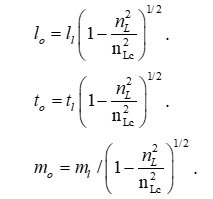
We bring a final observation to the attention of the reader. Singularities cannot occur with respect to an MQ description of nature. Such that all counts are physically significant where integer, equal or greater than one, we are not afforded with the opportunity for singularities.

8: Resolving the Hubble tension 68.261 and 73.510 km s Mpc
International Journal of Geometric Methods in Modern Physics
7: Measurement Quantization
Journal of High Energy Physics, Gravitation and Cosmology
6: Physically Significant Units of Measure
5: Measurement Quantization Unites Classical and Quantum Physics
4: Quantum Model of Gravity Unifies Relativistic Effects, Describes Inflation/Expansion Transition, Matches CMB Data
3: Measurement Quantization Accounts for Galactic Rotational Velocities and Obviates Dark Matter
2: Measurement Quantization Describes History of Universe -
Quantum Inflation, Transition to Expansion, CMB Power Spectrum
International Journal of Theoretical and Mathematical Physics
1: Measurement Quantization Describes the Physical Constants