

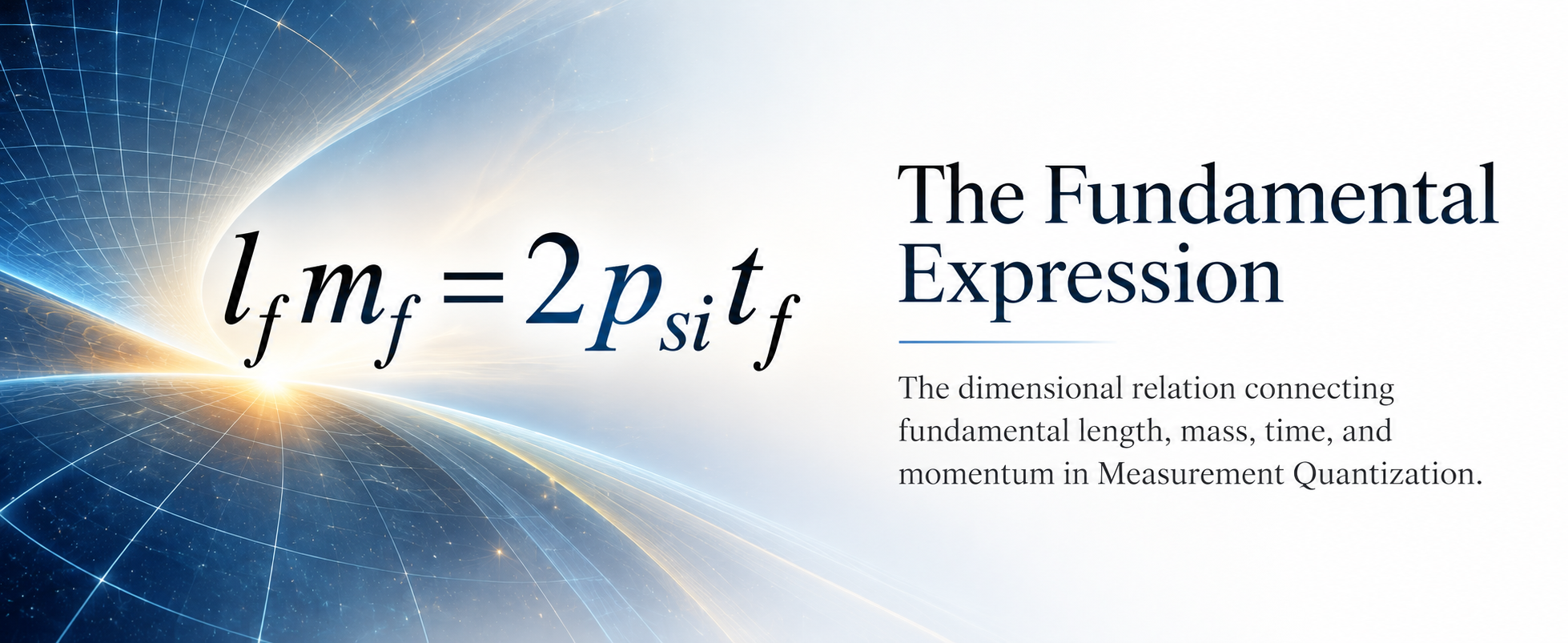







THE FUNDAMENTAL EXPRESSION
The fundamental expression is the compact dimensional relation connecting Measurement Quantization's three fundamental measures: fundamental length , fundamental mass , and fundamental time . In its dimensionally explicit form, the relation is written using the momentum realization :
Here is the dimensional momentum realization associated with the invariant scalar . The distinction preserves dimensional consistency. The left side has dimensions of mass times length, and the right side has the same dimensions because momentum multiplied by time is mass times length.
mq-aside mq-aside-title Why the momentum realization matters
Earlier presentations sometimes placed directly in the fundamental expression. The dimensionally explicit formulation separates the invariant scalar from its physical momentum realization. The scalar and the momentum quantity are related through realization, but they are not identified as quantities with the same dimensions. This distinction allows the fundamental expression to retain a conventional dimensional reading while preserving the underlying count structure.
The momentum realization is defined by , where denotes the reduced Planck constant at the upper count limit. Multiplying the first equality by returns the fundamental expression directly.
The fundamental measures are closely related to the conventional Planck units, but they play a different theoretical role here. For the Planck correspondence developed on this page, the reduced Planck constant and gravitational constant are evaluated at the upper count limit and are therefore written upright as and . Together with , these recover the familiar Planck length, Planck mass, and Planck time structure. Measurement Quantization instead develops its fundamental measures within a discrete measurement framework and then recovers the familiar Planck structure as a consequence. The conventional relations therefore serve as an important correspondence rather than as the starting definition of the fundamental measures.
At the upper count limit, the momentum realization can also be written . The same structure gives , , and . These are mutually consistent expressions of the same dimensional structure, not additional independent assumptions.
PLANCK CORRESPONDENCE
The connection to the conventional Planck construction follows by equating the two upper-count expressions for . The central equality is sufficiently important to display explicitly:
mq-equation
Solving this exact equality for fundamental length gives , the conventional Planck-length structure expressed through . Together with and , it reproduces the familiar Planck-time and Planck-mass structure. Further discussion is available on the Newton and Planck Constants and Fundamental Measures pages.
mq-aside mq-aside-title What the correspondence establishes
The algebraic recovery of the Planck relations establishes consistency between the fundamental measures and the conventional Planck construction. It does not by itself establish the physical interpretation proposed by Measurement Quantization. The additional content lies in the count-based origin assigned to the measures and in the distinction between finite-count realizations and their upper-count limits.
MEASURE AND COUNT
The fundamental expression becomes more informative when measure is distinguished from count. The measures , , and establish the dimensional reference units. Their associated counts specify how many fundamental units participate in a particular physical realization.
This distinction is central to the relationship between the Internal Frame and the System Frame. The Internal Frame describes discrete count relations. Through the Frames mapping, those relations are realized in the System Frame as dimensional physical quantities. The discrete structure therefore applies to measure and count in the Internal Frame, while observable dimensional quantities are expressed through their realization in the System Frame.
The defining relation between fundamental length and fundamental time is compact enough to remain inline: . Likewise, the fundamental mass-to-time ratio is . Counts extend these reference measures to physical intervals without changing the underlying dimensional units.
mq-aside mq-aside-title Finite count and upper-count notation
A fundamental measure specifies the size of the reference unit, while a count specifies how many such units participate in a realization. The notation also distinguishes the realization regime. At finite count, including the electromagnetic demarcation, the reduced Planck constant and gravitational coupling are written in italics together. Their count-resolved forms are and . At the upper count limit, both symbols are written upright. Keeping the pair typographically consistent prevents a finite-count realization from being confused with its limiting value.
At the upper count limit, the count geometry approaches its limiting realization. This is the regime in which the upright forms of and used in the Planck correspondence are obtained. The distinction is especially important for the gravitational constant, where the finite-count gravitational coupling is distinguished from its upper-count-limit value.
FROM THE FUNDAMENTAL EXPRESSION TO THE PHYSICAL CONSTANTS
The fundamental expression is more than a relation among three very small units of measure. It supplies the dimensional bridge between the fundamental measures and the momentum realization . That bridge is then used when physical constants and count-dependent relations are expressed through the fundamental measures.
The reduced Planck constant provides the most direct example. At the upper count limit, both and are upright. In that regime, the relation between , the momentum realization, and the fundamental measures is
mq-equation
Conversely, substituting this expression into the conventional Planck-length relation returns . The two descriptions therefore close algebraically on the same fundamental measures.
Gravitation provides the corresponding upper-count relation . At finite count, gravitational coupling depends on the realized count geometry rather than being identified with this limiting form. The derivation and physical implications of that distinction are developed on the Gravitational Constant and Gravity pages.
The structural role of the fundamental expression can now be stated precisely. The fundamental measures establish dimensional scale, their counts establish discrete resolution in the Internal Frame, provides the dimensional momentum realization associated with the invariant scalar, and the Frames mapping carries the count structure into its physical realization in the System Frame. The resulting relations connect the discrete description of measure to the familiar Planck construction without treating the Planck units themselves as the underlying explanation.

8: Resolving the Hubble tension 68.261 and 73.510 km s Mpc
International Journal of Geometric Methods in Modern Physics
7: Measurement Quantization
Journal of High Energy Physics, Gravitation and Cosmology
6: Physically Significant Units of Measure
5: Measurement Quantization Unites Classical and Quantum Physics
4: Quantum Model of Gravity Unifies Relativistic Effects, Describes Inflation/Expansion Transition, Matches CMB Data
3: Measurement Quantization Accounts for Galactic Rotational Velocities and Obviates Dark Matter
2: Measurement Quantization Describes History of Universe -
Quantum Inflation, Transition to Expansion, CMB Power Spectrum
International Journal of Theoretical and Mathematical Physics
1: Measurement Quantization Describes the Physical Constants