

TERMS INPUTS SYMBOLS CONDORDANCE ANALYSIS
—————————— read pre-print on research gate (new window) ——————————
Quantum Entanglement
Entanglement as a Non-Factorizable Realization of Conserved Measurement Availability
Quantum entanglement is one of the clearest demonstrations that quantum correlations cannot, in general, be understood as independent properties carried separately by distant objects. When two systems are prepared jointly and measured under appropriately chosen settings, their outcomes can exhibit correlations that violate a Bell inequality. Experiments have repeatedly confirmed these correlations. What remains conceptually difficult is explaining how the correlations arise without either reducing the phenomenon to a classical common cause or interpreting the result as a controllable influence propagating between distant measurements.
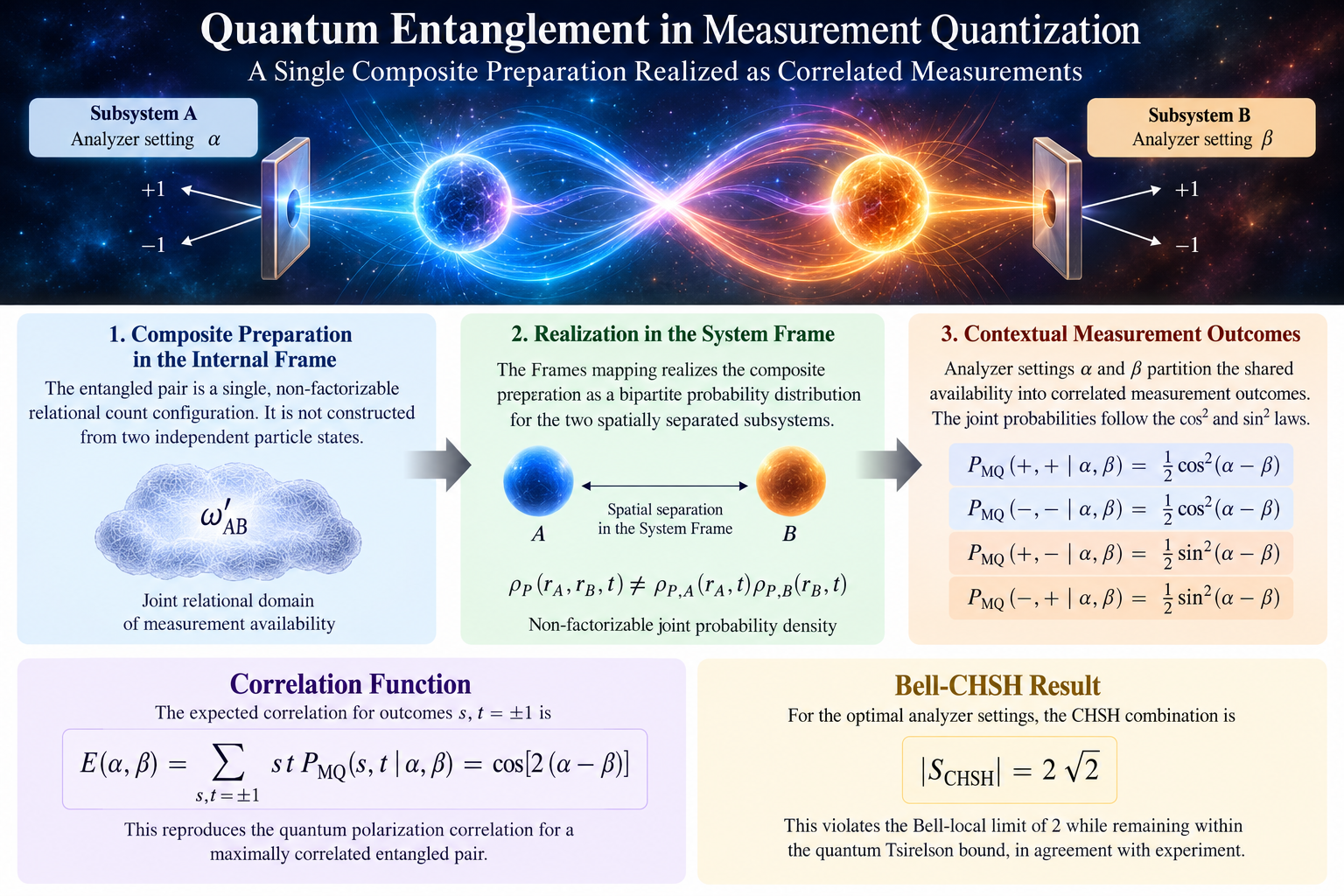
Measurement Quantization (MQ) approaches this problem from a different starting point. Entanglement is not introduced as a special interaction between two already independent particles. Nor is a nonlocal signal added to the theory. Instead, an entangled preparation begins as one composite count configuration in the Internal Frame. The observable subsystems, their spatial separation, analyzer orientations, and recorded outcomes arise only after this relational count structure is realized through the Frames mapping in the System Frame.
This distinction changes the physical question. MQ does not ask how one spatially separated particle instantaneously communicates a measurement result to another. It asks how a single non-factorizable preparation is resolved into spatially separated measurement records when the underlying preparation is not itself defined by those System Frame spatial coordinates.
That distinction is central to the MQ treatment of entanglement.
The Composite System Comes First
The primitive MQ description is discrete, relational, and pre-probabilistic. Consider two subsystems conventionally labeled A and B. Their joint preparation is represented by an Internal Frame relational domain ω'AB. A relational cell within that domain is ξAB, while nI(ξAB,A) denotes the nonnegative integer measurement availability count associated with that cell at Internal Frame update index A.
The essential point is that ω'AB is a joint domain. It is not constructed by first assigning independent physical states to A and B and then adding a correlation between them. The composite count configuration is primary.
Under the Frames mapping, the relational domain is realized as a bipartite System Frame domain ΩAB. When this realized measure admits a density representation, let ρS(rA,rB,t) denote the joint encoded availability density, where rA and rB are the realized coordinates of the two subsystems and t labels the realized temporal coordinate.
The total mapped availability N2(t) is the integral of this density over the bipartite configuration space. Normalization then produces the joint probability density ρP(rA,rB,t).
Entanglement appears when this normalized joint structure cannot be decomposed into the product of its subsystem marginals:
ρP(rA,rB,t) ≠ ρP,A(rA,t)ρP,B(rB,t)
Here ρP,A and ρP,B are the normalized marginal probability densities associated with subsystems A and B. This non-factorizability is the central MQ expression describing an entangled preparation.
It is important not to overinterpret this relation. Non-factorizability alone does not derive the experimentally observed angular dependence of Bell correlations. It establishes something more basic. The complete realized probability structure cannot generally be reconstructed from independent probability structures assigned to the two subsystems.
The correlation therefore belongs to the composite preparation.
Why Spatial Separation Does Not Split the Preparation
Ordinary intuition encourages us to imagine two particles separating in space while each carries a complete local specification of what it will later do. Bell's theorem shows why that picture cannot reproduce all quantum predictions when the relevant assumptions, including Bell-local factorization and measurement independence, are imposed.
MQ does not attempt to restore that picture.
The reason follows directly from the distinction between the Internal Frame and System Frame. Distance, orientation, and ordinary spacetime coordinates belong to the realized System Frame. The primitive Internal Frame configuration is relational and contains no intrinsic spatial metric assigning a conventional distance between the two components of the preparation.
Consequently, increasing the realized distance between detectors does not transform the original joint count configuration into two independent primitive configurations. Spatial separation is a property of the realized description. It is not an operation that factorizes the underlying preparation.
This does not mean that MQ dismisses locality. It means that several different concepts often grouped under the word "locality" must be kept separate.
MQ requires adjacency-local redistribution of conserved count structure in the Internal Frame. It also reproduces operational no-signaling in the System Frame. But it does not claim Bell local causality for the realized joint outcome statistics. Bell local causality would require a stronger factorization of the joint probabilities conditioned on a complete Bell hidden state. The MQ construction is not built from such local response functions.
Measurement Settings Define Contextual Partitions
Suppose the two analyzers have settings a and b. Each measurement has two possible output labels, conventionally represented by s,t = ±1. These labels are bookkeeping devices for the two measurement channels. They are not assumed to be values possessed by the systems before measurement.
The settings define a contextual partition of the joint availability into four mutually exclusive outcome regions corresponding to ++, +-, -+, and --.
Let Nstab(t) denote the encoded availability assigned to joint outcome st for analyzer settings a and b. The total contextual availability is Nabtot(t), obtained by summing the four joint outcome counts.
The realized MQ probability of a joint outcome is then
PMQ(s,t|a,b) = Nstab(t) / Nabtot(t)
This equation is particularly important because it shows where probability enters the entanglement description. Probability is not a primitive field assigned to the Internal Frame. It arises by normalization of realized contextual availability.
The analyzer settings therefore do not rewrite the prior preparation. They determine how the shared preparation is partitioned into distinguishable System Frame outcomes.
This preserves measurement independence in the MQ Bell construction. The source preparation is fixed before the analyzer settings are selected. The settings enter later as contextual partition choices. Thus, dependence of PMQ(s,t|a,b) on a and b is measurement-context dependence of the realized partition, not statistical dependence of the earlier preparation on settings chosen afterward.
Entanglement Does Not Require Predetermined Outcomes
This structure also separates MQ determinism from classical hidden-variable determinism.
MQ describes deterministic redistribution of encoded availability within the Internal Frame. It does not assert that every eventual System Frame outcome existed beforehand as a predetermined value.
That distinction matters.
A completed measurement context partitions the available realization structure into mutually exclusive record classes. Realization produces one stable record from that completed interaction. Across repeated identically prepared trials, normalized contextual availability determines the distribution of those records.
Thus, what evolves deterministically in the primitive description is not a secret list of future detector answers. It is the conserved availability structure from which contextual measurement records are realized.
This is why the broader MQ treatment of determinism and quantum behavior does not reduce entanglement to a conventional local hidden-variable model.
From Joint Availability to Bell Correlations
Non-factorizability explains why the two subsystems cannot generally be treated as statistically independent. A complete Bell treatment must go further. It must recover the experimentally observed dependence of the correlations on analyzer orientation.
MQ derives this angular response from the already established two-channel amplitude representation.
For an ideal lossless polarization analyzer, let α and β denote the two analyzer-axis angles in the realized System Frame, and define their relative angle Δ = α - β. Let η+(Δ) and η-(Δ) denote the real coefficients of the two mutually exclusive analyzer channels after removal of their common phase.
Conservation of total mapped availability requires the two-channel norm to remain unity. A pure change of analyzer orientation must therefore preserve
η+2(Δ) + η-2(Δ) = 1
Let U(Δ) denote the transformation acting on this two-channel amplitude. The MQ derivation requires that U(0) be the identity, that successive physical rotations compose by addition of their angles, that the transformation preserve the normalized two-channel norm, and that physical analyzer rotation be continuous.
These requirements place the transformation in the continuous orientation-preserving norm-preserving rotation group of the two-dimensional real channel space. The channel coefficients therefore resolve as cos(Δ) and sin(Δ), up to an outcome-irrelevant sign convention.
Because the MQ amplitude coefficient is already the square-root representation of normalized mapped availability, the corresponding channel probabilities become cos2(Δ) and sin2(Δ).
This point is conceptually significant. Within the MQ derivational chain, the squared-angle law is not inserted independently as Malus' law and is not added as a separate Born-rule assumption at this stage. It follows from the previously derived probability identification together with continuous norm-preserving rotation of the normalized two-channel System Frame amplitude.
For the symmetric maximally correlated polarization preparation, the equal-outcome channels therefore carry
PMQ(+,+|α,β) = PMQ(-,-|α,β) = (1 / 2 ) cos2(α - β)
while the unequal-outcome channels carry
PMQ(+,-|α,β) = PMQ(-,+|α,β) = (1 / 2 ) sin2(α - β)
The four probabilities sum to unity, but they are not products of independent local probabilities.
The dichotomic correlation follows by weighting each joint outcome with the product st of its ±1 labels:
E(α,β) = ∑s,t=±1 st PMQ(s,t|α,β) = cos[2 (α - β)]
This is the MQ polarization correlation function.
The importance of the result is not simply that MQ reproduces a familiar quantum expression. The derivational path is different. The angular dependence follows from conserved composite availability, realization through the Frames mapping, contextual partitioning, normalization, and continuous norm-preserving rotation of the resulting two-channel amplitude.
The Bell-CHSH Test
Bell's theorem establishes that measurement-independent theories satisfying the relevant Bell-local factorization condition cannot reproduce all quantum correlations. The Clauser-Horne-Shimony-Holt formulation expresses the constraint through four correlation measurements.
Let a and a' denote two analyzer settings available to the first measurement station, and b and b' two settings available to the second. The CHSH combination SCHSH is constructed from the four corresponding correlations.
Using the MQ-derived polarization correlation E(α,β) = cos[2 (α - β)] and the conventional optimal analyzer settings, MQ obtains
|SCHSH| = 2 √2
The Bell-local CHSH limit is 2, whereas 2 √2 is the quantum Tsirelson bound. The MQ construction therefore reproduces the Bell-violating correlation strength of the ideal quantum polarization benchmark.
This correspondence should be stated carefully. MQ does not evade Bell's theorem. It reproduces statistics that violate Bell-local factorization while retaining measurement independence and operational no-signaling. Bell's theorem remains fully applicable as a constraint on any attempted measurement-independent Bell-local hidden-variable completion of those statistics.
This distinction is essential. The MQ explanation is not that Bell's theorem somehow fails because the primitive description is discrete. Discreteness by itself is insufficient. The relevant MQ structure is the combination of a composite non-factorizable preparation, contextual realization under the Frames mapping, and normalized joint outcome partitions.
No-Signaling Without Bell Factorization
Entanglement correlations are stronger than correlations available to a Bell-local factorized model, but they cannot be used to transmit controllable information faster than light.
MQ reproduces this operational no-signaling property through the marginals of its contextual availability counts.
When the outcome at the distant analyzer is summed over, the local probability depends only on the local analyzer setting. In MQ notation,
∑t=±1 PMQ(s,t|a,b) = PMQ(s|a)
and similarly for the other subsystem. Changing b therefore does not change the observable marginal distribution at the detector using setting a.
At the same time,
PMQ(s,t|a,b) ≠ PMQ(s|a)PMQ(t|b)
in the entangled case.
These two statements are entirely compatible. The first expresses operational no-signaling. The second expresses non-product joint statistics. Neither should be substituted for the other.
This is one of the most useful conceptual consequences of the MQ construction. What appears paradoxical when the experiment is imagined as two independent objects exchanging influences becomes structurally different when the preparation is recognized as a single joint relational object whose realized marginals are spatially separated but whose joint probability measure remains non-factorizable.
What Happens When One Side Is Measured?
The language of "instantaneous collapse" can suggest that measurement at one detector physically travels across space and changes the distant system.
MQ does not require such a process.
Before completion of the measurement, the composite encoded availability remains distributed across the admissible outcome structure. Measurement restricts the realized System Frame representation to the outcome partition associated with the completed record and renormalizes the representation used for subsequent predictions.
The underlying conserved Internal Frame count structure is not replaced by a wave function physically collapsing through space.
For an entangled pair, conditioning on one observed result changes the conditional description of the joint realized system because both records are drawn from the same non-factorizable availability structure. This is a change in conditioned access to the shared realization structure, not a superluminal dynamical signal sent from one detector to the other.
The distinction mirrors the more general MQ solution to the quantum measurement problem. The primitive count structure, the normalized predictive encoding, and the completed realized record are different layers of description. Conflating them creates much of the apparent paradox.
Why Entanglement Is Natural in MQ
From the perspective of classical mechanics, entanglement appears exotic because classical modeling encourages separability. A composite system is ordinarily expected to be completely describable through the states of its constituent parts together with their interactions.
MQ reverses the order of construction.
The primitive description is relational. A composite preparation can therefore contain physically relevant joint count structure that has no decomposition into independent subsystem measures. The separate particles are recognizable as separate realized subsystems in the System Frame, but that does not imply that the earlier relational preparation was assembled from independent primitive states.
Entanglement is therefore not an additional force, field, or communication mechanism in MQ. It is the realized statistical signature of a composite count structure that was never factorizable in the first place.
This also explains why the Frames mapping is indispensable but insufficient by itself. A non-injective mapping can explain why a realized observable need not preserve every detail of the primitive count configuration. It cannot, on its own, determine the Bell correlation. The observed structure additionally requires the non-factorizable composite availability, the contextual outcome partition, normalization, and the analyzer-response relation derived from norm-preserving rotation.
That stronger chain is what distinguishes the present MQ account from the much simpler statement that hidden information is lost during realization.
A Different Meaning of Quantum Nonlocality
Quantum entanglement is often described loosely as "nonlocal." That word can conceal several mathematically distinct statements.
Bell experiments exclude the relevant class of measurement-independent Bell-local factorizable explanations. They do not demonstrate controllable faster-than-light communication. MQ consequently avoids describing entanglement as a superluminal force.
Instead, the framework places the non-factorizable structure before ordinary spacetime separation enters the description.
The Internal Frame is not a hidden copy of ordinary three-dimensional space. It is the relational domain in which conserved measurement availability is defined. The System Frame is where metric separation, analyzer orientation, detector location, and observable records are realized. Asking how quickly an Internal Frame joint count configuration communicates across a System Frame distance therefore mixes structures belonging to different descriptive levels.
This does not make the Bell correlations local in Bell's technical sense. MQ explicitly does not claim that. It explains why the absence of Bell factorization need not be interpreted as a controllable signal propagating between the two measurement stations.
The distinction is subtle but fundamental.
Entanglement as a Test of the MQ Architecture
Entanglement provides an unusually stringent test of Measurement Quantization because several independent parts of the framework must work simultaneously.
The primitive count description must support a genuinely composite preparation. The Frames mapping must realize that preparation without forcing factorization. Normalization must generate consistent joint probabilities. Contextual partitions must produce exclusive stable records. Marginalization must preserve operational no-signaling. The two-channel amplitude representation must generate the observed analyzer-angle dependence. Finally, the resulting correlation must violate the Bell-local CHSH bound while remaining within the quantum Tsirelson limit.
The resulting chain is therefore considerably stronger than simply reproducing an entangled wave function.
In the ideal polarization benchmark, MQ proceeds from conserved joint measurement availability to non-factorizable realized probability, from normalized availability to two-channel amplitude, from continuous analyzer rotation to squared-angle outcome weights, and from those weights to
E(α,β) = cos[2 (α - β)]
and ultimately
|SCHSH| = 2 √2
The final expressions agree with the standard quantum prediction, but the physical interpretation is different. Entanglement is not treated as evidence that two independently complete objects mysteriously coordinate across space. It is the observable consequence of resolving a single composite relational preparation into spatially separated records.
That is the central MQ insight. The measured systems may be spatially separate in the System Frame without their preparation ever having been physically factorizable in the Internal Frame.
The distinction connects quantum entanglement directly to the broader MQ description of frames of reference, determinism and quantum behavior, and the foundational Measurement Quantization framework. The current count-based quantum measurement derivation, including its Bell construction and measurement-conditioning analysis, is also available through the Institute's externally archived research record: Measurement Quantization: A Count-Based Resolution of the Quantum Measurement Problem.

8: Resolving the Hubble tension 68.261 and 73.510 km s Mpc
International Journal of Geometric Methods in Modern Physics
7: Measurement Quantization
Journal of High Energy Physics, Gravitation and Cosmology
6: Physically Significant Units of Measure
5: Measurement Quantization Unites Classical and Quantum Physics
4: Quantum Model of Gravity Unifies Relativistic Effects, Describes Inflation/Expansion Transition, Matches CMB Data
3: Measurement Quantization Accounts for Galactic Rotational Velocities and Obviates Dark Matter
2: Measurement Quantization Describes History of Universe -
Quantum Inflation, Transition to Expansion, CMB Power Spectrum
International Journal of Theoretical and Mathematical Physics
1: Measurement Quantization Describes the Physical Constants