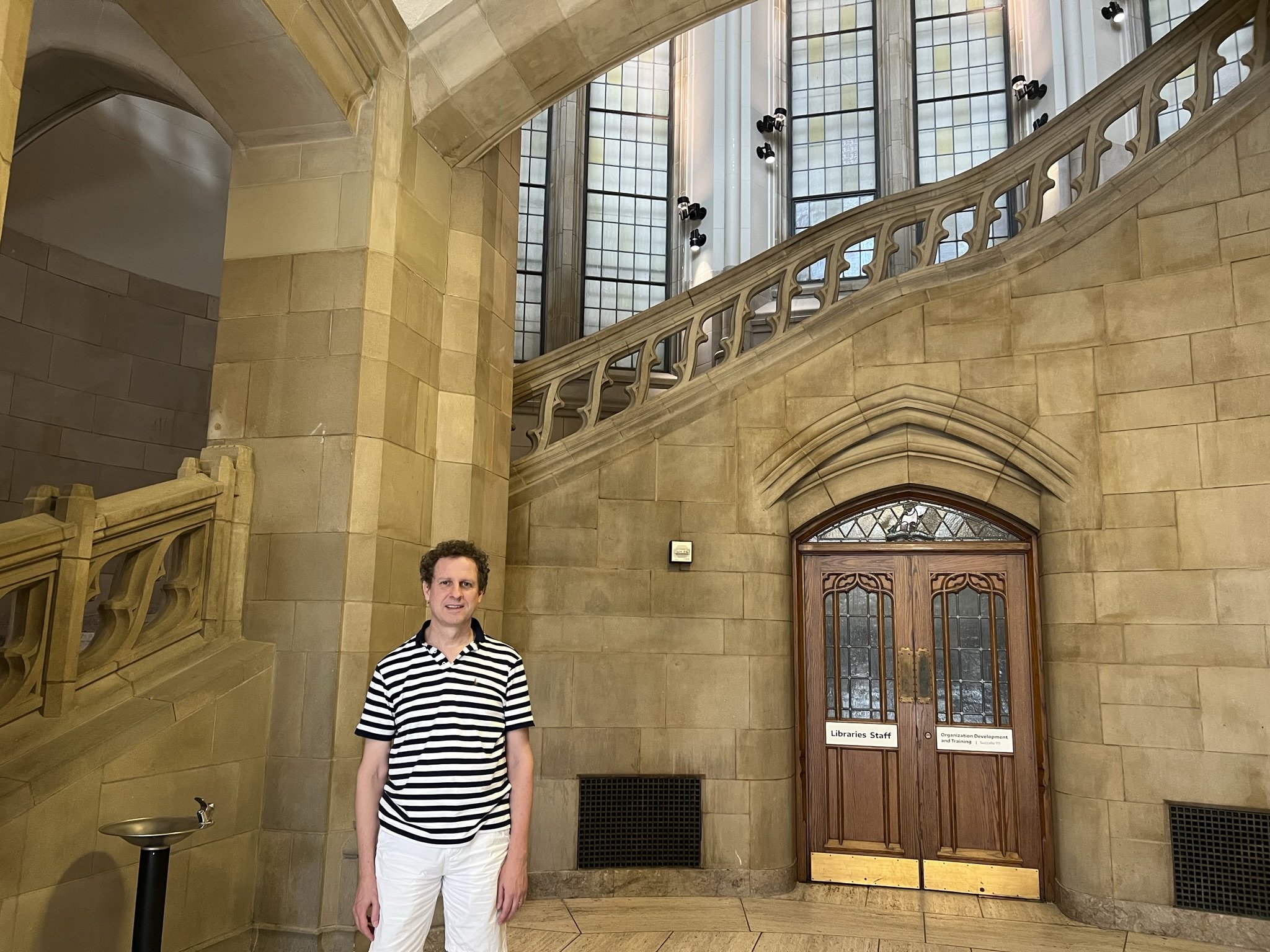

Jody Geiger (BIO)
Jody A. Geiger is an independent theoretical researcher and cofounder of the Informativity Institute. His research centers on Measurement Quantization (MQ), a first principles framework investigating whether physical measure, spacetime geometry, gravitation, and quantum behavior can be derived from an underlying discrete relational structure.
Geiger began his studies at the University of Florida in astronomy, intending to pursue theoretical astrophysics. During his first year, he worked as a research assistant to Dr. John E. Merrill on the binary-star system V1143 and discussed foundational questions in gravitation and physical description with Dr. James Ipser. These early investigations developed into a broader research program that Geiger later called Informativity.
In his fourth year, Geiger changed his major to English to study referential systems and the theory of knowledge. This work concerned how observations acquire meaning through their relationships to other observations, including their ordering in elapsed time. He completed his undergraduate studies in 1992 and entered the information technology and financial services industries, eventually serving for nearly a decade as Chief Data Officer of an investment management company with approximately $20 billion in capital under management. Throughout this period, he continued independent research into gravitation, measurement, and the mathematical foundations of physical theory.
Measurement Quantization
In 2016, Geiger developed a discrete formulation of gravitational curvature that became the foundation of Measurement Quantization.
MQ distinguishes between two complementary descriptions of physical phenomena:
the Internal Frame, a dimensionless and vectorless configuration domain in which conserved counts and relational configurations are defined; and
the System Frame, the realized physical domain in which measurable lengths, masses, times, velocities, fields, and other observables exist.
Observable physical quantities arise through the Frames mapping between these descriptions. The research investigates whether familiar physical laws and constants can be understood as realized expressions of this deeper count structure rather than as independent empirical inputs.
The resulting program now extends across fundamental measure, gravitation, electromagnetism, quantum foundations, galactic dynamics, and cosmology.
Principal Research Accomplishments
Fundamental measure and physical constants
MQ derives related fundamental measures of length, mass, and time from a common physical construction. These measures are then used to develop first principles expressions for several quantities ordinarily introduced through measurement or definition, including: the fine structure constant; elementary charge; the electric constant; the magnetic constant; Coulomb’s constant; the gravitational constant; the reduced Planck constant; and the Hubble constant.
The electromagnetic derivations distinguish source quantities from comparison quantities so that algebraically dependent agreement is treated as closure or internal-consistency evidence rather than incorrectly presented as an independent prediction.
Among the individual 2022 CODATA comparisons, the MQ elementary charge solution is reported at approximately 2.30σ concordance, the magnetic constant at approximately 1.93σ, and the electric constant at approximately 3.93σ. These sigma values describe agreement between the MQ calculations and the corresponding recommended values; where source measurements are shared, they should be interpreted as quantitative consistency tests rather than statistically independent discoveries.
Gravitation and general relativity
MQ describes gravitational behavior as a consequence of finite-count realization geometry. Newtonian gravitation is recovered in the appropriate classical regime, while the same construction is extended to gravitational curvature, the equivalence of inertial and gravitational descriptions, and the continuum structure represented by general relativity.
The research develops:
a discrete description of gravitational curvature;
a count-based physical interpretation of gravitational response;
an emergent metric obtained through realization and coarse-graining;
a derivation of curvature and stress-energy from a common action;
conservation through mapping symmetry;
and a route from discrete relational geometry to the Einstein field relation.
In this interpretation, spacetime curvature is a realized System Frame description rather than a primitive property assigned to the Internal Frame.
The dark matter phenomenon
Recent MQ work derives a universal galactic realization law from the same count geometry. The relation maps the Newtonian velocity calculated from an observed baryonic mass distribution to the gravitationally realized orbital velocity without introducing non-baryonic dark matter, modifying Newton’s gravitational law, or fitting a separate interpolation function or acceleration scale to each galaxy.
The same expression has been evaluated across galaxies spanning bulge-dominated spirals, conventional disk galaxies, gas-rich dwarfs, and low-surface-brightness systems. As an example, the MQ expression describes the Milky Way with:
an RMS residual of 0.65 km/s;
a mean absolute error of 0.42 km/s;
100% of evaluated points within approximately 1.3% of observation;
and a Pearson correlation coefficient of 0.99946.
The framework interprets flat rotation curves, enhanced gravitational lensing, apparent cluster-scale mass excesses, and cluster-collision offsets as different observational manifestations of one realized gravitational geometry rather than as evidence requiring separate phenomenological prescriptions.
Quantum foundations
MQ has also been applied to the quantum measurement problem. The research investigates whether probability, complex amplitudes, measurement records, and Schrödinger evolution can arise from normalized realization over an underlying deterministic configuration structure.
Within this treatment:
admissible outcomes are defined in the Internal Frame;
observable records arise through the Frames mapping;
Born-rule probabilities follow from normalized realization availability;
complex amplitudes encode relationships among admissible outcomes;
and classical measurement records correspond to stable, mutually exclusive realized states.
The objective is not to alter the experimentally successful predictions of quantum mechanics, but to provide a physical account of why its probabilistic formalism arises.
Cosmology and the early universe
MQ develops a count-based account of universe initiation, expansion, physical realization, and cosmological observation.
The research includes derivations concerning:
the initiation of the universe from a defect in a pre-physical configuration domain;
the transition from an initial quantum epoch to a physically realized System Frame;
the age and expansion history of the universe;
cosmological mass and domain fractions;
the cosmological constant;
the Hubble tension;
the present cosmic microwave background temperature;
and the unexpectedly rapid appearance of early galaxies.
The MQ CMB calculation derives a present-day temperature of approximately 2.72509 ± 0.00058 K, compared with the measured value of approximately 2.72548 ± 0.00057 K. The calculation is presented as an independent consistency test because the measured CMB temperature is not used as an input to the derivation.
The Hubble tension work interprets the differing observational determinations of cosmic expansion as distinct frame realizations of one underlying expansion process rather than necessarily as incompatible estimates of one primitive scalar.
The age-dependent dark matter solution further predicts that the large-scale gravitational realization associated with a given baryonic concentration was stronger at earlier cosmic epochs. This provides a testable mechanism that may accelerate the collapse and assembly of early galaxies without changing the gravitational constant or introducing an independently postulated dark matter halo. The current research explicitly treats this as a contribution to early structure formation, not as a replacement for primordial perturbations, gas cooling, star formation, feedback, and mergers.
Overall Quantitative Assessment
Across the current MQ research program, the framework reports an aggregate 8.74σ concordance across 11 physically independent measurements spanning quantum theory, gravitation, cosmology, and galactic dynamics. This aggregate result is intended to evaluate whether one underlying construction can account for observations in multiple physical domains, rather than relying on the significance of any single numerical agreement.
The physical significance of MQ therefore rests on three related claims:
a common distinction between the Internal Frame and System Frame can be applied across otherwise separate branches of physics;
the resulting expressions make quantitative contact with independently measured phenomena; and
several traditionally independent problems—including physical constants, quantum measurement, galactic dark-matter behavior, cosmic expansion, and early structure formation—may arise from the same realization geometry.
These claims remain open to independent examination and experimental challenge.
Publications and Reproducibility
Beginning in 2018, Geiger developed the MQ research into a program of approximately 50 single-author papers, with individual publications devoted to specific derivations, physical constants, theoretical problems, and observational predictions. The introductory and summary works provide the common mathematical foundation, definitions, appendices, and provenance connecting the specialized papers.
The numerical implementation of the research is supplied through supporting spreadsheets. These resources provide equation-by-equation calculations, intermediate values, uncertainty propagation, and solutions for both sides of the reported expressions. Because some MQ calculations require more than standard 15-digit spreadsheet precision, the numerical work uses extended-precision calculation tools where required.
The purpose of these materials is to make the derivations reproducible and to permit individual equations, assumptions, dependencies, and concordance assessments to be independently evaluated.
Scientific Service
In May 2023, Geiger was invited to join the editorial board of Scientific Reports, a Nature Portfolio journal, where he served through July 2026.
In April 2026, he was invited to join the editorial board of Scientific Reviews / Nature, where he presently serves.
Geiger continues to direct the Informativity Institute and the development of Measurement Quantization, with current research focused on:
independent validation of the MQ physical-constant derivations;
the relation between discrete count geometry and general relativity;
quantum measurement and the emergence of observable records;
parameter-free tests of the galactic realization law;
gravitational lensing and cluster dynamics;
early galaxy formation;
and observational tests capable of distinguishing MQ from ΛCDM and modified-gravity interpretations.
The central research question is whether apparently separate phenomena across quantum, gravitational, and cosmological scales can be traced to one physically consistent process by which dimensionless relational structure becomes measurable reality.
Click an image to display the full resolution version, then right-click and select ‘save as’ to download. Images may be reprinted so long as the author is identified.