








Gravitational Constant
The gravitational constant G is the least precisely determined of the fundamental constants commonly used in physics. More than two centuries after Cavendish's torsion-balance experiment, precision measurements continue to disagree by substantially more than many of their reported uncertainties. Measurement Quantization (MQ) approaches this problem from a different direction. Rather than treating G only as an experimentally determined proportionality constant, MQ asks whether its form and value can be derived from the more primitive relations that define physical measure.
From Discrete Count to Gravitational Measure
The derivation begins with the distinction between the Internal Frame and the System Frame. The Internal Frame is MQ's discrete, pre-geometric configuration domain. Its primitive content consists of conserved counts and adjacency relations. Physical distance, elapsed System Frame time, vectors, and metric geometry are not primitive properties of this domain.
Those physical properties arise through the Frames mapping, which realizes Internal Frame count relations in the continuous, measurable System Frame. Length, mass, time, motion, and curvature therefore belong to the realized physical description.
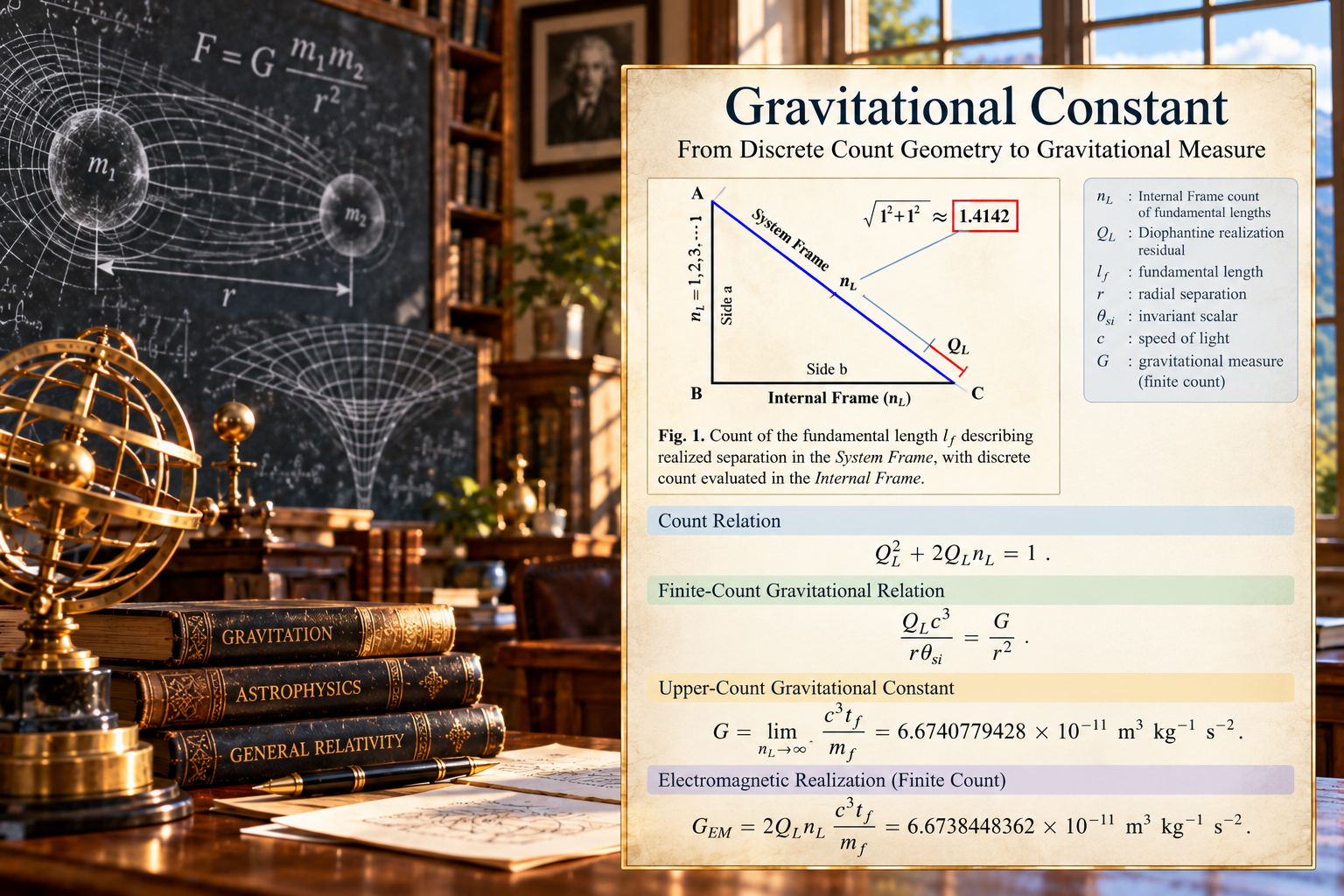
For the right-triangle count geometry, nL denotes the Internal Frame count of fundamental lengths and QL denotes the residual count introduced by realization. Their exact relation is
which reduces to
The triangle is not literal Euclidean geometry residing in the Internal Frame. It is a representation of the relation between discrete count and realized System Frame measure.
This distinction leads to the Informativity differential. In its current MQ definition, the Informativity differential is the finite-count departure of the realization normalization factor from unity. Because the exact count relation above gives , the differential approaches zero as the count becomes large.
This finite-count effect is distinct from Lorentz contraction. It does not arise from relative velocity. In MQ it arises from discrete count realization through the Frames mapping.
Gravitational curvature is consequently a System Frame phenomenon. MQ does not assign metric curvature to the primitive Internal Frame. Instead, the count structure is realized as measurable geometry in the System Frame, where gravitational acceleration and curvature can be described.
The Scalar θsi
A second quantity enters the gravitational construction. The scalar θsi participates repeatedly in MQ relations connecting discrete count with gravitational, electromagnetic, and cosmological realization.
The current MQ determination is
MQ also identifies a corresponding experimental angular value in the polarization geometry analyzed by Shwartz and Harris in their 2011 paper Polarization Entangled Photons at X-Ray Energies. For one maximally entangled Bell-state configuration at degenerate frequency, their calculation gives equal signal and idler angles of 3.26239 radians.
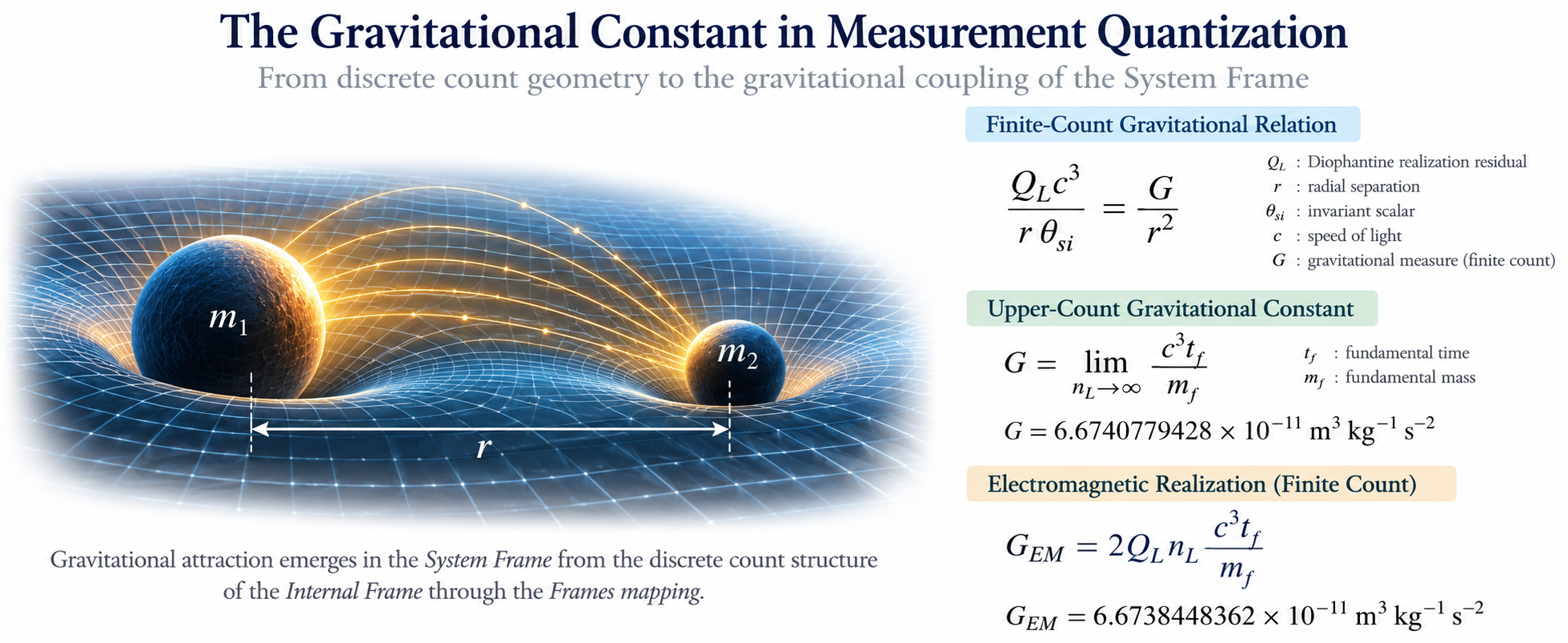
The same scalar enters the count-resolved gravitational relation. With r denoting realized radial separation and c the speed of light, the current MQ relation is
Here G denotes the finite-count gravitational measure evaluated within the same realization regime as the left-hand side. This exact same-regime relation replaces older approximate presentations of the gravitational correspondence.
The derivation and earlier MQ treatment of the gravitational constant can also be reviewed in Discrete Expressions for the Gravitational Constant Offer Improved Precision.
The Upper Count Limit
The distinction between a finite-count measure and the upper-count gravitational constant is fundamental to the current MQ formulation.
From the exact count identity,
increasing nL drives QL toward zero while 2 QLnL approaches unity. The Informativity differential therefore approaches zero.
The resulting upper-count gravitational constant is
Here tf and mf are the fundamental measures of time and mass. Together with fundamental length lf, they form the three fundamental measures used throughout MQ.
The upright G is significant. Under current MQ notation, it denotes the gravitational constant evaluated at the upper count limit. A gravitational measure evaluated at a finite demarcation is italicized.
The upper count limit is not a special location in space and does not require an infinite physical distance. It is the limiting count condition under which the finite-count correction approaches null.
The Electromagnetic Demarcation
MQ predicts that a gravitational measure evaluated at a finite electromagnetic demarcation differs slightly from the upper-count value.
At the electromagnetic demarcation , the current canonical MQ expression is
The distinction is small but experimentally relevant. The more highly resolved values retained in the MQ BIPM comparison are GEM = 6.6738448362 × 10⁻¹¹ and Ggrav = 6.6740779428 × 10⁻¹¹ .
Their physical separation is
Normalized to the lower electromagnetic value, the predicted separation is 34.9284 parts per million (ppm).
Connecting Fundamental and Cosmological Measure
The gravitational relation connects directly to MQ's fundamental measures and fundamental expression.
Because at the fundamental relation, the upper-count gravitational expression can also be written exactly as
This exposes the dimensional structure of the gravitational constant. Three factors of length frequency provide the three realized spatial dimensions, while the inverse mass-frequency contribution supplies the mass relation. The resulting dimensions are .
These dimensions belong to the realized System Frame. They should not be projected backward onto the Internal Frame as though three-dimensional metric space, physical mass, and elapsed System Frame time already existed there.
The same fundamental measures can participate in expressions realized at much larger physical scales. MQ therefore uses the common count structure to investigate relations among fundamental, electromagnetic, gravitational, galactic, and cosmological measure.
This does not imply that a local fundamental mass is physically generated by the present diameter or age of the universe. The MQ claim is instead that quantities realized at very different scales can reduce to common underlying count relations.
The same qualification applies to MQ calculations involving the cosmic microwave background (CMB). Agreement between a derived CMB quantity and observation can provide a cross-scale closure test, but such agreement is not automatically an independent test when observationally informed cosmological inputs also enter the calculation.
Why G Has Been Difficult to Measure
The experimental history of the gravitational constant makes the finite-count prediction particularly interesting.
A 2017 NIST review, Measurements of the Newtonian Constant of Gravitation, G, noted that more than a dozen precision measurements had produced scatter much larger than their assigned uncertainties. The review reported a Birge ratio of about five.
The inconsistency persisted in the 2022 CODATA adjustment. CODATA retained 16 measurements of G. Because those measurements remained mutually inconsistent, their standard uncertainties were multiplied by a common expansion factor of 3.9 before the recommended value was determined. After expansion, the adjustment gave χ2 = 12.9 for 15 degrees of freedom and a Birge ratio of 0.93.
The conventional interpretation remains that difficult and incompletely characterized experimental systematics contribute to the dispersion. That explanation remains viable and is especially important for torsion-balance experiments, where geometry, torsional response, electrostatic effects, thermal gradients, material properties, angle metrology, and other small effects can influence the inferred value of G.
MQ adds a more specific hypothesis. It predicts that a gravitational realization and an electromagnetic realization need not return exactly the same value because the electromagnetic realization occurs at finite count while the count-resolved gravitational realization approaches the upper-count value.
The BIPM Torsion Balance
The torsion balance developed at the International Bureau of Weights and Measures (BIPM) is unusually useful for examining this possibility because essentially the same apparatus can determine G in two different operating modes.
In free-deflection mode, also called the Cavendish method, the gravitational torque produces a mechanical deflection of the torsion balance. In electrostatic-servo mode, an applied electrostatic counter-torque holds the pendulum near a fixed angular position and the gravitational torque is inferred through the electrostatic compensation.
The two methods were deliberately developed to provide a robust determination of G using different measurement chains. They were not designed to test MQ.
The original BIPM Mark I result was published in 2001. A substantially rebuilt Mark II apparatus produced the later BIPM result reported in 2013 and 2014. Both experiments used free deflection and electrostatic compensation.
For Mark I, the mature published values were 6.67553 × 10⁻¹¹ in electrostatic compensation and 6.67565 × 10⁻¹¹ in free deflection. For Mark II, the corresponding values were 6.67515 × 10⁻¹¹ and 6.67586 × 10⁻¹¹ .
The central values therefore placed free deflection above electrostatic compensation in both mature BIPM experiments, although the individual mode differences carried large uncertainties.
An earlier preliminary discrepancy of roughly 300 ppm was traced to a problem associated with electrostatic operation. It is therefore not treated in the current MQ analysis as evidence for the predicted interaction-dependent separation.
The 2026 NIST Replication
The BIPM apparatus was subsequently transferred to the National Institute of Standards and Technology (NIST), where Schlamminger and colleagues undertook the first replication of a high-precision determination of G using an established apparatus from another laboratory.
Their peer-reviewed 2026 paper, Redetermination of the Gravitational Constant with the BIPM Torsion Balance at NIST, reports
G = (6.67387 ± 0.00038) × 10-11 .
The relative standard uncertainty is 57 ppm. The result is lower than the earlier BIPM determination by about 2.5 × 10⁻⁴, or approximately 250 ppm.
This journal value is the authoritative result used here. A NIST publication metadata page has displayed a conflicting value of 6.67366 ± 0.00020 × 10⁻¹¹ . That metadata value is inconsistent with the peer-reviewed paper and with NIST's own subsequent public description of the experiment, and it is therefore not used in the MQ comparison.
The experiment produced four individual determinations. With copper test masses, electrostatic servo gave 6.673642 × 10⁻¹¹ , while free deflection gave 6.674021 × 10⁻¹¹ . With sapphire test masses, electrostatic servo gave 6.672637 × 10⁻¹¹, while free deflection gave 6.673636 × 10⁻¹¹ .
Free deflection was therefore higher than electrostatic servo in both material configurations.
The copper configuration provides the cleaner quantitative comparison. Its free-minus-servo separation is 56.7889 ± 29.4252 ppm. The measured central difference exceeds the fixed MQ target of 34.9284 ppm by 21.8605 ppm, corresponding to 0.743 standard deviations using the differential uncertainty.
The result is therefore statistically compatible with the fixed MQ separation, but it is not a measurement of the MQ value itself.
The distinction is important. MQ's two numerical gravitational realizations predate the 2026 NIST result. The apparatus-specific identification of free deflection with the count-resolved gravitational realization and electrostatic servo with the finite-count electromagnetic realization was made after examination of the BIPM/NIST measurement architecture. The present comparison is consequently compatibility evidence, not a preregistered prospective confirmation of the mode assignment.
What the Combined BIPM and NIST Measurements Show
The combined analysis also examines the mature BIPM and NIST mode pairs together. Because measurements from the same apparatus and related configurations are not all statistically independent, the analysis uses their covariance rather than simply averaging the reported ppm differences.
For the mature BIPM Mark I, BIPM Mark II, NIST copper, and NIST sapphire comparisons, the covariance-aware generalized least-squares estimate of a common free-minus-servo separation is
Within that statistical model, exact zero separation is 2.265 standard deviations from the fitted center.
The fixed MQ target is 34.9284 ppm. Under a two-hypothesis likelihood comparison using the quoted covariance, the paired-mode data have a likelihood about 8.14 times greater under the fixed MQ separation than under exact zero separation.
The result also depends on treatment of unexplained heterogeneity. When an additional heterogeneity contribution is allowed, the fixed-MQ-to-zero likelihood comparison falls to about 5.4 to 1.
Nor is 34.9284 ppm the unconstrained best-fitting separation. If the common gap is allowed to float freely, the present mode-pair data center near 60.994 ppm. The measurements therefore do not establish the exact MQ value and do not identify the physical origin of the observed mode differences.
This is especially important because the 2026 NIST analysis itself finds evidence for configuration-dependent unexplained effects. The sapphire measurements show substantially greater vulnerability to unmodeled systematics than the copper measurements. The current data therefore cannot distinguish uniquely among unidentified apparatus effects, an interaction-dependent physical contribution, or some combination of both.
Systematics and the MQ Interpretation
The current MQ interpretation does not require inserting a missing multiplicative correction into the NIST analysis.
Detailed review of the dimensional factors in the free-deflection and electrostatic-servo estimators does not justify treating every laboratory length as though it acquires one common MQ rescaling. Applying such a uniform factor produces the wrong structure for the observed positive mode gap.
Likewise, the voltage and capacitance-gradient quantities used in the electrostatic-servo estimator are already laboratory-realized electromagnetic measurements. Applying an additional universal MQ correction after measurement would risk counting the same realization effect twice.
The appropriate MQ proposition is therefore interaction-based. Electrostatic servo closes the torque measurement through an active electromagnetic counter-torque, while free deflection obtains the gravitational torque from the mechanical response of the balance. MQ associates those two measurement chains with different realization conditions.
The remaining 21.8605 ppm difference between the NIST copper central result and the fixed MQ target does not need to be forced into the theory. It lies well within the scale of mode- and configuration-dependent effects historically demonstrated by the apparatus.
A conventional apparatus explanation therefore remains viable. So does a model in which a smaller physical differential is superimposed on apparatus-dependent offsets. The present experiment cannot decide between those possibilities.
A Direct Experimental Test
MQ specifies a fixed servo-normalized free-minus-servo target of 34.9284 ppm. A purpose-built same-apparatus experiment can therefore test a numerical prediction rather than merely ask whether measurements of G continue to disagree.
If the differential standard uncertainty were reduced to about 11.6 ppm, the MQ target would be separated from zero by approximately 3 standard deviations. At about 7 ppm, the separation would approach 5 standard deviations. Precision near 5 ppm would also begin to distinguish meaningfully between the fixed 34.9284 ppm MQ prediction and the larger central gap suggested by the present combined data.
Such an experiment would need to control the conventional sources of mode-dependent bias while preserving the physical distinction between free gravitational deflection and active electrostatic compensation.
A result converging on the specified positive differential would strengthen the MQ realization hypothesis. A sufficiently precise result converging on zero would falsify or require revision of the proposed gravitational-electromagnetic realization mapping. A stable nonzero separation substantially different from the MQ value would likewise require the theory to be reconsidered.
What the Gravitational Constant Represents in MQ
The gravitational constant occupies an unusually broad role in Measurement Quantization.
At the theoretical level, MQ derives the gravitational coupling from fundamental measure, count geometry, the Frames mapping, and θsi. At finite count, the realized measure retains the Informativity differential. At the upper count limit, that contribution approaches zero and the relation reduces to
The same expression can be written
G = (lf / tf)3(tf / mf),
making explicit the three realized spatial contributions and the mass-frequency relation that produce the dimensions of the gravitational constant.
At the experimental level, MQ predicts that an electromagnetic finite-count realization can differ slightly from the count-resolved gravitational value. That prediction gives a specific physical separation rather than an unrestricted explanation for the historical scatter in G.
The longstanding difficulty of measuring G is therefore not peripheral to MQ. It provides one of the framework's clearest laboratory tests.
The BIPM and NIST measurements have not established that the MQ interpretation is correct. They have established something more limited but experimentally useful. The same torsion balance, operated through distinct gravitational and electrostatic measurement chains, has repeatedly produced central values ordered in the direction associated with the MQ branches, and the best current copper comparison is statistically compatible with the fixed MQ differential.
The next step is consequently well defined. Measure the same differential with substantially greater precision and tighter control of mode-dependent systematics. The predicted separation either remains or it does not.

8: Resolving the Hubble tension 68.261 and 73.510 km s Mpc
International Journal of Geometric Methods in Modern Physics
7: Measurement Quantization
Journal of High Energy Physics, Gravitation and Cosmology
6: Physically Significant Units of Measure
5: Measurement Quantization Unites Classical and Quantum Physics
4: Quantum Model of Gravity Unifies Relativistic Effects, Describes Inflation/Expansion Transition, Matches CMB Data
3: Measurement Quantization Accounts for Galactic Rotational Velocities and Obviates Dark Matter
2: Measurement Quantization Describes History of Universe -
Quantum Inflation, Transition to Expansion, CMB Power Spectrum
International Journal of Theoretical and Mathematical Physics
1: Measurement Quantization Describes the Physical Constants