

TERMS INPUTS SYMBOLS CONDORDANCE ANALYSIS
—————————— read pre-print on research gate (new window) ——————————
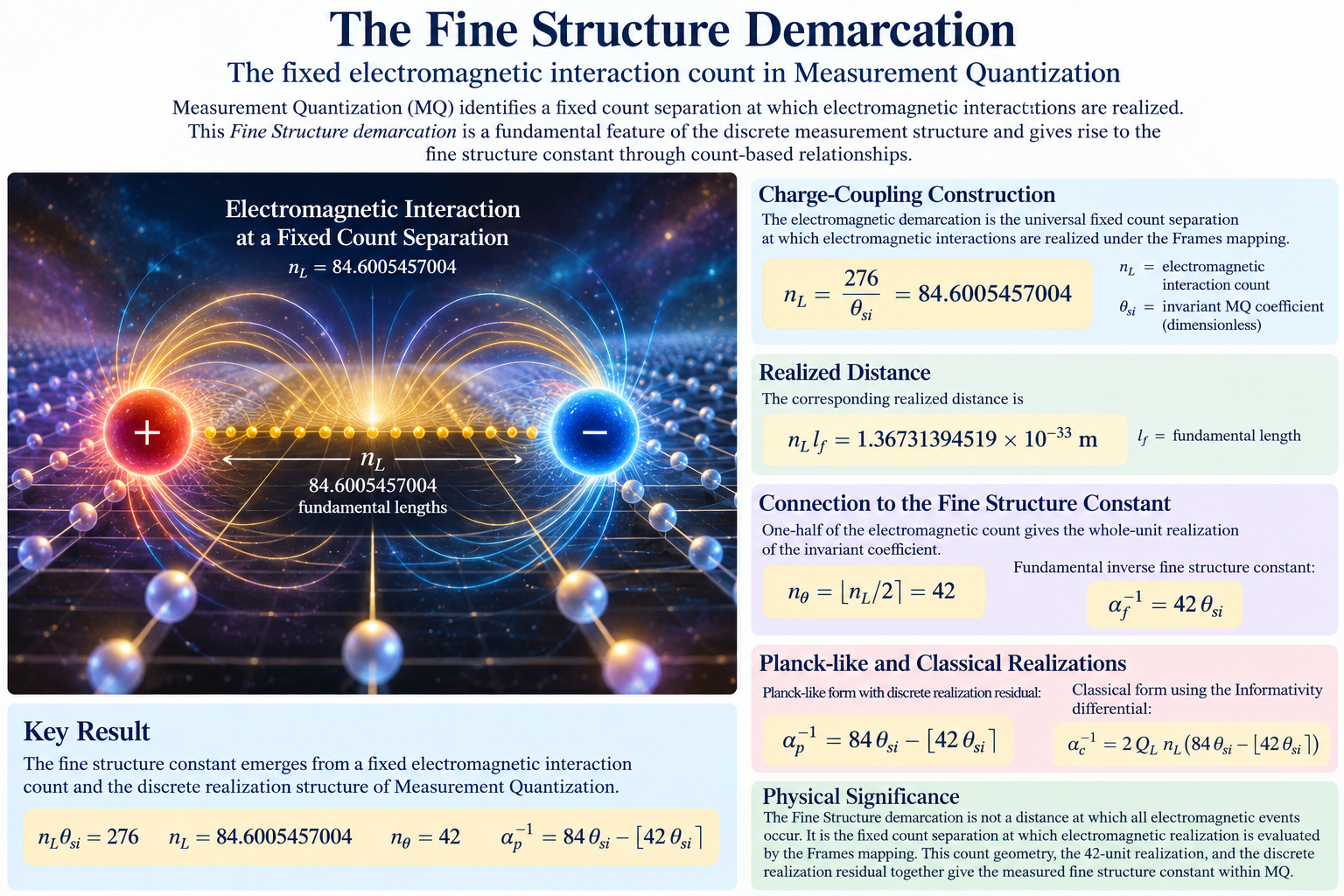
The Fine Structure Demarcation
The fixed electromagnetic interaction count in Measurement Quantization
The fine structure constant, α, is conventionally understood as the dimensionless coupling constant that characterizes the strength of electromagnetic interaction between charged particles. Measurement Quantization (MQ) approaches the same constant from a different direction. Rather than beginning with charge and asking what numerical coupling strength follows, MQ begins with the discrete geometry of measurement and asks at what count separation electromagnetic interaction is realized. The answer is the Fine Structure demarcation, also called the charge coupling demarcation.
This distinction is important. The Fine Structure demarcation is not another name for the fine structure constant itself. It is the fixed electromagnetic interaction count from which the MQ construction of the fine structure constant emerges. In the current MQ formulation, the electromagnetic demarcation is the universal fixed count separation at which electromagnetic interactions are realized under the Frames mapping. It is therefore a count-domain boundary condition of the MQ measurement structure, not a wavelength, an energy, a propagation distance, or a conventional QED renormalization scale.
The construction rests on the relationship between the Internal Frame, in which the underlying count structure is specified, and the System Frame, in which physically realized quantities are expressed. The invariant coefficient θsi carries the same numerical coefficient through this mapping, while its dimensionally distinct angular and momentum realizations are represented separately. This distinction is developed more generally in MQ Frames of Reference and The Fundamental Expression.
For the electromagnetic interaction, the defining charge-coupling relation is remarkably compact. Let nL denote the fundamental-length count associated with the electromagnetic demarcation and θsi the invariant dimensionless MQ coefficient. The charge-coupling construction gives
nL = 276 / θsi = 84.6005457004(82)
This is the central expression of the Fine Structure demarcation. It states that the electromagnetic realization occurs at a fixed count of approximately 84.60055 fundamental lengths. The corresponding realized distance is obtained using the fundamental length lf,
nL lf = 1.36731394519(20) x 10-33 m
The physical meaning of this result requires care. MQ is not asserting that every electromagnetic event occurs across a conventional spatial distance of 1.3673 x 10⁻³³ m. The demarcation instead specifies the fixed count separation at which electromagnetic realization is evaluated by the Frames mapping. Ordinary electromagnetic phenomena remain observable across macroscopic and microscopic distances. The demarcation identifies the underlying count scale entering their MQ realization.
This count has an immediate and consequential relationship to the fine structure constant. The MQ Fundamental Expression gives
lf mf = 2 θsi tf
where mf and tf are the fundamental mass and fundamental time, respectively. Thus, one count expressed in fundamental length corresponds to twice the count expressed through θsi. At the electromagnetic demarcation, the relevant half-count is therefore
nθ = ⌊nL / 2⌉ = ⌊84.600545700482 / 2⌉ = 42
where nθ denotes the realized whole count of θsi. The value 42 is consequently not inserted as an independently fitted integer. It is the whole-count realization of one-half of the electromagnetic demarcation.
The corresponding continuous count product satisfies
nL θsi = 276
and the fundamental inverse fine structure constant is constructed from 42 counts of θsi,
αf-1 = 42 θsi
where αf-1 denotes the fundamental MQ representation of the inverse fine structure constant. This exposes the structural connection between the demarcation and electromagnetic coupling. The demarcation fixes the count geometry. Its half-count identifies the 42-unit realization. The invariant coefficient then supplies the continuous quantity carried by those units.
The result is especially revealing because 42 θsi is not itself a whole number. That difference is precisely where discrete realization enters the construction. MQ defines the associated count residual by the difference between the continuous product and its whole-unit realization,
Qnθ = 42 θsi - ⌊42 θsi⌉
where Qnθ is the discrete realization residual associated with the 42-count construction. The Planck-like inverse fine structure constant then follows by adding this residual to the fundamental expression,
αp-1 = 42 θsi + (42 θsi - ⌊42 θsi⌉)
which reduces to the major MQ realization relation
αp-1 = 84 θsi - ⌊42 θsi⌉
Here αp-1 denotes the Planck-like realization of the inverse fine structure constant. The expression makes the physical role of the demarcation unusually transparent. The electromagnetic coupling is not represented simply by a continuous coefficient. Its MQ form contains both the continuous count product and the whole-unit realization selected by the discrete measurement structure.
The same electromagnetic count also enters the Informativity differential. For a count separation nL, MQ defines the residual length ratio QL through the right-triangle count geometry,
QL = (1 + nL2)1/2 - nL
At the charge coupling demarcation, this gives
QL nL = 0.499982536417(25)
The product lies close to, but is not exactly, one-half. That small departure from one-half is physically significant within MQ. It records the finite-count geometric difference between the underlying count construction and its large-count limit. The MQ Informativity Differential describes how this finite-count effect participates in the transformation from the Planck-like representation to the classically measured representation.
The classical inverse fine structure constant therefore follows from
αc-1 = 2 QL nL (84 θsi - ⌊42 θsi⌉)
where αc-1 denotes the classically realized inverse fine structure constant. This equation brings the entire construction together. The 42-count structure supplies the discrete electromagnetic realization, while 2 QL nL supplies the finite-count correction associated with the Informativity differential. What is measured classically is therefore the final realization of a sequence that begins with the fixed electromagnetic count geometry.
The direction of the derivation can also be reversed. Beginning with the measured classical fine structure constant and the MQ right-triangle relation, MQ solves for the invariant coefficient. With
QL = (1 + nL2)1/2 - nL
and the electromagnetic constraint nL θsi = 276, the classical fine structure relation can be reduced to an equation containing θsi as the remaining MQ coefficient. The current MQ construction obtains
θsi = 3.262390305(36)
This reciprocal structure is conceptually important. The fine structure constant constrains θsi through the classical electromagnetic realization, while θsi and the count relation determine the electromagnetic demarcation. The demarcation then returns the 42-count structure from which the MQ fine structure expressions are constructed. The result is a closed count geometry rather than an isolated numerical coincidence.
The charge-coupling construction is also not the only MQ route to this interaction scale. An independent Blackbody Demarcation follows from the gravitational-curvature and fundamental-measure relations. Its defining solution may be written
nL = θsi lf [1 / (ℏ (ℏ - 2 θsi lf))]1/2
where ℏ is the reduced Planck constant. The blackbody construction gives nL = 84.6005496647(07), while the charge-coupling construction gives 84.6005457004(82). Their agreement through the first several significant digits is important, but it must be interpreted correctly. These are alternative MQ derivational routes into the same electromagnetic count geometry. Their numerical agreement is therefore an internal closure test of the framework, not two statistically independent experimental measurements of a new physical length.
This distinction becomes even more important when the elementary-charge construction is included. MQ obtains closely corresponding electromagnetic demarcations through blackbody radiation, charge coupling, and elementary charge. These routes approach electromagnetic realization through different physical expressions, yet converge on the same narrow count interval near nL = 84.60055. The significance within MQ is not that three unrelated laboratory experiments have independently measured the same hidden distance. It is that several electromagnetic constructions become mutually compatible when evaluated at the same fixed interaction count.
The fine structure constant consequently occupies a particularly revealing position in MQ. It connects a familiar dimensionless electromagnetic constant to the discrete count structure of the measurement framework. The conventional expression identifies α with electromagnetic coupling strength. MQ retains that experimentally established role while proposing a deeper count-based description of why the coupling takes its observed value. The coupling is associated with a fixed demarcation, the demarcation selects a 42-count realization, and the difference between continuous and whole-count realization generates the correction required to pass from the fundamental expression to its Planck-like form. The Informativity differential then completes the finite-count transformation to the classical value.
This also explains why the Fine Structure demarcation is more fundamental in MQ than a simple numerical restatement of α. The value 84.60055 is not introduced merely because it reproduces the inverse fine structure constant. It appears as an electromagnetic interaction count and participates independently in the blackbody, elementary-charge, and gravitational-electromagnetic constructions. Conversely, the fine structure constant provides a high-precision electromagnetic constraint on the invariant coefficient that determines this count. The two quantities are therefore related, but they are not interchangeable.
The broader implication is that MQ relocates electromagnetic coupling from an unexplained dimensionless number to a realization condition in a discrete measurement geometry. This is an MQ theoretical interpretation, not an established result of quantum electrodynamics. Its empirical significance ultimately depends on whether consequences derived from the same count structure can be tested independently of the measurements used to establish its inputs. Agreements among quantities that share the same upstream fine structure input demonstrate mathematical closure and consistency. They should not, by themselves, be treated as independent experimental confirmations.
For the detailed derivation of the coupling constant itself, see Fine Structure Constant. The underlying count relations are developed in Fundamental Measures, The Fundamental Expression, and Quantization Ratios. The associated charge realization is developed in Elementary Charge. The research paper developing the fine structure construction is also available as Describing the Fine Structure Constant Using Only the Fundamental Measures.
In this form, the Fine Structure demarcation identifies the point in MQ count geometry at which several otherwise separate ideas meet. The invariant coefficient θsi, the electromagnetic interaction count nL, the whole-count marker 42, the discrete realization residual, the Frames mapping, and the Informativity differential are not separate numerical devices. They form a connected realization sequence. The charge-coupling relation nL θsi = 276 fixes the electromagnetic count geometry. Its whole-count projection selects 42. The residual at that count generates the Planck-like fine structure expression. The finite-count geometry then produces the classical coupling observed in laboratory measurement. Within Measurement Quantization, that sequence is the physical content of the Fine Structure demarcation.

8: Resolving the Hubble tension 68.261 and 73.510 km s Mpc
International Journal of Geometric Methods in Modern Physics
7: Measurement Quantization
Journal of High Energy Physics, Gravitation and Cosmology
6: Physically Significant Units of Measure
5: Measurement Quantization Unites Classical and Quantum Physics
4: Quantum Model of Gravity Unifies Relativistic Effects, Describes Inflation/Expansion Transition, Matches CMB Data
3: Measurement Quantization Accounts for Galactic Rotational Velocities and Obviates Dark Matter
2: Measurement Quantization Describes History of Universe -
Quantum Inflation, Transition to Expansion, CMB Power Spectrum
International Journal of Theoretical and Mathematical Physics
1: Measurement Quantization Describes the Physical Constants