
TERMS INPUTS SYMBOLS CONDORDANCE ANALYSIS
—————————— read pre-print on research gate (new window) ——————————
Schrodinger Evolution
From Discrete Count Redistribution to Quantum Time Evolution
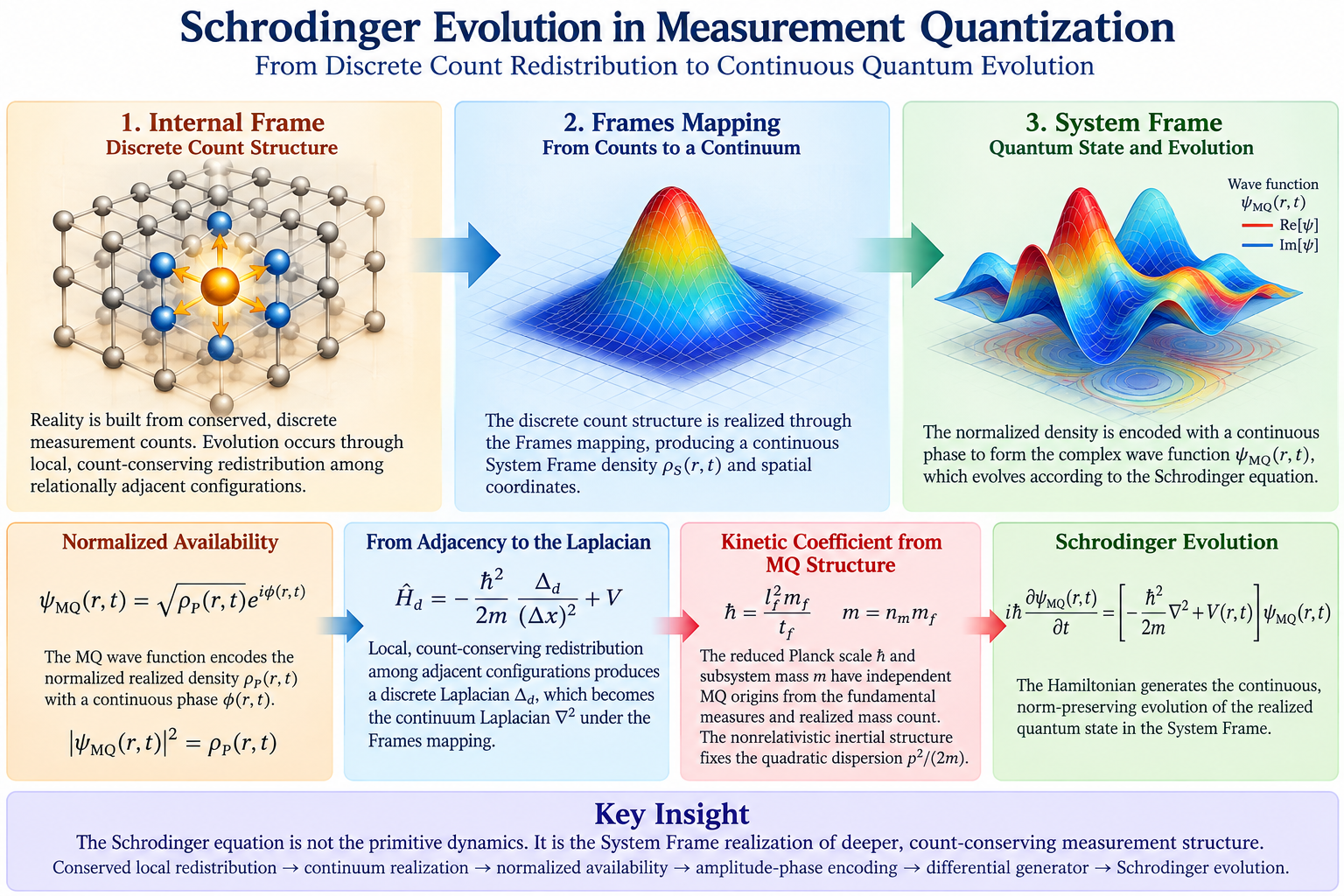
The Schrodinger equation occupies a distinctive position in quantum mechanics. It specifies how a nonrelativistic quantum state changes with time, but in the conventional formulation the equation itself is part of the dynamical structure of the theory. Measurement Quantization (MQ) approaches the problem from the opposite direction. Rather than beginning with a wave function and prescribing its evolution, MQ begins with conserved discrete measurement availability in the Internal Frame, maps that structure through the Frames mapping, and asks what dynamical representation emerges in the realized System Frame.
This distinction is essential. MQ does not claim that discreteness or count conservation alone uniquely implies the Schrodinger equation. The stronger and more precise result is that once the nonrelativistic continuum realization is specified, several ingredients conventionally assembled into Schrodinger dynamics have independent origins within MQ. Count conservation supplies normalization preservation. Adjacency-local redistribution supplies the discrete differential structure. The Frames mapping supplies the continuum representation. MQ fundamental measures fix the phase-action scale. Realized mass count supplies the subsystem mass. The nonrelativistic contraction of the MQ-derived local Lorentz/Poincare symmetry fixes the Galilean transformation law, which, together with the phase-action and Hamilton-Jacobi structure, determines the quadratic inertial dispersion. These elements converge on Schrodinger evolution rather than beginning with it.
This makes Schrodinger dynamics an unusually useful example of the distinction between the two MQ frames. The primitive Internal Frame contains relational count structure rather than a continuous wave propagating through a pre-existing space. Position, spatial derivatives, continuous time, the Laplacian, and the wave function belong to the realized System Frame description. The familiar quantum equation therefore describes how mapped availability evolves after realization into the continuum representation.
Readers unfamiliar with this distinction may first wish to review Establishing the Discreteness of Measure, Fundamental Measures, and Determinism and the Foundations of Quantum Behavior.
The State Before the Wave Function
MQ begins with nonnegative integer multiplicity assigned to relationally distinguishable Internal Frame configurations. Let nI(ξ,A) denote the count associated with relational element ξ under admissible context A. For a finite admissible region ω', the corresponding count is additive over disjoint subregions. The important physical point is that the primitive object is a conserved count, not a probability amplitude.
When this count structure is realized through the Frames mapping, it admits a continuous System Frame density ρS(r,t). Here r is the realized spatial coordinate and t is System Frame time. For the one-body realization, the total realized availability is N1(t), giving the normalized density ρP(r,t) through ρP(r,t) = ρS(r,t)/N1(t).
The MQ wave function is then introduced as an amplitude-phase encoding of this already-normalized realized density. With φ(r,t) denoting the realized phase field,
ψMQ(r,t) = √ρP(r,t) eiφ(r,t) = √[ρS(r,t)/N1(t)] eiφ(r,t)
and consequently |ψMQ(r,t)|2 = ρP(r,t).
This reverses the usual explanatory order. Probability density is not obtained by first postulating a complex wave function and then applying a separate probability rule to its modulus squared. In the MQ construction, normalized availability is established from the count structure first. The complex wave function subsequently packages that density together with its phase into the representation required for reversible continuous evolution. The wave function is therefore physically meaningful without being primitive.
The complex representation is also not introduced merely because conventional quantum mechanics uses complex numbers. In the source construction, once the flow-derived phase coordinate is continuous and the encoding is required to be reversible, linear, norm-preserving, and minimal, the phase representation is fixed by the continuous norm-preserving rotation structure, yielding the familiar U(1) complex phase representation up to global phase and complex conjugation.
From Adjacency to the Laplacian
The kinetic term of the Schrodinger equation contains a second spatial derivative. MQ therefore has to explain why a Laplacian should appear when its primitive Internal Frame contains no continuum spatial derivative at all.
The answer begins with adjacency.
Primitive evolution acts through local, count-conserving redistribution among relationally adjacent count configurations. On a regular realized representation, forward and backward first differences may be composed to form a centered second difference. Summing those second differences isotropically over the three realized spatial directions produces the discrete Laplacian Δd. Under a controlled Frames mapping continuum limit, the discrete operator becomes the ordinary System Frame Laplacian ∇2.
The conceptual sequence is therefore
adjacency-local redistribution → first differences → centered second differences → discrete Laplacian → System Frame Laplacian.
This is more than a change of notation. The differential operator governing spatial evolution appears only after relational count redistribution has acquired a continuum System Frame representation. MQ does not differentiate primitive Internal Frame variables with respect to physical position because physical position is not primitive at that level.
The discrete kinetic generator has the form Hd = -[ℏ2/(2 m)] [Δd/(Δx)2] + V, where Δx is the realized lattice spacing, m is the realized subsystem mass, and V is the real multiplicative potential representing admissible external, boundary, or interaction constraints in the nonrelativistic System Frame realization.
In the continuum limit, Δd/(Δx)2 becomes ∇2. The spatial form of the Schrodinger generator therefore descends from the discrete redistribution structure rather than being introduced initially as a continuum differential law.
Why the Kinetic Coefficient Is Not Inserted by Hand
Recovering a Laplacian is not sufficient to derive the Schrodinger kinetic term. One must also explain its coefficient,
ℏ2/(2 m).
This is where the MQ construction becomes considerably more restrictive.
The reduced Planck scale used by the quantum evolution equation has an independent MQ origin. Let lf, tf, and mf denote the fundamental measures of length, time, and mass. The MQ phase-action relations give the realization-appropriate reduced Planck scale through the fundamental measures. In dimensionally explicit form,
ℏ = lf2 mf/tf.
The subsystem mass is independently represented by its realized mass count nm,
m = nm mf.
Neither quantity is introduced merely to reproduce the coefficient of the Schrodinger equation. The phase-action scale belongs to the broader MQ measurement relations, while the mass belongs to the realized subsystem.
The remaining factor of 1/2 is equally important. MQ does not simply assume the familiar free-particle relation T = p2/(2 m) and then claim the Schrodinger operator follows. In the current construction, the local Lorentz/Poincare symmetry of the realized System Frame is selected from the mapped metric and causal invariants. Its nonrelativistic contraction supplies the Galilean boost law. Combining that transformation behavior with the independently established phase-action relation and the realized Hamilton-Jacobi characteristic relation fixes the free inertial Hessian and integrates to
T = p2/(2 m).
The momentum generator is then represented by p̂ = -i ℏ ∇. Substitution produces the kinetic operator -[ℏ2/(2 m)]∇2.
The coefficient is consequently assembled from structures that have already been resolved elsewhere in MQ. The fundamental measures determine ℏ. The subsystem count determines m. The nonrelativistic inertial structure determines the quadratic dispersion and its factor of 1/2. The discrete-to-continuum mapping determines the Laplacian. This separation is important because merely writing the correct differential operator would not explain why nature should attach precisely this coefficient to it.
The connection between the MQ fundamental measures and Planck quantities is developed further in Fundamental Measures and Newton & Planck Constants.
Schrodinger Evolution as a System Frame Realization
These constructions converge on the central nonrelativistic result. For the MQ wave function ψMQ(r,t), the realized Hamiltonian operator ĤMQ generates time evolution according to
i ℏ ∂ψMQ(r,t)/∂t = ĤMQψMQ(r,t)
with
ĤMQ = -[ℏ2/(2 m)]∇2 + V(r,t).
Equivalently, the explicit Schrodinger-form evolution is
i ℏ ∂ψMQ(r,t)/∂t = {-[ℏ2/(2 m)]∇2 + V(r,t)}ψMQ(r,t).
This equation is the principal continuum result. It is not the fundamental Internal Frame update rule. It is the compact System Frame representation of the evolution generated when conserved relational availability is mapped into the admissible nonrelativistic continuum description.
That distinction clarifies what "unitary evolution" means in MQ. Closed-domain count conservation is primitive. After normalization and continuum realization, that conservation becomes preservation of the norm of the encoded state. On an admissible self-adjoint domain,
d/dt ∫ |ψMQ(r,t)|2 d3r = 0.
For a time-independent potential, the self-adjoint Hamiltonian generates the continuous unitary time evolution of the encoded state. Functional analysis then guarantees the standard relation between a strongly continuous unitary group and its self-adjoint generator. MQ does not use that theorem to manufacture the kinetic coefficient. The theorem characterizes the realized unitary evolution once the generator has been physically constructed.
The corresponding time-evolution operator takes the familiar form U(t) = exp[-(i/ℏ)Ĥt] for a time-independent Hamiltonian. What changes in MQ is therefore not the experimentally successful mathematical action of Schrodinger evolution. What changes is the proposed explanatory hierarchy beneath it.
The Realization-Appropriate Reduced Planck Scale
MQ adds another layer that is absent from conventional Schrodinger dynamics. The reduced Planck scale appearing in the evolution law is itself resolved by measurement count.
Let nL denote the realized length count, QL(nL) the corresponding MQ length realization term, and θsi the MQ angular measure. The canonical count-resolved relation is
ℏ(nL) = θsi lf/[QL(nL) nL]
with QL(nL) = √(1 + nL2) - nL.
At the electromagnetic demarcation, the relation reproduces the reduced Planck scale appropriate to ordinary electromagnetic quantum measurements. At the upper count limit, MQ resolves a distinct limiting realization. Consequently, MQ does not interpret every occurrence of the reduced Planck scale as a primitive count-independent input extending unchanged across all measurement regimes.
For ordinary atomic, molecular, optical, and other electromagnetic quantum systems, the conventional Schrodinger phenomenology is retained because those measurements occupy the electromagnetic realization. The distinction becomes potentially observable only where the physical system accesses a different MQ realization of the phase-action scale. The source paper identifies gravitationally bound quantum states as the relevant discriminating regime and derives a parameter-free transition-frequency displacement for that case. This is a prediction of the broader MQ framework, not a modification that should be applied indiscriminately to ordinary laboratory quantum mechanics.
What MQ Derives and What It Conditions
The derivation is strongest when its boundaries are kept explicit. MQ derives the pre-probabilistic count carrier, closed count conservation, adjacency-local redistribution, normalized System Frame availability, the amplitude-phase wave-function representation, the discrete differential structure, the phase-action scale, the subsystem mass realization, the relevant local inertial symmetry, and the resulting nonrelativistic quadratic dispersion.
The final Schrodinger realization nevertheless requires a controlled continuum representation. Regular local lattice representability, sufficient smoothness, isotropic summation of nearest-neighbor second differences, an admissible self-adjoint domain, suitable boundary behavior, and a real conservative multiplicative potential delimit the nonrelativistic realization under discussion. These are representation conditions rather than consequences of count conservation alone.
This distinction prevents two opposite errors. It would be too weak to say that MQ merely rewrites the Schrodinger equation, because the framework supplies independent origins for its probability density, differential structure, phase-action scale, mass realization, and kinetic coefficient. It would be too strong to say that integer count conservation alone logically forces all of nonrelativistic quantum mechanics. The actual result lies between those statements and is more informative. MQ provides a conditional but coefficient-resolved reconstruction of Schrodinger evolution from a deeper count-based architecture.
Evolution Without Ontological Collapse
The role assigned to the Schrodinger equation also separates evolution from measurement realization.
Between completed measurement records, normalized encoded availability can evolve continuously according to the Schrodinger representation. A completed measurement does not require the primitive Internal Frame count structure to undergo a stochastic physical collapse. Instead, the measurement context restricts the admissible realization and the resulting System Frame representation is renormalized on the realized outcome domain.
Thus the wave function can retain its familiar role as the carrier of interference, phase, momentum, expectation values, and unitary evolution without requiring it to be the fundamental material object from which reality itself is constructed. It is the complex System Frame encoding of normalized realized availability and phase.
This distinction also explains why deterministic underlying redistribution and probabilistic observed outcomes are not contradictory in MQ. Deterministic conservation and redistribution belong to the pre-probabilistic Internal Frame structure. Probability belongs to normalized realized records in the System Frame. Schrodinger evolution governs the continuous encoded representation between such realized records.
A broader treatment of this architecture is available in Determinism and the Foundations of Quantum Behavior, while the underlying paper is available through Measurement Quantization: A Count-Based Resolution of the Quantum Measurement Problem.
From Count Evolution to Quantum Evolution
The conceptual significance of the MQ construction is therefore not that it produces a different Schrodinger equation for ordinary nonrelativistic quantum systems. Its significance is that the familiar equation ceases to be the beginning of the description.
At the primitive level there is conserved relational count and adjacency-local redistribution. Through the Frames mapping, that structure acquires a continuous density, spatial coordinates, and System Frame time. Normalization converts realized availability into the density represented by the modulus squared of the MQ wave function. Reversible phase encoding supplies its complex structure. Successive adjacency differences become gradients and the Laplacian. The MQ fundamental measures establish the phase-action scale. Realized mass count establishes the subsystem mass. The derived inertial symmetry and phase-action structure establish the free quadratic dispersion. Together they produce the Hamiltonian that generates Schrodinger evolution.
The resulting hierarchy may be summarized conceptually as
count → conservation → adjacency redistribution → Frames mapping → normalized availability → amplitude-phase encoding → differential generator → inertial dispersion → Schrodinger evolution.
In this construction, quantum evolution is neither abandoned nor replaced. It is repositioned. The Schrodinger equation remains the correct nonrelativistic evolution law in its realized domain, but MQ places beneath it a discrete, count-conserving structure from which its principal ingredients can be traced.
That is the central MQ interpretation of Schrodinger evolution. The wave function evolves continuously because it is the realized complex encoding of conserved availability. The Hamiltonian generates that evolution because the mapped redistribution structure becomes a self-adjoint differential generator in the admissible continuum representation. The kinetic coefficient has its value because its action scale, mass scale, inertial dispersion, and differential operator have separately identifiable origins.
Schrodinger evolution is therefore not the primitive dynamics of the Internal Frame. It is the nonrelativistic System Frame expression of a deeper measurement architecture.

8: Resolving the Hubble tension 68.261 and 73.510 km s Mpc
International Journal of Geometric Methods in Modern Physics
7: Measurement Quantization
Journal of High Energy Physics, Gravitation and Cosmology
6: Physically Significant Units of Measure
5: Measurement Quantization Unites Classical and Quantum Physics
4: Quantum Model of Gravity Unifies Relativistic Effects, Describes Inflation/Expansion Transition, Matches CMB Data
3: Measurement Quantization Accounts for Galactic Rotational Velocities and Obviates Dark Matter
2: Measurement Quantization Describes History of Universe -
Quantum Inflation, Transition to Expansion, CMB Power Spectrum
International Journal of Theoretical and Mathematical Physics
1: Measurement Quantization Describes the Physical Constants