
TERMS INPUTS SYMBOLS CONDORDANCE ANALYSIS
—————————— read pre-print on research gate (new window) ——————————
Born Rule and Probability
How Measurement Quantization derives probability before introducing the wave function
The Born rule is one of the most successful and consequential statements in quantum mechanics. It connects the mathematical state of a quantum system to the probabilities of measurement outcomes. In its familiar position-space form, the probability density associated with a wave function ψ is the squared magnitude |ψ|2. Standard quantum mechanics uses this rule with extraordinary empirical success, but the rule is ordinarily introduced as part of the quantum formalism rather than derived from a more primitive physical description.
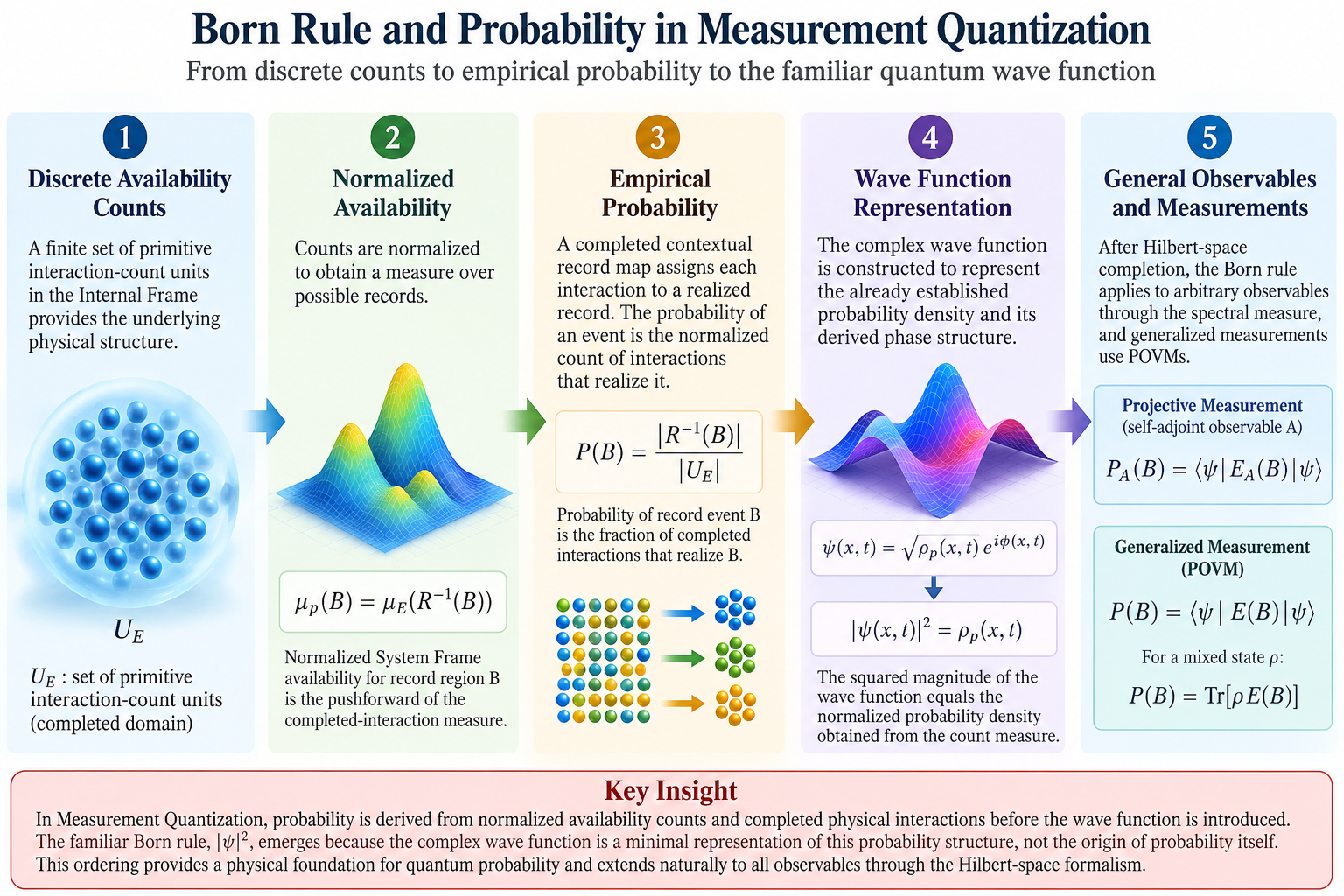
Measurement Quantization (MQ) reverses that order. Probability is not assigned to the wave function and then interpreted physically. Instead, MQ begins with discrete, conserved availability counts in the Internal Frame, maps those counts into the realized System Frame, constructs a normalized measure over possible records, and identifies that measure with empirical probability through completed physical interactions. Only after probability has been established does the familiar complex wave function appear as an amplitude-phase representation of the already normalized probability structure.
This distinction is central. In MQ, the Born rule is not a statement that probability mysteriously emerges when a complex number is squared. The squared modulus appears because a complex amplitude is constructed to represent a probability measure that has already been obtained from a deeper count structure.
Probability Begins Before the Wave Function
The primitive MQ description contains no probability amplitude. It contains discrete relational counts, their adjacency structure, and admissible count redistribution. These quantities belong to the Internal Frame, which is not itself a continuum spacetime description. The MQ frames architecture separates this underlying count description from the continuously encoded quantities accessible in the System Frame.
Consider a finite completed-interaction domain containing a multiset UE of primitive interaction-count units. Let R denote the completed contextual record map, which assigns each complete admissible interaction to exactly one realized record. For a measurable record event B, MQ obtains the event probability directly from the relative multiplicity of the interactions that realize that event:
P(B) = |R-1(B)| / |UE|
Here P(B) is the probability of record event B, R-1(B) is the set of complete interactions mapped to that event, and |UE| is the total number of primitive interaction-count units in the completed domain.
This expression exposes the physical meaning of MQ probability. An event is probable in proportion to the normalized availability of complete interactions that realize it. No amplitude has yet been introduced. No complex Hilbert space is required at this stage. There is also no freely selected weighting function placed over otherwise equivalent possibilities. The weights arise from the count structure itself.
This makes the order of construction fundamentally different from the conventional textbook presentation. MQ proceeds from count measure to normalized availability, from normalized availability to record events, and from record events to empirical probability. The wave function comes later.
From Availability to Empirical Frequency
Normalization alone is not enough to establish physical probability. Any positive measure can be normalized mathematically. MQ therefore requires a second step connecting the normalized availability measure to actual records.
Let μp(B) denote the normalized System Frame availability assigned to record region B, and let μE denote the normalized measure on the completed-interaction domain. The completed contextual record map R provides the required bridge:
μp(B) = μE(R-1(B))
The left side describes the normalized availability assigned to an observable record region. The right side describes the measure of all complete physical interactions that actually map to that record. Their equality means that the normalized availability measure is not merely a convenient distribution. It is the pushforward probability distribution of realized records.
Repeated identically prepared trials then provide the ordinary statistical connection between this probability measure and observed relative frequencies. The statistical character seen by an observer arises after the Frames mapping, even though the underlying completed interaction maps to a single record.
This distinction is especially important for understanding determinism and quantum behavior. MQ does not require primitive randomness to generate probabilistic observations. The complete contextual realization fixes an outcome, while observers have access to the encoded System Frame description rather than the complete underlying count configuration. Probability characterizes the distribution of realized records across the admissible interaction ensemble.
Probability is therefore neither ignorance arbitrarily imposed on the system nor an independent stochastic substance. It is a normalized measure inherited from discrete availability and empirically identified through realization.
Why the Squared Amplitude Appears
Once the normalized probability density has been established, MQ constructs the wave function. Let ρp(x,t) denote the normalized System Frame probability density at realized position x and time t, and let φ(x,t) denote the dimensionless phase coordinate reconstructed from mapped count redistribution. The MQ wave-function representation is
ψ(x,t) = √ρp(x,t) eiφ(x,t)
where i is the imaginary unit.
The Born-form identity follows immediately:
|ψ(x,t)|2 = ρp(x,t)
This is one of the most important logical distinctions in the MQ treatment of quantum probability. The second equation does not independently derive probability by squaring an amplitude. Probability was already established through count normalization and the completed-interaction record map. The amplitude is subsequently defined so that its norm represents that probability density.
The square is therefore not an unexplained probabilistic prescription. It follows from the norm of the minimal complex amplitude representation.
The phase is equally significant. It is not appended to ρp as an arbitrary mathematical decoration. MQ reconstructs its local gradient from the conserved redistribution current produced by the mapped count dynamics. Reversibility, continuous composition, norm preservation, linearity, and minimal dimensionality then select the two-real-dimensional rotation representation SO(2), equivalently U(1), for the nontrivial continuous phase. The complex amplitude consequently packages two already derived pieces of System Frame information: normalized availability in its magnitude and mapped redistribution in its phase.
The familiar quantum wave function is therefore downstream of probability rather than its primitive source.
Normalization and the Position-Space Born Rule
Because ρp is normalized over the realized configuration domain Ωsys, the corresponding wave-function representation satisfies
∫Ωsys |ψ(x,t)|2 dx = 1
For a measurable position region B contained in Ωsys, the probability of obtaining a position in B is therefore
P(X ∈ B) = ∫B |ψ(x,t)|2 dx
Here X denotes the realized position observable. This is the conventional position-space Born rule, but its interpretation within MQ is different. The integral does not create probability. It represents in continuum form the normalized availability measure whose empirical meaning was established before the wave function was constructed.
That ordering also explains why normalization by itself should not be described as a complete derivation of the Born rule. Normalization establishes unit total weight. The completed-interaction pushforward relation establishes why those weights are probabilities of physical records. The amplitude representation then produces the modulus-squared form.
Each step answers a different question.
The Born Rule for General Observables
Position probability is not the whole Born rule. Quantum experiments measure energy, momentum, spin-related observables, polarization, and many other quantities whose operational description requires the Hilbert-space measurement structure.
MQ therefore separates the derivation of probability from its later functional-analytic representation.
After the normalized MQ state geometry has been completed as a Hilbert space, let A denote a self-adjoint observable and EA(B) its projection-valued spectral measure for a measurable spectral set B. The probability that a measurement of A produces a value in B is
PA(B) = ⟨ψ | EA(B) | ψ⟩
This is the general projective Born rule. Its role in MQ must be stated carefully. MQ does not claim that count normalization alone generates the spectral theorem or the operator algebra of quantum mechanics. Instead, the earlier count-derived probability measure is carried into the Hilbert-space representation. Once a realized observable is represented by a self-adjoint operator, the spectral theorem supplies the projection-valued measure through which that already established probability functional is expressed.
The distinction prevents two logically different results from being conflated. MQ derives the physical probability measure from mapped count availability and completed realization. Hilbert-space completion supplies the standard mathematical representation of that probability for arbitrary projective observables.
This separation is also consistent with the significance of Gleason-type results. Such theorems constrain the form of probability assignments once the relevant Hilbert-space projection structure and associated assumptions are present. They do not, by themselves, explain why physical events possess probabilities in the first place. MQ addresses that earlier question at the count and record level.
Generalized Measurements
Real measurements need not correspond to ideal projective measurements. Once the MQ state has reached its Hilbert-space representation, generalized measurements can be expressed using a positive operator-valued measure, or POVM.
Let E(B) denote the positive operator associated with measurable outcome set B. Then
P(B) = ⟨ψ | E(B) | ψ⟩
with the POVM normalized over the complete outcome space so that the total probability is unity.
For a mixed state represented by density operator ρ, the corresponding probability takes the familiar trace form P(B) = Tr[ρE(B)]. This does not introduce a second probability mechanism. It is the generalized operator representation of the same normalized MQ probability structure after Hilbert-space completion.
Measurement conditioning can then be represented by restriction and renormalization of the encoded System Frame state. The underlying conserved Internal Frame count structure need not undergo a physical stochastic collapse. What changes after a realized record is the conditioned description appropriate to that record.
This provides an important separation between outcome realization and state updating. The completed interaction produces one record. Conditioning then updates the encoded description given that record.
Why Probability Is Not Primitive Randomness
The conceptual consequence is substantial. Standard quantum mechanics predicts probabilities with extraordinary precision, but the formalism itself does not require a unique interpretation of what those probabilities mean ontologically. MQ proposes a specific underlying architecture.
Before normalization there are conserved availability counts. After the Frames mapping there is a realized measure. After normalization there are outcome weights. Once completed interactions are partitioned into mutually exclusive records, the pushforward of the interaction measure identifies those weights with empirical probabilities. The wave function then encodes the normalized probability density together with its derived phase structure. Finally, Hilbert-space completion extends the probability rule to arbitrary observables and generalized measurements.
Apparent quantum indeterminism therefore enters at the level of accessible encoded description rather than as a primitive random law assigned to the underlying count structure.
This does not mean that an observer can predict each individual outcome. The complete contextual interaction contains information that is not recoverable from the accessible System Frame state. Multiple admissible underlying configurations can correspond to the same encoded description. Consequently, the theory can be deterministic at the completed realization level while remaining probabilistic at the experimentally accessible level.
The distinction between deterministic realization and probabilistic accessibility is what allows MQ to retain the observed statistical structure of quantum mechanics without introducing probability as an irreducible primitive.
Interference Does Not Replace Probability
The phase component of the wave function explains why quantum probability cannot generally be treated as classical probability over independently additive alternatives. When amplitudes corresponding to indistinguishable alternatives combine, their phases affect the resulting amplitude before the squared norm is evaluated. Cross terms therefore appear in the probability density.
This is the mathematical origin of interference in the System Frame representation. It does not imply that the underlying availability counts themselves are complex numbers. Complex structure belongs to the continuum amplitude representation required to encode normalized availability and its reversible phase relations.
The same distinction clarifies the particle-wave question. MQ does not require a microscopic object literally to alternate between being a classical particle and a physical wave. Discrete count structure and continuous amplitude representation describe different levels of the same physical architecture. The interference pattern belongs to the relational phase structure of the encoded realization.
What MQ Adds to the Born Rule
The central MQ result is therefore deeper than recovering the familiar expression |ψ|2. That expression is only one stage of the construction.
The more fundamental result is that probability can be placed downstream of a finite, conserved, pre-probabilistic count structure. On a finite completed-interaction domain, permutation invariance of primitive count units, finite additivity, normalization, and consistent coarse-graining fix the normalized counting measure. Completed contextual realization then maps that measure onto mutually exclusive records. The probability of a record is consequently the normalized measure of its realization preimage.
The wave function does not determine those probabilities because nature has independently chosen "amplitude squared" as an additional rule. Rather, the wave function is constructed as the minimal norm-preserving complex representation of a probability density and phase structure already supplied by MQ. Its squared modulus must return the density because that is what its norm represents.
The full Born rule then emerges in layers. Count structure fixes availability. Normalization fixes relative weights. Completed realization identifies those weights with empirical record probabilities. Complex amplitude representation yields the modulus-squared identity. Hilbert-space completion supplies projective spectral probabilities, and POVMs extend the same probability functional to generalized measurements.
That ordering changes the foundational question. Instead of asking why a wave function should mysteriously produce probabilities when squared, MQ asks what physical structure must exist before a wave function can represent probability at all.
Its answer is discrete availability, conservation, realization, and normalization under the Frames Principle.
The broader derivation, including the measurement architecture, wave-function construction, Hilbert-space completion, and generalized Born rule, is developed in the current MQ quantum-foundations paper, Measurement Quantization: A Count-Based Resolution of the Quantum Measurement Problem.

8: Resolving the Hubble tension 68.261 and 73.510 km s Mpc
International Journal of Geometric Methods in Modern Physics
7: Measurement Quantization
Journal of High Energy Physics, Gravitation and Cosmology
6: Physically Significant Units of Measure
5: Measurement Quantization Unites Classical and Quantum Physics
4: Quantum Model of Gravity Unifies Relativistic Effects, Describes Inflation/Expansion Transition, Matches CMB Data
3: Measurement Quantization Accounts for Galactic Rotational Velocities and Obviates Dark Matter
2: Measurement Quantization Describes History of Universe -
Quantum Inflation, Transition to Expansion, CMB Power Spectrum
International Journal of Theoretical and Mathematical Physics
1: Measurement Quantization Describes the Physical Constants