








Physical Support for Measurement Quantization
Measurement Quantization (MQ) is not supported by a single numerical coincidence or by agreement with one physical constant. Its physical case rests on a more demanding question: can the same discrete measurement framework describe independently measured phenomena across very different physical scales without introducing a new empirical mechanism for each one?
The evidence developed to date spans laboratory metrology, fundamental constants, cosmological expansion, galactic dynamics, and gravitational phenomena. These tests are not all equally mature. Some are direct quantitative comparisons, some test consequences of the MQ framework, and others identify predictions that remain open to stronger experimental verification. Taken together, however, they provide multiple independent opportunities for the framework to fail.
Physical Constants from a Common Measurement Framework
A first test comes from the physical constants themselves.
In conventional physics, constants such as G, α, ħ, ε0, μ0, and related electromagnetic quantities enter theory through experimentally determined values, exact SI definitions, or relations involving other measured constants. MQ instead asks whether these quantities can be related through a common count-based measurement structure.
The framework begins by distinguishing fundamental measures—lf, mf, and tf—from the integer and fractional counts by which those measures are realized. Physical quantities are then resolved through the relationship between the discrete Internal Frame and continuous System Frame, connected by the Frames mapping.
This is important because the MQ calculations are not intended merely to reproduce constants independently. The same geometric and count relations recur across the derivations.
For example, the electromagnetic realization of the fine-structure constant incorporates both the geometric remainder produced by the Frames mapping and the finite-count normalization associated with the electromagnetic Fine Structure demarcation. The integer count appearing in the construction is independently obtained from the electromagnetic demarcation rather than selected by fitting the measured value of α.
Likewise, the MQ treatment of gravitation produces a gravitational realization rather than introducing G as an unrelated empirical number. At the upper count bound, the gravitational constant is
At the electromagnetic realization, MQ gives
The distinction between these values is not treated in MQ as experimental scatter around one unknowable constant. It is a predicted consequence of resolving gravitation through different measurement regimes.
More detail is provided on the Gravitational Constant and Fine Structure Constant pages.
A Laboratory Test: The Gravitational Constant
The gravitational constant provides an unusually useful test because measurements of G have historically disagreed by considerably more than their reported uncertainties.
MQ predicts two physically distinct realizations separated by
corresponding to a servo-normalized free-minus-servo difference of 34.9284 ppm.
This prediction can be compared with torsion-balance experiments in which the same underlying gravitational interaction is measured using different experimental modes.
A covariance-aware analysis of mature paired-mode measurements from BIPM Mark I, BIPM Mark II, NIST copper, and NIST sapphire configurations gives a common measured free-minus-servo separation of 60.994 ± 26.930 ppm.
A zero mode separation is therefore 2.265σ from the combined central estimate.
A positive paired-mode separation is the relevant empirical signature. Present measurements can test its sign and scale, but their uncertainty is still too large to identify the exact MQ separation as established. The likelihood ratios quoted below compare specified models; they are not posterior probabilities that MQ is correct.
The present measurements do not establish the precise MQ value. Indeed, the freely fitted common separation is larger than the fixed MQ prediction. But they provide an important physical observation: the available paired-mode measurements collectively favor a positive mode separation in the direction predicted by MQ.
Under a restricted comparison between two fixed hypotheses—the MQ prediction of 34.9284 ppm and an exact zero separation—the measured data are approximately 8.14 times more likely under the MQ value than under zero, using the stated covariance model. Allowing additional unexplained heterogeneity reduces that ratio to approximately 5.4:1. These are likelihood ratios, not probabilities that MQ is correct.
The distinction matters. The current evidence is suggestive rather than decisive, but the MQ prediction is quantitatively falsifiable.
A purpose-built same-apparatus experiment could test it much more sharply. A differential uncertainty near 11.6 ppm would distinguish the MQ separation from zero at approximately 3σ; an uncertainty near 7 ppm would reach approximately 5σ. At about 5 ppm, an experiment would begin distinguishing the specific MQ prediction from the larger common separation presently indicated by the measurements.
That makes G one of the clearest near-term laboratory tests of Measurement Quantization.
Additional discussion and the experimental record are provided on the Gravitational Constant page.
Two Realizations of Cosmic Expansion
MQ also produces a distinctive cosmological consequence.
Because measurement can be resolved with respect to the continuous System Frame or discrete Internal Frame, universal expansion does not have to appear with exactly the same measured value in both descriptions.
Using the MQ frame relations and adopted universe-age normalization, the two resulting expansion rates are
This is particularly interesting because modern measurements of the Hubble constant have separated into lower values inferred primarily from early-universe observations and higher values obtained from local distance-ladder measurements.
The agreement is not exact. Current combined CMB measurements lie below the MQ System Frame value, while recent SH0ES measurements lie close to the MQ Internal Frame value. More importantly, the separation between the two MQ frame predictions is close to the observed separation between representative early- and late-universe determinations.
In the current analysis, the difference between the predicted MQ split and the observed SH0ES-minus-combined-CMB split is approximately 0.78σ.
MQ therefore offers a specific physical interpretation of the Hubble tension: the two observational regimes may be resolving expansion through different realizations of the same underlying measurement structure rather than measuring an evolving fundamental law.
This interpretation remains testable as cosmological uncertainties decrease. See Hubble's Constant.
Galactic Rotation Without a Fitted Dark-Matter Halo
An entirely different test occurs at galactic scales.
MQ does not alter Newton's circular-velocity relation by inserting an empirical acceleration scale. Instead, it applies the count bounds of the same measurement framework to the gravitational mass that can be realized along an orbital path.
The resulting realized-velocity relation can be written in the equivalent forms below.
One useful form is . The squared form emphasizes the relation among realized, observed, and baryonic velocities:
This relation is parameter-free once the baryonic source model and MQ realization structure are specified. It therefore provides a direct empirical test: baryonic matter determines the source, and the MQ relation determines how its gravitational response is realized.
Across the complete SPARC catalog of 175 galaxies and 3,366 radial measurements, the point-weighted mean signed residual between MQ realized velocity and observed velocity is +0.02644 km s−1,
while the ratio of mean realized to mean observed velocity is 1.00019.
The mean residual and velocity ratio test global normalization across the catalog. MAE and RMS retain the point-by-point scatter. The two statements answer different statistical questions and should be read together.
Those near-zero aggregate values should not be confused with perfect point-by-point agreement. The pooled mean absolute error is approximately 16.20 km s−1, and the pooled RMS residual is approximately 22.82 km s−1. The significance of the aggregate result is therefore the absence of a substantial global normalization bias across thousands of measurements, not a claim that every galactic radius is reproduced to five significant figures.
The Milky Way provides a more controlled example. Using the Eilers rotation curve and the McMillan baryonic source model with the dark halo removed, the baryonic Newtonian model produces an RMS residual of approximately 69.03 km s−1.
Applying the MQ realization relation reduces the RMS residual to approximately 8.90 km s−1,
an 87.1% reduction. With the specified propagated source covariance, the analysis gives χ2 = 39.57 for 38 degrees of freedom, corresponding to p = 0.400. Because the complete observational covariance of the Eilers data is not available, this result should not be interpreted as a covariance-complete likelihood test.
The important physical point is that the same count-constrained framework developed from MQ's measurement foundations produces the additional gravitational response normally attributed to a dark halo.
The derivation and physical interpretation are discussed further on the Effective Mass of a Galaxy page.
The Radial Acceleration Relation
Galactic observations reveal another stringent regularity: the observed radial acceleration of stars is strongly correlated with the acceleration predicted from visible baryonic matter.
Any alternative description of galactic dynamics must therefore do more than flatten rotation curves. It must reproduce this coupling between baryonic structure and observed gravitational response.
In MQ, that connection is not imposed as a separate empirical law. Both quantities arise from the same baryonic source after applying the count-constrained realization of gravitation. The radial acceleration relation therefore emerges as another representation of the same effective-mass behavior rather than as an independent fitting rule.
This is a stronger requirement than reproducing individual rotation curves because it tests whether the framework preserves the observed relationship between matter distribution and gravitational response across many different galaxies.
The relationship is developed in detail on the Deriving the Galactic Radial Acceleration Relation page.
Rotation Curves and Gravitational Lensing Are Separate Tests
MQ also makes an important distinction between orbital dynamics and gravitational lensing.
Rotation curves constrain orbital dynamics. Lensing constrains metric deflection. Requiring the same realized gravitational mass to account for both prevents a successful fit in one observable from being treated as automatic validation of the other.
A successful rotation-curve calculation does not automatically validate the gravitational field required for lensing.
For weak-field lensing, MQ retains the standard relativistic deflection structure while using the realized gravitational mass as the gravitating mass.
This creates an important cross-observable requirement. If MQ is correct, the gravitational realization inferred from baryonic structure must be consistent not only with orbital velocities but also with the metric response measured through gravitational lensing. There is no independent lensing-specific mass distribution that can simply be adjusted after the rotation curve has been calculated.
That makes lensing a genuine independent test.
The current MQ work establishes the theoretical prescription and its falsifiability, but this should be distinguished from the much more extensive quantitative validation already completed for galactic rotation. Detailed strong- and weak-lensing validation, particularly in dynamically complex galaxy clusters, remains an important research requirement.
One Framework, Many Opportunities to Fail
The significance of these results is not that every MQ prediction has already been experimentally established. It has not.
Rather, MQ makes the unusual claim that phenomena normally treated as belonging to separate areas of physics arise from a shared measurement structure:
That chain is applied to physical constants, gravitation, electromagnetism, cosmological expansion, and galactic dynamics.
This provides an important form of physical support because each additional application creates another opportunity for the framework to contradict observation. A relation that explains one constant can be accidental. A relation that is repeatedly reused across independent physical domains becomes progressively more constrained.
The strongest evidence presently comes from several complementary directions:
- Physical constants are reproduced through common count and frame relations rather than independent numerical assignments.
- Paired gravitational measurements exhibit a positive mode-dependent separation in the direction predicted by MQ, although present precision does not yet establish the exact MQ separation.
- The two MQ frame realizations of cosmic expansion fall near the two observational regimes underlying the Hubble tension, with their separation providing an additional quantitative test.
- Count-constrained gravitational realization substantially improves baryonic predictions of Milky Way rotation and has been tested across all 175 SPARC galaxies.
- The same realized gravitational mass is required to account for both orbital dynamics and gravitational lensing, preventing the two phenomena from being independently adjusted.
These tests span laboratory metrology through galactic dynamics and cosmology. They use different instruments, different datasets, different physical systems, and different observational methods.
That independence is central to evaluating Measurement Quantization.
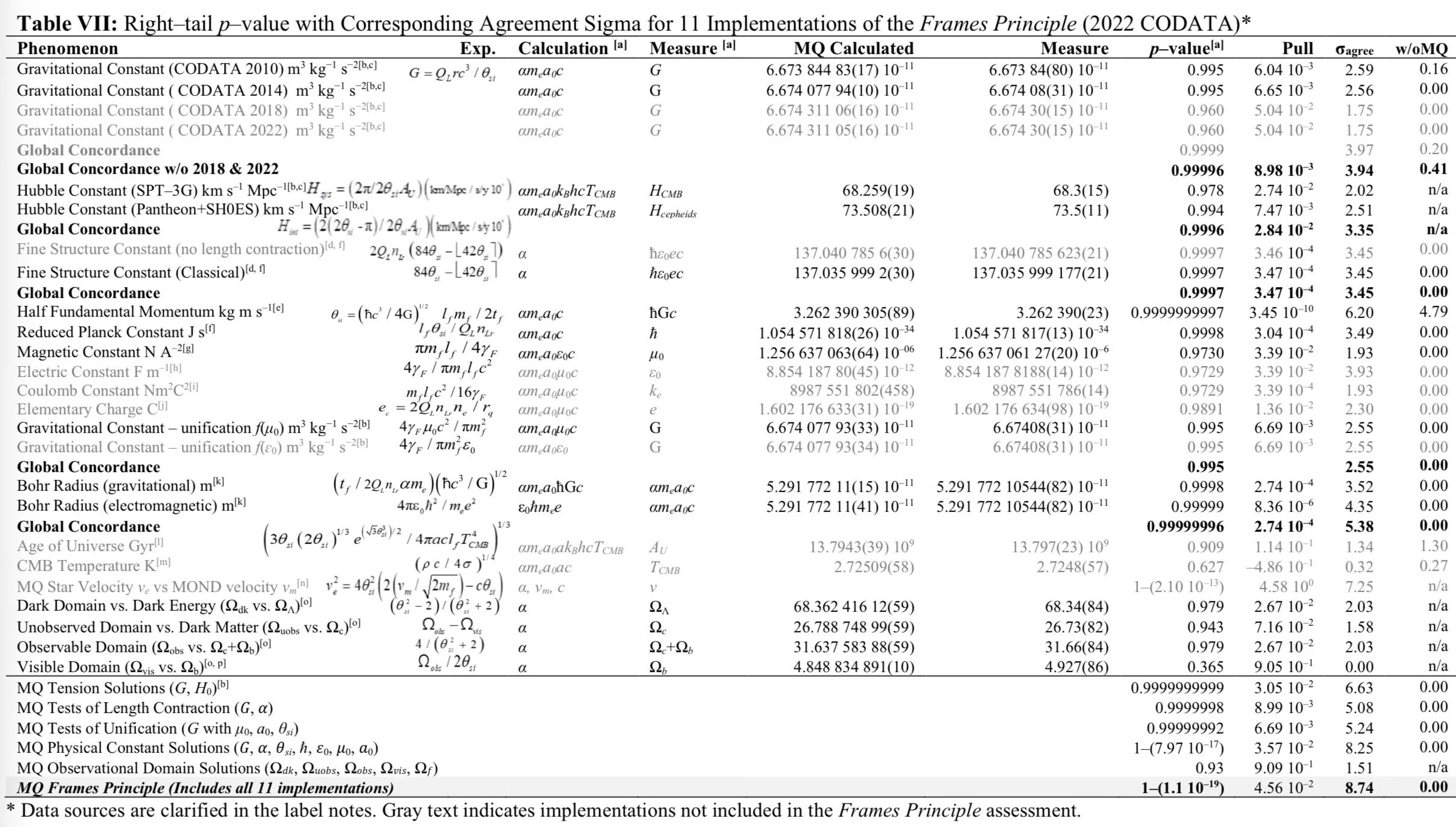
The table below summarizes additional quantitative concordances between MQ calculations and physical measurements. No individual entry establishes the framework. Their relevance lies in whether a single underlying measurement model can continue to produce independently testable quantities across otherwise unrelated domains of physics.
As experimental precision improves, the standard becomes correspondingly stricter: MQ must continue to reproduce new measurements using the same fixed structure, or the framework must fail.